

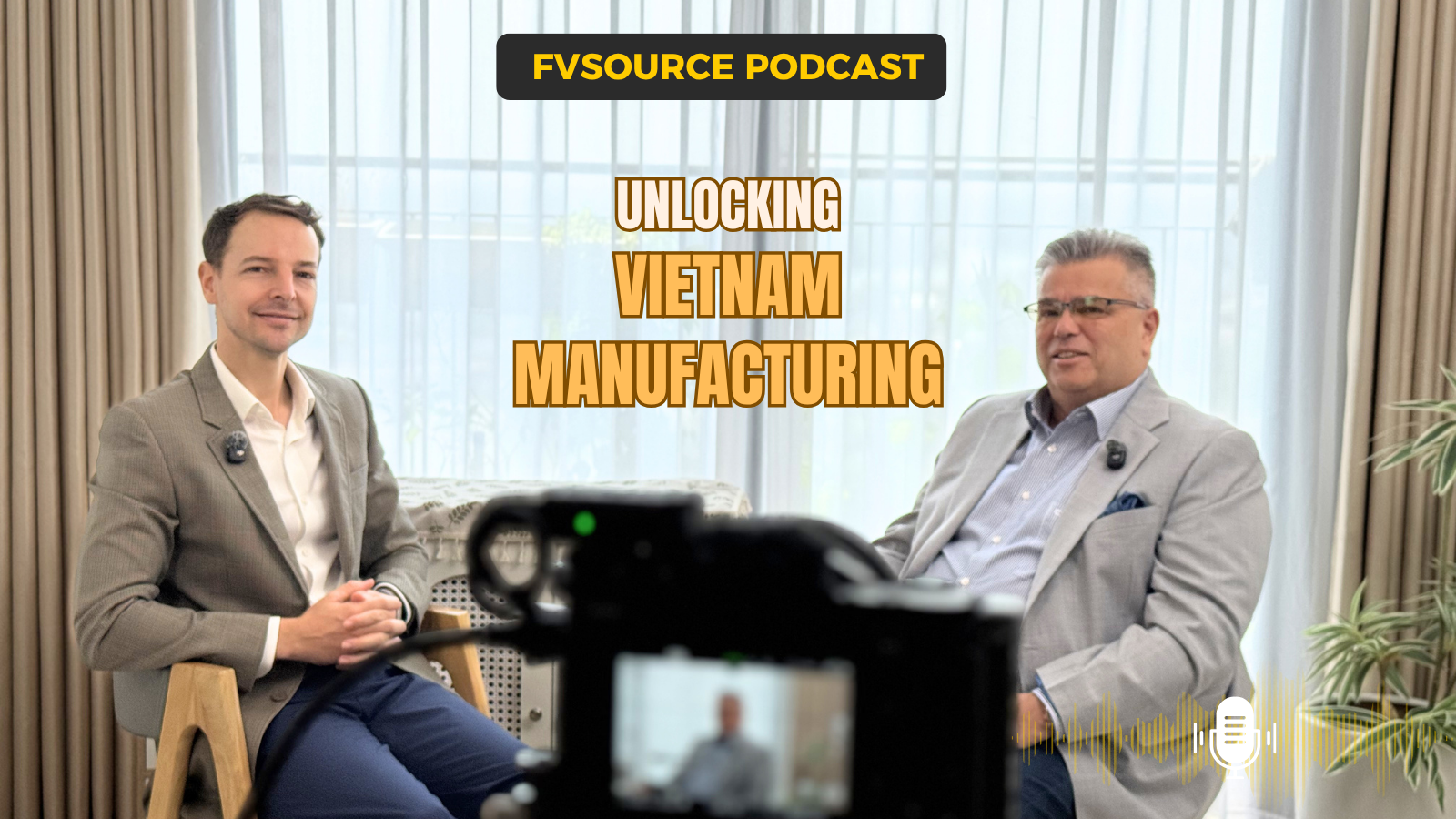
A new podcast series focused on manufacturing in Vietnam has been launched, aiming to bring more practical, field-based discussion to a topic that is often dominated by high-level market narratives.
As Vietnam continues to attract international buyers, operations teams, and supply chain decision-makers, conversations around manufacturing are becoming more detailed. While cost advantages remain relevant, companies are increasingly focused on execution: how to structure outsourcing, manage operational risk, and build supply chains that can scale sustainably.
The podcast enters a space where operational insight is often limited. Vietnam’s industrial growth is frequently framed through export figures, foreign direct investment, and supply chain diversification trends. However, these perspectives do not always reflect how manufacturing and outsourcing decisions unfold in practice.
Looking beyond the macro narrative
For many companies, the most complex challenges arise after the decision to manufacture in Vietnam has already been made. Production setup, outsourcing structure, quality control, and subcontracting transparency all play a critical role in determining whether a strategy succeeds.
Gaps between commercial expectations and factory-level execution can lead to delays, quality issues, or misalignment in production requirements. These challenges are not unique to Vietnam, but they remain central to the manufacturing experience in the country.
Rather than relying on simplified narratives, the podcast adopts a more operational perspective — focusing on how manufacturing and outsourcing decisions are actually implemented on the ground.
Check out the latest episode on this page.
The discussion emphasizes how companies can structure outsourcing in a way that balances cost, control, and long-term reliability. Topics such as contract manufacturing, hybrid production models, and factory setup strategies are central to that conversation.
This is particularly relevant as Vietnam becomes more integrated into regional and global manufacturing networks. Many companies are no longer relying on a single-country production model, but instead building diversified supply chains across Asia, with Vietnam playing an increasingly important role.
However, translating opportunity into execution often proves more complex than expected. Suppliers that appear capable during initial evaluation may struggle under real production pressure, while communication gaps between buyers and factory teams can affect timelines and quality outcomes.
The operational side of manufacturing
In many cases, risks only become visible after production begins. Issues such as inconsistent quality, unstable lead times, or limited transparency in subcontracting can quickly impact performance.
This reflects a broader shift in how manufacturing in Vietnam is being approached. Earlier conversations often focused primarily on labor cost and growth potential. Today, there is greater emphasis on production structure, supplier capability, quality systems, and governance.
These factors shape not only day-to-day operations but also the long-term stability of supply chains.

The podcast format allows these topics to be explored in greater depth. Unlike short-form content, long-form discussions provide room for context, examples, and practical insight drawn from real-world manufacturing and outsourcing experience.
This is particularly valuable in industrial contexts, where decisions around factory setup, outsourcing structure, and production management rarely have straightforward answers.
Why long-form discussion matters
As Vietnam’s industrial ecosystem continues to evolve, the need for more nuanced discussion is becoming increasingly clear.
The country now hosts a wide range of manufacturers, contractors, and industrial operators across multiple sectors. Understanding how these actors interact — and where potential risks may emerge — is an important part of building effective production and outsourcing strategies.
Podcasts offer a format that supports this level of analysis. They allow industry practitioners to move beyond general narratives and focus on execution, which remains one of the most critical aspects of manufacturing.
>> Vietnam manufacturing podcast series on Spotify : https://open.spotify.com/playlist/4XBKMmEvCQ8zjwZKJo3tRN?si=qA4WDsJxTBG2WVDj-SZS0Q&nd=1&dlsi=87a848edb7e549b0
A broader shift in industry communication
The launch of this podcast also reflects a broader shift in how companies in manufacturing and industrial services communicate.
Rather than relying solely on trade fairs, static content, or case studies, many are turning to long-form digital formats to explain complex topics, share expertise, and engage with a more informed audience.
For companies exploring manufacturing opportunities in Vietnam, this type of content can provide a clearer view of how production strategies are structured and managed in practice.
As Vietnam’s role in global manufacturing continues to expand, discussions that focus on execution — rather than only opportunity — are likely to become increasingly important.
Discover more from Vietnam Insider
Subscribe to get the latest posts sent to your email.