

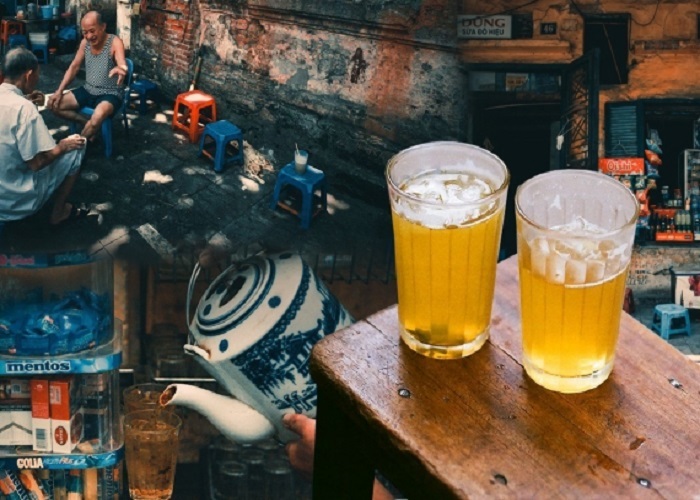
If you want to capture the raw, authentic essence of Vietnamese urban life, stay away from sleek, air-conditioned spaces. Instead, seek out the worn, patched-up sidewalks. There, people sit low on backless plastic stools, just centimeters above the asphalt. The ground beneath them radiates either a bone-chilling winter mist or suffocating summer heat. Yet, locals and strangers alike still gather here. They happily trade less than 25 cents for a glass of iced tea (Vietnam’s sidewalk trà đá).
More Than a Drink: A State of Being
 Source: aFamily
Many people mistake this amber-colored street drink for a simple refreshment. However, through the lens of local culture, it represents an entire state of being. Vendors serve this liquid in rough, thick glass cups filled with air bubbles. Furthermore, it carries only a very mild bitterness. Sometimes, the flavor is so diluted that you feel as though you are drinking the raw essence of the streets rather than a premium tea.
Trà đá is never about refined appreciation. On the contrary, it exists to satisfy a much more fundamental human need. It fosters unconditional connections between people in a society moving at a breakneck pace.
The Equalizing Power of the Low Stool
The true beauty of iced tea culture on these low stools lies in its absolute inclusivity. On those cheap plastic seats, all boundaries of class or social status instantly vanish. For example, you might see a manual laborer with clothes stained by dried, salty sweat. Leaning against the wall, he shares the exact same view with an office worker in a crisp shirt who is busy typing on a laptop.
 Source: People’s Army Newspaper of Vietnam
These strangers do not even need to speak to one another. Moreover, simply sharing an open space creates a silent bond between them. Together, they endure the roar of traffic and breathe in the smog of urban exhaust. People come to the sidewalk tea stall to strip away their social masks. Consequently, the cold glass, beaded with condensation, becomes an excuse to pause, to breathe, and to find comfort amidst the frantic hustle outside.
 Source: MIA.vn
The Living Clocks of the Neighborhood
Middle-aged and elderly women usually keep the rhythm of life at these nameless street corners. They are vendors with sharp, observant eyes and extraordinary patience. Furthermore, they sit there from early morning until the last streetlights flicker out. Over the years, they remain as the living clocks of the neighborhood.
Naturally, they sell more than just tea. They remember the specific habits of every regular customer. They quietly listen to the simple joys and sorrows of daily life, holding the deepest secrets of passing souls. Time at a sidewalk tea stall does not tick away in digital numbers. Instead, it flows slowly and steadily with every ladle of hot water poured into the teapot.
 Source: Luhanhvietnam
An Authentic Encounter for Travelers
For foreign tourists, this chaotic street scene can feel overwhelming at first. The dust and frantic energy of a fast-growing city often cause sensory overload. However, at that exact point, you escape the detached gaze of an outsider. You instantly feel the most authentic and vibrant pulse of local life.
 Source: MIA.vn
In these hidden corners, beauty does not sit inside museum display cases. Instead, it comes from the heavy breath of daily survival and the rhythmic clinking of an aluminum spoon against glassware. It echoes in the deep, nostalgic tones of old men lost in a hazy cloud of cigarette smoke.
 Source: Thoi Dai
Amid the whirlwind of modernization that shrinks public spaces, sidewalk iced tea stalls resiliently endure as an underground cultural current. It is neither luxurious nor demanding. It simply exists in silence to preserve the humble soul of the streets. Like a quiet comma in a long novel, trà đá forces people to pause for a brief second before plunging back into the endless, swirling current of life.
Discover more from Vietnam Insider
Subscribe to get the latest posts sent to your email.