

Getting Rich on the Water
In late July, the calm waters of the Trung Son Hydropower Reservoir stretch quietly. Meanwhile, rows of fish cages line up across the mountain backdrop. This peaceful scene reflects a successful shift in local livelihoods. In particular, residents have moved from wild fishing to cage aquaculture, steadily boosting their income and stabilizing their lives.
Having farmed cage fish for many years, Mr. Ngo Van Chien (37), residing in Ta Ban village, is a local pioneer running a large-scale setup.

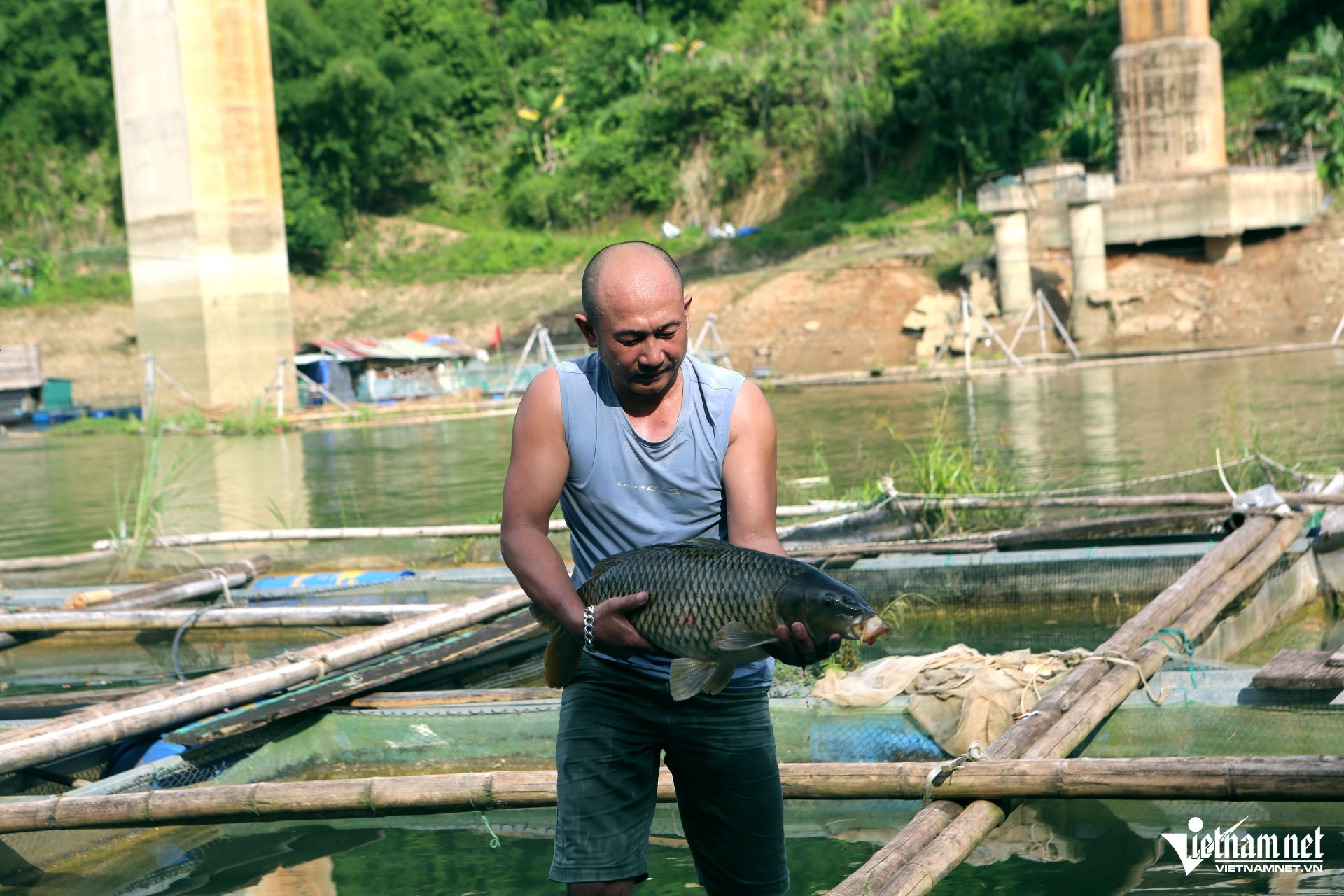
Residents farming cage fish on the Trung Son Hydropower Reservoir.
Currently, his family manages 12 fish cages. Specifically, they mainly raise high-value species like red-tail catfish, grass carp, tilapia, and common carp. Thanks to the reservoir’s clean water, the fish grow fast and stay healthy. Consequently, their firm, flavorful meat consistently attracts buyers.
Mr. Chien shared that his family previously relied on slash-and-burn farming and natural fishing along the Ma River. However, unstable income made life tough. Recognizing the potential of the vast reservoir, he boldly invested in fish cages instead.

The owners of these fish cages were once struggling families driven to make a living on the Trung Son Reservoir. Today, clusters of floating cages—resembling “water plots” across the reservoir—have become the primary livelihood for dozens of households.
“In the early years, we faced many challenges due to a lack of experience and high capital costs,” Mr. Chien said. “However, local officials and experts guided us on technical skills. Therefore, I soon mastered fish care and disease prevention. Today, cage farming is our primary income source.”
According to Mr. Chien, his family sells tens of tons of commercial fish each year. After deducting expenses, their net income reaches 120–150 million VND. As a result, this earnings boost improved their living standards and helped fund their children’s education.

Thanks to cage fish farming, Mr. Chien’s family earns hundreds of millions of dong every year.
In addition, Mr. Dinh Cong Chuc, also from Ta Ban village, is another trailblazer. He transitioned early from natural fishing to cage aquaculture on the reservoir.
Starting with just a few initial cages, his family now runs 6 cages. They raise both specialty fish and common species. By applying proper care techniques, their fish stock grows steadily and delivers high economic returns.
Today, fish farming brings his family around 100 million VND per year. Furthermore, beyond boosting his own household income, Mr. Chuc actively helps fellow villagers invest in cage farming.
Creating Sustainable Livelihoods
Local residents note that Trung Son Reservoir offers ideal natural conditions for aquaculture. For instance, the water stays clear and well-circulated year-round. With minimal pollution, fish grow rapidly and maintain top quality.
Crucially, using the water surface for cage farming does not disrupt land agriculture. Instead, it efficiently utilizes local resources, creates new jobs, and raises income for mountain residents.


Each year, these cages supply around 35 to 40 tons of seafood to the market. After deducting costs, each cage generates a net profit of 14 to 16 million VND, helping many lakeside families stabilize their lives.
Mr. Ngo Si Tam, Deputy Secretary of the Party Committee of Trung Son Commune, noted that local authorities prioritized cage farming right after the plant’s completion. Thus, it became a key strategy for shifting local livelihoods.
For this purpose, the commune government partnered with technical experts to run training workshops. They taught locals seed selection, proper feeding, disease control, and market distribution.
“Many households invested boldly and achieved clear economic results,” Mr. Tam shared. “Consequently, numerous families escaped poverty and now secure hundreds of millions of dong annually. This model fits our natural conditions well, so we will continue expanding it.”


In the past, locals relied on simple bamboo and wooden cages. Over time, they gradually transitioned to sturdy iron-frame structures. Additionally, a few households have adopted modern HDPE plastic cage technology, though high investment costs keep their numbers very limited.
Additionally, Mr. Tam added that cage aquaculture is proving to be a perfect fit for Trung Son commune. In 2025, 57 local households operated a total of 173 fish cages. The commune aims to maintain 190–200 cages across 65–70 households by 2030. That target includes an annual yield of 45–47 tons and revenues near 10 billion VND.
Alongside scale expansion, Trung Son commune will encourage safe production standards and quality control. Overall, these steps will help build the Trung Son Reservoir Fish brand and raise product value.
Ultimately, cage fish farming on Trung Son Reservoir does more than maximize water usage. It provides sustainable livelihoods, reduces poverty, and drives economic development across Thanh Hoa’s mountain region. From floating cages on the water, many families have built stable, prosperous lives right in their homeland.
Source: Thanh Hoa Newspaper
Discover more from Vietnam Insider
Subscribe to get the latest posts sent to your email.