

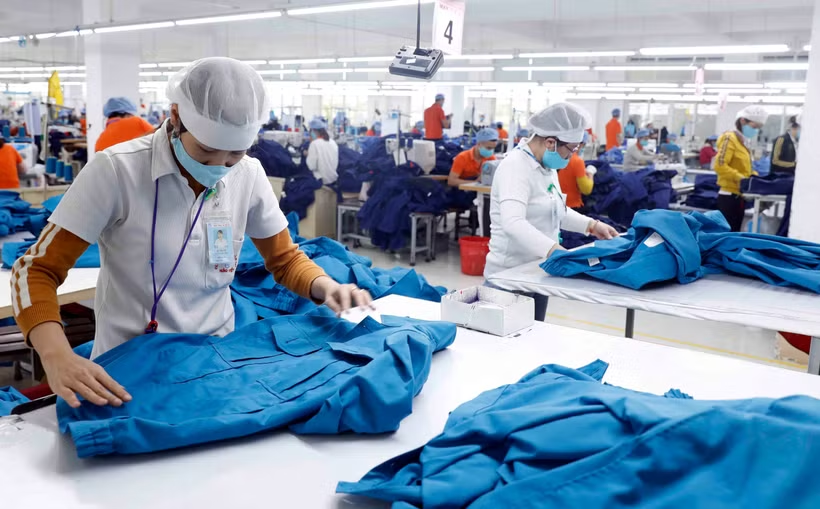
The Vietnam Trade Office in Argentina, also covering Paraguay and Uruguay, reports that these Southern Cone economies are unlocking significant opportunities for Vietnamese exporters as they accelerate regional integration, investment, and trade diversification.
According to data from Argentina’s National Institute of Statistics and Censuses (INDEC), bilateral trade in the first half of 2026 saw Vietnam remain one of Argentina’s major trade-surplus partners. Argentina exported approximately $1.801 billion worth of goods to Vietnam while importing $469 million, resulting in a trade surplus of $1.332 billion in Argentina’s favor.
Economic Reforms and Sectoral Demand Open New Gateways
Recent macroeconomic reforms in Argentina—marked by procedural streamlining, eased foreign exchange controls, and tariff reductions—are facilitating greater access for foreign goods. Notably, Argentina eliminated import tariffs on mobile phones originating outside Mercosur on January 15, 2026.
Concurrently, Argentina has substantial demand for electronic equipment and components to supply its local assembly, telecommunications, and consumer sectors. Given Vietnam’s established large-scale manufacturing base, electronic components, semi-finished goods, tech accessories, and digital transformation hardware stand to benefit significantly.
Beyond consumer electronics, mega-projects in the Vaca Muerta shale basin, lithium extraction, renewable energy, logistics, and infrastructure are fueling demand for heavy machinery, spare parts, and industrial supplies. This development presents a strategic shift for Vietnamese manufacturers: transitioning from one-off export contracts to becoming long-term equipment suppliers for South American industrial and infrastructure projects.
Tailoring Strategies for Uruguay and Paraguay
While Argentina offers the largest market scale, neighboring Uruguay and Paraguay present distinct strategic advantages.
Uruguay features a smaller domestic market paired with a transparent and open business environment. Trade data for the first half of 2026 indicates sustained high import volumes, with FOB imports reaching approximately $1.184 billion in June 2026 alone. For Vietnamese exporters, a niche strategy focusing on high-quality electronics, precision machinery, processed foods, textiles, and consumer goods is best suited for this market.
Paraguay, meanwhile, leverages strengths in agriculture, hydropower, and its strategic location within South American logistics networks. Opportunities for Vietnamese enterprises extend beyond traditional retail commodities to agricultural machinery, industrial equipment, processing components, and processed seafood. Reciprocally, Paraguay produces abundant supplies of soybeans, agricultural by-products, cotton, and livestock products—raw materials that complement Vietnam’s processing and manufacturing demands, creating a solid foundation for balanced two-way trade.
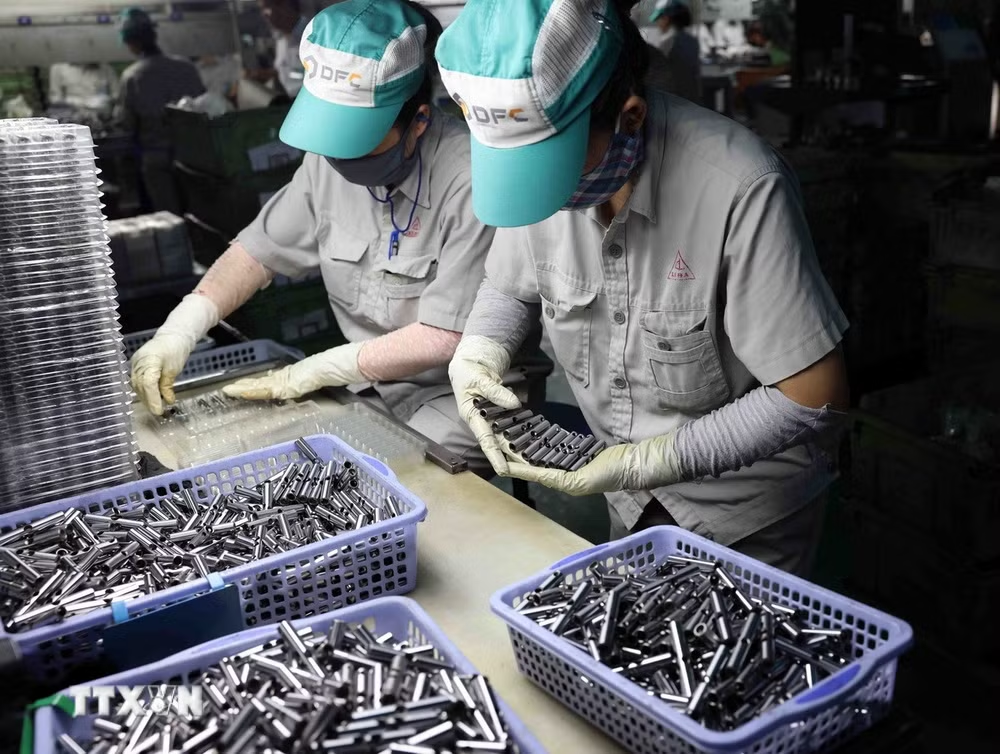
Quality inspection of motorcycle spare parts at the Dong Anh Mechanical Joint Stock Company factory, Hanoi. (Photo: Vu Sinh/VNA)
Navigating Competition and Shifting from Short-Term Deals to Local Presence
Between 2026 and 2030, high-potential growth sectors across Argentina, Uruguay, and Paraguay will center on mobile electronics, industrial machinery, supporting industries, and processed seafood. While Vietnamese apparel and footwear maintain a solid foothold, they face severe competition from Asian peers and Mercosur domestic producers. Consequently, exporters should prioritize targeted, value-added product lines over pure volume expansion.
Similarly, given South America’s formidable agricultural base, Vietnamese commodity produce faces tough direct competition. The clearer opening lies in high-value, differentiated products such as specialty processed coffee, whole pepper, tropical fruit-based foods, organic items, and packaged beverages.
To capitalize on these openings, trade promotion efforts must evolve. Rather than relying solely on generic trade fairs, commercial agencies must proactively link Vietnamese manufacturers directly with industrial project developers, importers, and regional distribution networks. Furthermore, establishing after-sales services, technical support, and localized brand recognition is vital. Highly price-competitive machinery cannot sustain market share without reliable spare-parts logistics and local maintenance support.
Trade interest is increasingly running both ways. On July 22, 2026, representatives from Paraguay’s CMA met with the Vietnam Trade Office in Argentina to explore sourcing opportunities, expressing readiness to tailor packaging, formulation, and OEM production for Vietnamese retail chains. The Trade Office subsequently invited CMA to attend the Vietnam International Sourcing 2026 (VIS 2026) expo in Ho Chi Minh City from September 3–5.
Trade experts emphasize that alongside broader Vietnam–Mercosur trade framework talks, practical assistance should focus on Spanish-language market intelligence, regulatory navigation, technical standards, and foreign-exchange payment mechanisms. While South America remains geographically distant, taking deliberate, localized steps in distribution and partnerships will allow Vietnamese businesses to secure a lasting footprint across the continent.
(Source: Vietnamplus)
Discover more from Vietnam Insider
Subscribe to get the latest posts sent to your email.