

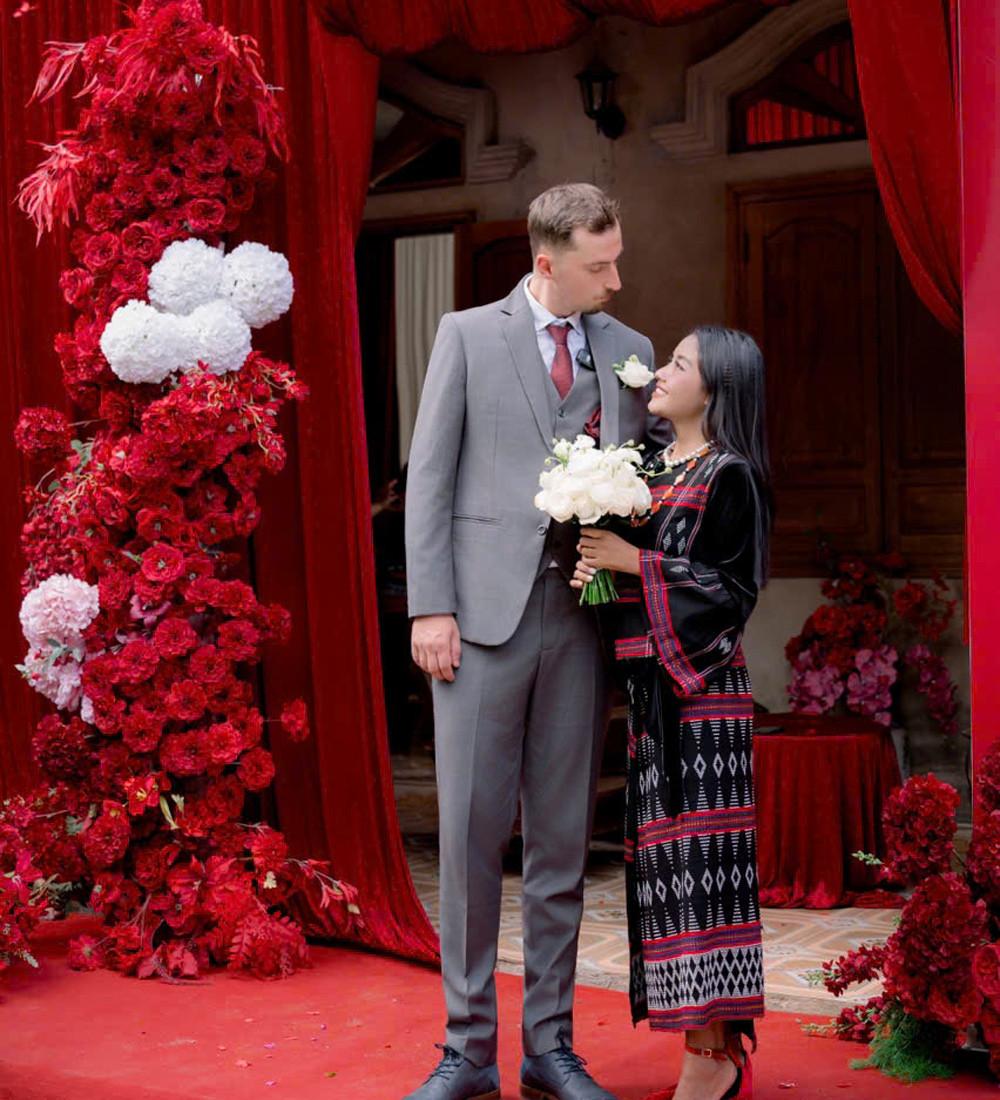
Persistently Courting the Pa Co Woman
In September 2026, the wedding of Le Thi Kim Sieu (born in 1996, from A Luoi, Thua Thien Hue) and Cools Nick Dirk (born in 1991, from Antwerp, Belgium, currently working as a chemical engineer) took place amidst vibrant celebrations in the bride’s hometown.
Before tying the knot, the couple weathered a lengthy long-distance relationship. Consequently, they had to bridge major linguistic and cultural divides to stay together.
Kim Sieu belongs to the Pa Co ethnic community (a subgroup of the Ta Oi ethnic group). In late 2023, following unexpected personal upheavals, she moved to Hoi An to work at a tailoring shop, seeking peace and a fresh start.

Kim Sieu alongside her Belgian husband.
In March 2024, Kim Sieu connected with Nick online while he was traveling in Vietnam to attend a friend’s wedding.
After exchanging a few messages, the Belgian engineer visited her tailor shop to order a bespoke suit, then invited her out for dinner.
Initially, Sieu turned down his advances. However, his quiet persistence gradually won her heart.
Their romance blossomed during leisurely bicycle rides through Hoi An’s golden rice fields. Along the way, they shared candid conversations about work and long-term aspirations.
“He invited me on a road trip across the northern mountains, but I declined. After a week on the road, he returned to Hoi An just to be close to me,” Kim Sieu recalled. “He confessed his feelings repeatedly, but I felt it was too early. I suggested we date for six months first. If compatible, we would commit. He agreed and boarded his flight back to Belgium.”

The couple tied the knot after two years of dating.
Exactly six months later, Nick returned to Vietnam to reaffirm his feelings. This time, deeply moved by his dedication, Kim Sieu accepted.
The couple then resumed their long-distance relationship, staying connected through international video calls. Finally, in October 2025 during a vacation in Bali, Nick proposed on a romantic rainy evening.
A Wedding Steeped in Indigenous Customs
In September 2026, the couple celebrated their wedding in Kim Sieu’s village. Due to professional and health reasons, Nick’s parents and siblings could not fly in.
Nevertheless, they followed every stage of the ceremony via live video calls from Belgium. Earlier, his mother had hand-knitted blankets, bags, and wool socks as thoughtful wedding gifts for her new daughter-in-law.

The Belgian groom presents the traditional dowry offerings to his parents-in-law.
Nick’s siblings sent heartfelt congratulatory messages, welcoming Kim Sieu warmly into their family circle.
The wedding lasted three consecutive days. Kim Sieu’s family observed all ancestral rituals handed down through generations.
To the Pa Co people, wedding rites do more than formalize a marriage; they carry spiritual weight, ensuring ancestral protection and peace for the household. Therefore, completing each ritual remains paramount.
To marry Kim Sieu, Nick prepared an elaborate dowry: 10 pigs (three piglets and seven large hogs weighing over 50 kilograms each), a pair of goats, and 10 live chickens.

Kim Sieu’s father presents traditional wedding gifts to the groom’s side.
In addition, the groom offered two sets of bronze gongs, gold, silver, and a financial gift to the bride’s parents to express profound gratitude for raising their daughter.
“Before the wedding, my family explained the mandatory offerings and sacred customs to Nick,” Kim Sieu said. “He was surprised by the requirements. However, he embraced them with genuine enthusiasm, showing deep respect for my heritage.”
On the first day, Nick arrived at the bride’s house with the offerings to conduct the formal engagement rite. The bride’s family hosted an intimate gathering of six dining tables.

The groom’s family follows the ceremony via video call.
On the second day, the bride’s relatives visited the groom’s party. Because Nick’s family lived abroad, this banquet was hosted at a local restaurant with 10 dining tables.
Early that morning, the couple pointed toward a 70-kilogram hog brought as part of the dowry, declaring aloud: “This is the gift brought by the groom’s family to purify today’s marriage ceremony.” Only then was the animal prepared for the feast.
Moreover, the family set up an ancestral altar for prayers. The bride and groom fed each other traditional a quat cakes—symbolic sweet pastries baked to foster marital peace and enduring devotion.
On the third day, the groom’s party returned to the bride’s home for the formal wedding nuptials. The bride’s family arranged a banquet of 15 dining tables for relatives and village neighbors.
For Kim Sieu, this was the most emotional milestone, as she had to perform the solemn rite of departing her ancestral lineage to join her husband’s family.

The entire family gathers around traditional wine jars during the wedding feast.
Surrounded by family beside ceremonial clay jars of ruou can (straw wine), elders handed Nick a handwoven brocade cloth embodying the bride’s soul.
The groom is tasked with preserving this sacred fabric, signifying that the bride belongs to his household.
“At that moment, my entire family cried alongside me. I felt overjoyed to find a loving partner, yet heartbroken to leave my family’s ancestral hearth,” Kim Sieu shared.
Throughout the final day, offerings were presented according to custom, and the bride’s family reciprocated with handmade brocade fabrics.
For Nick, the wedding offered an unforgettable immersion into Pa Co culture. He grew particularly fond of indigenous handwoven textiles, traditional rice wine, and rustic highland cuisine.
Looking ahead, the newlyweds plan to split their time between Vietnam and Belgium, staying close to both families while embracing the distinct cultural traditions of both nations.
Photo: Provided by the subjects
Source: baomoi.com
Discover more from Vietnam Insider
Subscribe to get the latest posts sent to your email.