

For over a year, 80-year-old Mrs. Ngoc from Ngoc Ha Ward, Hanoi, regularly visited an establishment on Van Cao Street to lie on complimentary thermal massage beds.
Financially comfortable thanks to past real estate business and her late husband’s pension, Mrs. Ngoc found herself increasingly isolated after his passing. Her children work all day, and longtime friends around the alley have thinned out. At 80, she needed a place that offered both physical care and daily conversation.
What began as a plan to try a free service quickly shifted as staff built rapport. Mrs. Ngoc soon opened her wallet, buying a box of calcium supplements for 3.5 million VND—nearly six times the market rate—and a box of herbal stroke-prevention boluses for 8.5 million VND.
Her spending grew steadily. She spent 40 million VND on a massage machine, but the device was soon sidelined for lack of results. When she planned to spend another 140 million VND on a full-body thermal massage bed, her children intervened and held her savings passbooks.
Recently, Mrs. Ngoc paid 5 million VND for a 10-day acupressure course. “At my age, whenever someone mentions a good remedy or an innovative machine, I want to try it,” Mrs. Ngoc said.

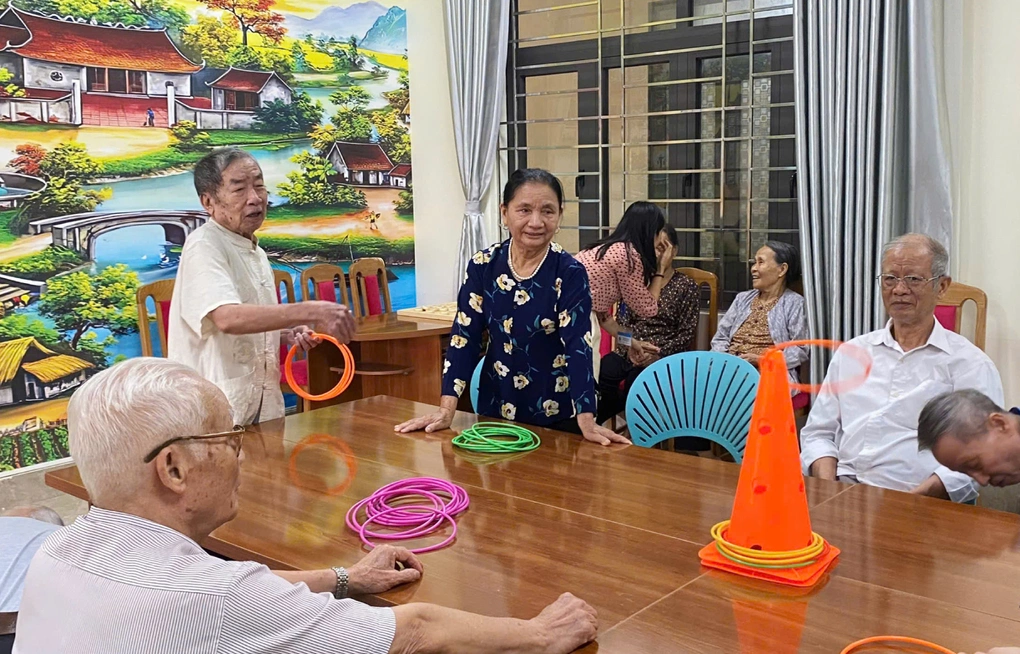
An elderly citizen receives a routine health check at a public daycare center in Tay Ho Ward, Hanoi
A similar dynamic unfolded in Hai Phong, where for the past two years, 70-year-old Mr. Hoang from Gia Vien Ward and his neighbors regularly visited a massage bed facility a kilometer away. “We get free thermal massage sessions, and while waiting, staff and visitors chat and share healthcare knowledge,” said Mr. Hoang, a retired ocean-going ship captain.
Each month, Mr. Hoang and his wife allocate 15 million VND from their maritime pensions and children’s allowances to purchase healthcare items. At the free massage venue, they spent nearly 30 million VND on heart rate bands, spinal belts, and heated mugwort mats.
Their daughter, Hong Hoa, once bought them a 30-million-VND massage machine so they would not have to walk, but it sat unused because they felt “lying alone is sad.” In their alleyway in Gia Vien Ward, the daily rhythm resembles a retirement village. Roughly 80% of residents are over 55, collect monthly pensions of at least 5 million VND, and have no childcare burdens. While their desire for healthy aging is strong, the absence of regulated community spaces and professional consulting means retirement savings often flow according to crowd psychology.
“Whenever a household buys a new massage unit, neighbors drop by to ask about the price and buy one too. If one person shows off an imported medicine, nearby families immediately ask for help ordering, willing to use their own bodies as test subjects,” Mr. Hoang said.
A Massive Demand Trapped in an Unregulated Market
Associate Professor Dr. Pham Thanh Binh, President of the Vietnam Association for Health Promotion and Counseling, noted that the experiences of Mrs. Ngoc and Mr. Hoang stem from seniors’ proactive demand for personal health management.
Millions of older adults are willing to pay to manage their well-being in their later years, creating a massive silver economy. However, a transparent supply of accredited eldercare remains absent.
“Elderly care must be paired with professional, reasonably priced services. It cannot become a commercial tool that exploits loneliness to sell products,” Mr. Binh stated.
United Nations projections indicate Vietnam will transition to an aged society by 2036. The number of seniors requiring essential daily living assistance is forecast to surge 38%, rising from 4.7 million in 2025 to 6.5 million by 2035.
While population aging is often characterized purely as a fiscal strain on social security, from an economic standpoint it marks a massive shift in consumer spending.
An August 2026 report by RMIT University Vietnam projected that the domestic silver economy centered on home-care solutions will expand from 2.6 billion USD in 2023 to 4.8 billion USD by 2034. Furthermore, data from e-commerce analytics platform Metric revealed that the senior food and grocery sector across Vietnam’s four largest online platforms generated 194.6 billion VND between October 2025 and September 2026, up 35% compared to 2025.
Yet supply reveals a critical void. Nationwide, only 46 dedicated social assistance facilities operate, satisfying roughly 0.05% of actual demand. Community-based day services reach barely 15% of the senior population, while formal home care covers just 3% to 5%.

Elderly residents participate in morning physical fitness routines at a day center in Tay Ho Ward, Hanoi
Associate Professor Dr. Catherine Earl of RMIT University Vietnam pointed out that the market overlooks essential non-medical needs, including mental well-being, social networks, lifelong learning, and end-of-life care. “The care economy needs a conceptual reset. Rather than being treated as simple transactional services, it must become a core economic pillar and a collective societal responsibility,” she said.
Bridging the Eldercare Divide Beyond Commercial Gimmicks
The silver economy stretches far beyond selling health supplements or massage machinery. Mr. Binh highlighted at least four untapped, high-potential verticals: preventive health and chronic disease management; age-appropriate physical rehabilitation and clinical nutrition; professional adult day care, home nursing, and assisted living; and mental health counseling paired with remote telecare technologies.
Instead of leaving older adults to manage on their own, Dr. Earl argued for building a comprehensive care ecosystem extending beyond hospital settings, with family-based care remaining the central anchor.
Alongside that foundation, Mr. Binh advocated expanding day-care centers, senior fitness clubs, and social engagement hubs. The core solution requires public health education, empowering seniors with the knowledge to make independent, autonomous choices regarding available services.
While these models are gradually emerging as an aging society approaches, reaching the general public will take time. For now, individuals like Mrs. Ngoc and Mr. Hoang must continue to navigate options on their own.
In early September, Mrs. Ngoc found relief when her family secured her a spot in a pilot municipal elder daycare program in Tay Ho District. Spending her weekdays there, she found renewed energy participating in group activities, socializing with peers, and receiving professional supervision.
“It costs only 100,000 VND a day, covering meals, herbal foot soaks, and routine checkups by nurses,” Mrs. Ngoc shared. “Best of all, I have companions to talk to.”
Source: vnexpress.net
Discover more from Vietnam Insider
Subscribe to get the latest posts sent to your email.