

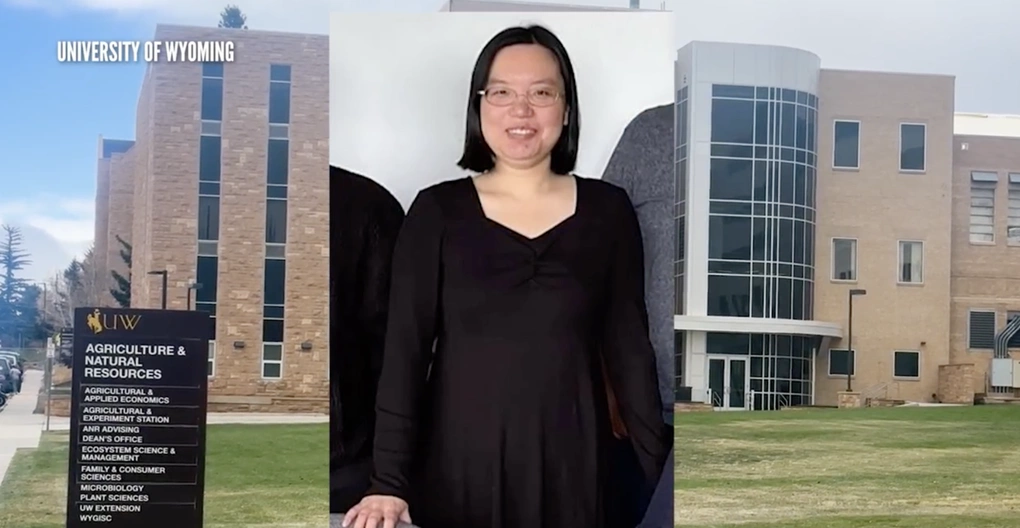
Aili Wang, 32, was arrested by police at Los Angeles International Airport on October 6 when authorities suspected she was attempting to fly back to China after being questioned regarding the poisoning of her colleague at the University of Wyoming.
Wang, a microbiology doctoral student, is accused of twice purchasing the chemical acrylamide via eBay around mid-year before requesting that the e-commerce platform delete her account. She is then alleged to have spiked this neurotoxin into a coffee maker owned by a Vietnamese PhD student identified by the initials K.T.
Upon arresting Wang at the airport, law enforcement seized laptops, electronic storage devices, and research files, fueling suspicions that she poisoned her peer to steal his scientific breakthroughs.

Doctoral student Aili Wang. Photo: AP
A Strange Taste in the Tea Cup
According to microbiology professor Mark Gomelsky, the faculty advisor overseeing both doctoral candidates, K.T. began exhibiting acute fatigue, insomnia, and unexplained neurological symptoms after attending a prestigious academic conference in August.
He also noted that tea brewed using the compact coffee maker on his desk carried an odd flavor. The peculiar taste vanished whenever he washed the machine.
The victim visited the university student health clinic in August due to progressively worsening numbness and tingling in his fingers, accompanied by lower-limb weakness. Suspecting foul play against K.T., his wife and university staff inspected the water reservoir of the coffee maker.
Boiling off the water inside the reservoir, they collected 63 milligrams of white powder residue. A university chemistry professor analyzed the substance and confirmed the presence of acrylamide.
Acrylamide is a compound that can form when carbohydrate-rich foods are cooked at elevated temperatures or when tobacco burns. The chemical exerts acute toxicity when exposure occurs at high doses, and it is routinely utilized in biochemical research concerning proteins and DNA.
K.T.’s spouse subsequently coordinated with campus police to install covert video surveillance inside the shared office space occupied by Wang.
Duplicating Research Notebooks
A University of Wyoming police officer reported that camera footage from September 27 captured Wang rummaging through K.T.’s desk. By October 1, she was recorded photographing and inspecting the notebooks on her colleague’s workspace, before rinsing his mug with liquid poured from her own cup.
Investigators maintained that Wang lacked any legitimate reason to inspect K.T.’s desk, given that the two pursued distinct research tracks and did not share a positive working relationship.
K.T.’s research receives funding from US federal grants and involves a novel platform technology designed for oncological therapeutics, neurodegenerative conditions, and genetic disorders.

The University of Wyoming library building campus in April 2025. Photo: WyoFile
K.T.’s scientific work is currently undergoing patent registration. According to investigative filings, Aili Wang had conducted related research in China prior to relocating to the United States.
Professor Gomelsky noted that K.T. was an outstanding Vietnamese-origin doctoral student, whereas Wang had failed her initial dissertation defense and may have grown envious of her peer’s breakthrough regarding bacterial-mediated delivery of RNA into human cells.
Tak Sumaya, an associate professor of chemistry at the university, assessed K.T.’s focus as an exceptionally promising therapeutic approach for cancer. He added that Wang had photographed every single page of the research notebook left on her colleague’s desk.
“You don’t do that to a colleague’s notebook in the same office or laboratory without good reason, and she had no reason,” Sumaya said.
Wang was interrogated by campus police on October 5. In initial statements, she claimed she had “not used acrylamide in many years.” The next day, she departed campus and traveled to the airport to return to China, but was intercepted by law enforcement officers.
Gomelsky noted that doctoral candidate K.T. continues to experience the effects of acrylamide following extended exposure. He faces difficulty concentrating, tires easily, and has lost sensation across his left hand. The professor voiced concern that his mentee might not recover completely.
“Acrylamide is a neurotoxin; it cannot be neutralized, so it remains within nerve cells and essentially kills them. Therefore, it is unclear whether he will make a full recovery,” he said.
The University of Wyoming is conducting an independent disciplinary review, while emphasizing that the allegations remain unproven and that Wang is presumed innocent.
Wyoming state prosecutors have charged Wang with aggravated assault, which carries a potential statutory sentence of up to 10 years in prison along with a 10,000 USD fine. Judge Robert Sanford granted the prosecutor’s motion, raising the defendant’s bail from 200,000 USD to 1.5 million USD cash.
Source: AP, CBS, People
Discover more from Vietnam Insider
Subscribe to get the latest posts sent to your email.