

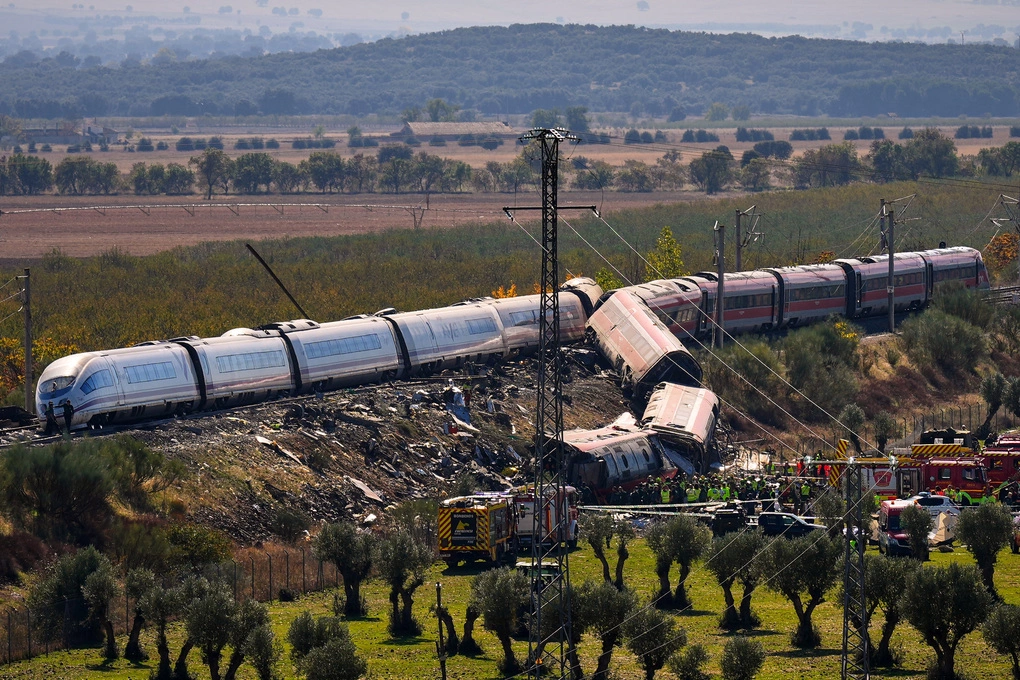
At around 7:54 AM on October 28, high-speed train number 6076 departed Madrid with 147 passengers on board. Operated by private rail carrier Iryo, the train began its journey toward Seville, a renowned tourist destination in southwest Spain. This corridor represents one of the nation’s busiest railway lines, operating continuously since 1992.
Ten minutes later, AVE train number 2080 followed on the exact same route. Operated by state rail company Renfe, the train carried 397 passengers. Everything proceeded smoothly for the next 20 minutes. Several passengers fell asleep, while others opened laptops to work or checked their smartphones.
At 8:30 AM, both trains traveled past the town of Urda in the autonomous region of Castilla-La Mancha. Suddenly, the LZB automatic train protection system at Urda station failed. A network breakdown between three interconnected computers caused the disruption.
LZB functions as an automatic train control system on Spanish high-speed lines. It monitors train speeds continuously and prevents rear-end collisions. When an outage occurs, the system automatically transmits stop signals to all operating trains within the affected sector.
Spanish Transport Minister Oscar Puente explained that the network outage at Urda affected a 63-kilometer stretch of track. Such technical failures occur rarely, though precedents do exist. Initially, operations adhered strictly to safety protocols, and roughly six trains traveling in both directions stopped safely.
The disruption triggered manual dispatch procedures at the control center of rail infrastructure agency Adif in Atocha, Madrid. This shift marked the beginning of human errors that led directly to the catastrophic collision.
Traffic control transferred to an on-duty dispatcher at the Adif control center. The dispatcher chose to authorize trains to continue their journeys, issuing instructions by phone and written dispatches.
Communication audio logs revealed that the control center contacted the AVE train at 8:36 AM. During the five-minute call, the dispatcher instructed the driver to disconnect from LZB and switch to the BSL signaling system.
The BSL system relies on physical trackside light signals, functioning much like street traffic lights. It allows trains to operate without LZB protection. However, switching to BSL fundamentally alters operational rules. Train drivers must watch trackside signals closely and rely directly on instructions from the dispatch center.
After completing the instructions, the dispatcher ordered the AVE train to proceed “at normal speed.” This command violated standard railway safety protocols. Under an LZB outage, trains must run at sight speed so drivers can spot and avoid obstacles, never exceeding 40 kilometers per hour.
Furthermore, the dispatcher failed to verify whether the preceding train had gained sufficient distance. The leading train needed a clearance gap of over 30 kilometers to prevent a collision with trailing traffic.
Meanwhile, the driver of the Iryo train contacted the control center at 8:41 AM. The driver reported that the train encountered an onboard fault while switching to BSL, making it impossible to enter Urda station. The dispatcher instructed the driver to reset the system and proceed “at regular speed.”
However, at 8:48 AM, the Iryo driver called back. The driver reported that the system failed to restart and that the train remained completely stationary.
According to El Pais, the dispatcher could view the Iryo train’s location on the monitoring screen. The dispatcher should have recognized the red signal at that exact track section. An assistant and a supervisor were also present in the control room, yet nobody instructed the trailing AVE train to slow down or stop.
At 8:53 AM, after 17 minutes of travel, the AVE train rear-ended the stationary Iryo train. Authorities have not confirmed the AVE train’s exact collision speed, though trains can reach 100 kilometers per hour along that stretch. The violent impact derailed two carriages of the Iryo train. One carriage was torn apart, scattering wreckage across the surrounding fields below.

Location of the two Spanish high-speed trains colliding on October 28.
Local authorities confirmed that the disaster killed at least 68 people and injured more than 100 others, warning that the casualty count may rise further. This tragedy marks the second major rail catastrophe in Spain this year. It stands as the deadliest Spanish rail disaster since the Santiago de Compostela derailment in July 2013, which killed 80 people.
Transport Minister Puente stressed that a rear-end collision on Spain’s high-speed network was considered virtually impossible. Therefore, investigators must determine the precise sequence that caused this breakdown.
Puente stated that the AVE train should have stopped immediately. An occupied train still blocked the track ahead, and trackside BSL signals showed a red light forbidding forward movement. He described the dispatcher’s clearance decision as “difficult to explain,” confirming that the individual faces a formal investigation.
Source: El Pais, Reuters, AFP
Discover more from Vietnam Insider
Subscribe to get the latest posts sent to your email.