

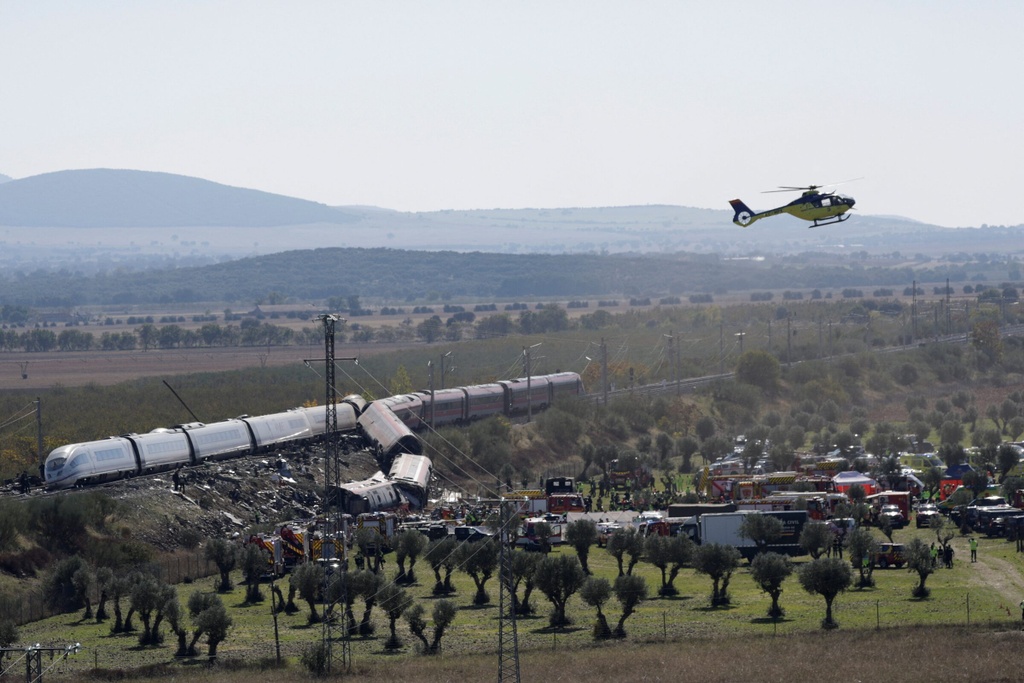
The high-speed rail collision in central Spain on the morning of October 28 killed at least 69 people and injured more than 100 others. Standing as the country’s deadliest rail disaster since 2013, the catastrophe has triggered scrutiny regarding operational standards and safety systems across the national high-speed railway network.
According to Spanish Minister of Transport Óscar Puente, the disaster occurred at roughly 8:53 AM between the towns of Mora and Orgaz, near Toledo province, approximately 118 kilometers south of Madrid.
At that time, an Iryo high-speed train remained stopped before a red signal when a trailing Renfe train traveling from Madrid to Seville struck it from behind. The violent impact sent three passenger carriages sliding off the tracks and down an embankment, Reuters reported.
Train Granted Clearance Despite Active Red Stop Signal
Preliminary findings indicate the disaster stemmed from a confluence of equipment failure and operational mismanagement.
Around 8:30 AM that day, the automated LZB safety system suffered an outage across a 63-kilometer rail section south of Toledo. The failure immediately triggered an automated stop mechanism for six trains traveling in the area.
Following the system breakdown, the operations center of Adif, Spain’s state-owned rail infrastructure manager, located at Atocha station in Madrid, switched to manual control.
By 8:36 AM, the Renfe train received clearance to resume its trip despite an active red light and while the leading Iryo train remained stationary ahead. According to Puente, the Renfe train was not placed under speed restrictions and accelerated to roughly 200 km/h prior to the collision.
“The red signal prohibited forward movement, yet the train received authorization to proceed,” Puente said, describing the decision as “inexplicable.”
Inexplicable Directives Preceded Catastrophe
Radio communication recordings between dispatchers and train operators, broadcast by Spanish media, shed light on the minutes preceding the crash. In the audio dispatches, the controller appears to instruct the Renfe train to run at regular speed without confirming whether the preceding Iryo train had cleared the sector.
Standard operating safety procedures specify that during such automated signal disruptions, trains must restrict their speed to around 40 km/h. This sight-speed buffer ensures drivers have adequate reaction time and braking distance to stop for obstructions.
A secondary audio recording indicates the Iryo operator also received orders to resume regular operations. However, several minutes later, the driver radioed back that the train could not restart and remained fully stationary on the tracks.
Nevertheless, rail worker unions cautioned against rushing to blame individual dispatchers. Union representatives noted that leaked audio files were edited and might omit critical context from the operational exchange.
Beyond dispatch errors, the condition of the LZB infrastructure has drawn intense scrutiny. Salvador Garcia-Ayllon, a professor at the Technical University of Cartagena, described LZB as an obsolete system phased out across other European nations. Upgrades to replace it had been slated since 2021, yet modern installations were never implemented on the corridor where the crash occurred.
The SEMAF train drivers’ union stated that it had submitted multiple requests demanding urgent rail maintenance and safety overhauls. According to the union, formal safety negotiations with the government, initiated after the fatal rail crash in Adamuz this past January, collapsed without consensus in April.
The latest disaster marks the third fatal rail accident in Spain this year. The January incident in Córdoba province left 46 people dead, while a subsequent derailment near Barcelona killed a train driver.
Prime Minister Pedro Sánchez pledged an exhaustive inquiry. “If negligence occurred, it will be brought to light. If safety mechanisms failed, we will take decisive action,” he affirmed.
Victim Identification Continues Amid Search Operations
Updated figures from the regional government of Castilla-La Mancha indicate the Iryo train carried 151 passengers, while the Renfe train carried 393 individuals. Among the deceased, 24 traveled on the Renfe train and 44 aboard the Iryo train.
Hospitals admitted 110 injured passengers, with 60 individuals discharged as of the morning of October 29 local time.
More than 500 emergency personnel, rescue workers, at least three helicopters, and specialized drone units mobilized at the wreckage site. Search crews worked overnight to extract victims trapped within crushed train carriages.
The Spanish Civil Guard opened four field processing offices across different cities to expedite forensic identification and collect DNA samples from family members. According to the agency, families have filed 67 missing person reports following the accident.


Rescue teams work at the collision site between two high-speed trains between the towns of Mora and Orgaz near Toledo, Spain, on October 28.
A woman named Rosario shared that she submitted DNA samples to help locate her 32-year-old son, Francisco José, who was traveling aboard one of the affected trains. She recounted that her son had originally planned to board a train involved in the fatal Adamuz crash in January, but rescheduled for a later departure that day, according to CNN.
Authorities confirmed that the fatalities include a Civil Guard officer named José Manuel and former Spanish Minister Fátima Báñez.
Spain’s Ministry of Foreign Affairs reported that 42 foreign nationals from seven countries were caught up in the disaster. Among them, at least one died and seven sustained injuries. The United States Department of State confirmed that several American citizens were injured.
Spain commenced three days of official national mourning on October 29. Prime Minister Sánchez stated that recovery teams remain focused on retrieving bodies from the wreckage for formal identification. The government will also begin rolling out victim compensation packages in the coming days.
Source: znews.vn
Discover more from Vietnam Insider
Subscribe to get the latest posts sent to your email.