

General Secretary and State President To Lam has identified citizens’ health and physical fitness as a vital component of national strength, directing localities to allocate land funds for sports and physical activity right from the planning stages of new industrial parks, urban areas, and residential zones, while maximizing the effective use of existing public facilities.
VnExpress interviewed Assoc. Prof. Dr. Bui Hoai Son, Deputy Head of the Central Propaganda and Mass Mobilization Commission and a member of the 16th National Assembly, on solutions to expand physical fitness spaces, repurpose surplus public properties, and ensure equitable public access to community facilities.
Following the directive from the General Secretary and State President, citizens have voiced strong aspirations for more parks, playgrounds, and exercise venues near their homes. How do you view this demand?
There is a glaring paradox in urban development: residential housing, apartment complexes, and construction projects are multiplying rapidly alongside growing populations, yet spaces for walking, recreation, and physical exercise have not expanded proportionately. Some localities build large-scale cultural and sports complexes, yet everyday residents still lack convenient places to exercise near home.
For older adults, that need might simply be a safe path for a morning walk; for children, a neighborhood playground; for workers, an open courtyard or park to stay active after working hours. These needs do not require grandiose structures, yet they directly shape public health and quality of life.
The root cause lies not only in land scarcity or budget constraints, but also in urban planning mindsets. When playgrounds and parks are treated as an afterthought—considered only after residential, commercial, and other developments have been allocated—recreational spaces are relegated to leftover plots, or omitted altogether.
The directive from the General Secretary and State President mandates a fundamental shift in this approach. Once citizens’ health and physical vitality are recognized as pillars of national strength, exercise spaces must be treated as essential infrastructure—factored in from the very beginning and integrated directly into residential communities.
Rather than merely tallying how many facilities have been constructed, authorities must measure how many residents actually enjoy safe, convenient access to them. A livable city cannot be measured solely by skyscrapers or modern architecture; it must be a place where children have room to play, seniors have safe paths to walk, and everyone has the daily opportunity to care for their health.
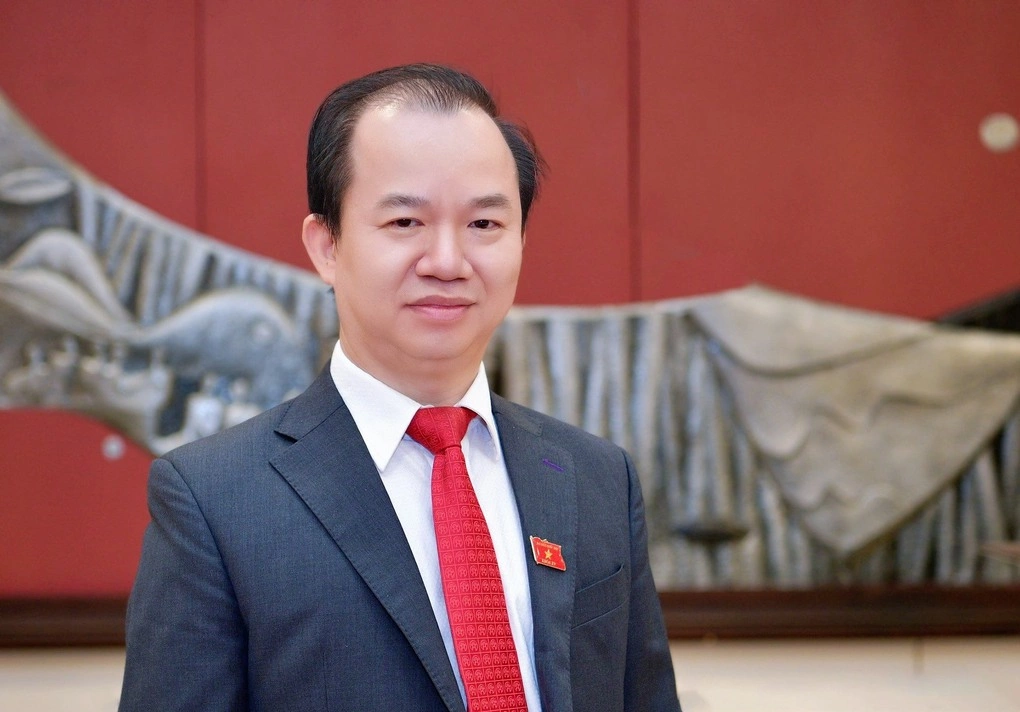
Assoc. Prof. Dr. Bui Hoai Son, Deputy Head of the Central Propaganda and Mass Mobilization Commission. Photo: Hoang Phong
Many government headquarters and public land plots have become redundant following administrative apparatus streamlining. How can these assets be leveraged to add recreational and fitness spaces for citizens?
This presents an opportunity to solve two challenges simultaneously: preventing public asset waste and supplying the community amenities citizens currently lack. Following organizational restructuring, a number of office buildings are no longer needed. Left vacant, these structures will deteriorate while surrounding residents continue to suffer from a shortage of playgrounds, community halls, and workout spaces.
Depending on local conditions, former offices can be renovated into public libraries, community centers, club venues, or indoor fitness facilities. Suitable land plots can be converted into open green spaces for walking and recreation.
However, not every surplus office building can be turned into a park or playground. Authorities must evaluate location, area, structural integrity, legal status, and neighborhood needs. Some properties should be preserved for multi-purpose community use; others are ideal for green spaces; still others are urgently needed for schools or healthcare clinics.
What matters most is transforming how we perceive the value of public assets. A parcel of land holds not only commercial value, but also immense social value when it serves essential community needs.
Therefore, handling surplus real estate should not be calculated solely in terms of how much revenue it can generate through sale or lease, but must weigh the public benefits of retaining it for residents. Turning an unused asset into a new public welfare facility is itself a practical way to combat waste.
If a single land plot could accommodate a school, a medical station, or a park and sports field, what criteria should local authorities use to prioritize?
Authorities should not apply a rigid, one-size-fits-all hierarchy across every locality. Decisions must stem from the actual deficits experienced by local residents.
Where students must commute long distances due to classroom shortages, or where residents lack access to healthcare, schools and medical stations must take precedence. Conversely, in residential neighborhoods already well-served by schools and clinics—yet lacking playgrounds for children or walking paths for seniors—recreational and fitness spaces become the more urgent priority.
To make the right choice, local governments must assess the number of beneficiaries, disadvantaged demographic groups, accessibility, renovation and operating costs, and long-term social returns. Authorities cannot simply hand over a surplus building to whichever agency finds it convenient to claim, and figure out its function afterward.
In particular, agencies must carefully consider preserving open spaces in densely populated neighborhoods. Buildings can be repaired or repurposed, but once open land is built over, restoring playgrounds and green spaces becomes nearly impossible.
Prior to making a decision, authorities should publicly disclose proposed options and listen to residents. Local people understand best what their neighborhood lacks and which facilities are genuinely needed. Public assets must be allocated according to community demand, not administrative convenience.
While the policy of repurposing surplus public properties is clear, functional conversion still takes considerable time. What bottlenecks need to be removed to accelerate this process?
Bottlenecks typically arise because a single asset must pass through multiple procedural stages across several agencies without a unified focal point accountable from start to finish. Converting an office building into a community facility requires clarifying legal status, disposal authority, utilization plans, zoning, land-use purposes, building condition, and renovation funding. When documentation is fragmented and accountability is diffused, procedures drag on while the asset continues to decay.
I propose a mechanism of “one focal point, one plan, one deadline.” Every surplus asset should have a publicly accessible dossier clearly specifying the lead agency, intended function, and processing timeline. Once a plan is selected, a single designated entity must be held accountable for seeing it through to completion. Concurrently, stronger decentralization is needed so localities can act proactively within their jurisdiction, supported by unified guidelines on land, urban planning, public assets, and construction investment.
Accelerating progress does not mean bypassing legal procedures or safety standards. What must be shortened is unnecessary waiting time, paired with crystal-clear accountability at every step. Citizens have the right to know what an empty public building in their neighborhood will be used for and when it will open to the public.

Residents walk and exercise at Thong Nhat Park, Hanoi. Photo: Giang Huy
Once facilities open, funding maintenance and operations poses another challenge. How can businesses be mobilized to participate while keeping public access affordable?
Operation and maintenance plans must be factored in right at the investment decision stage. Focusing exclusively on construction often leaves facilities vulnerable to rapid deterioration or underutilization. I support the participation of businesses, social organizations, and communities, provided we draw a clear distinction between socialization (public-private resource mobilization) and commercialization. Socialization aims to mobilize resources so more citizens can benefit—not to turn public assets into exclusive venues accessible only to the wealthy.
Services can be divided into two tiers. Basic public utilities—such as playgrounds, walking paths, green lawns, and simple outdoor fitness equipment—must remain free of charge or accessible at nominal, affordable rates. Supplementary services, such as specialized coaching or talent classes, may charge regulated fees to generate revenue for facility upkeep.
Operating contracts must explicitly stipulate the area reserved for open community access, operating hours, fee-based services, pricing caps, maintenance obligations, and safety standards. These terms must be made public so citizens can exercise oversight.
Revenue must never be treated as the sole metric of success. If operators chase profit margins above all else, they will prioritize commercial offerings over everyday public fitness needs. A successful public facility is one that is heavily used by the community, well-maintained, and easily accessible—not necessarily one that generates maximum cash flow.
Currently, many sidewalks are encroached upon, cultural house courtyards are turned into parking lots, and public sports facilities restrict resident access. How can we prevent these spaces from being misused?
Building new facilities is essential, yet without effective management, citizens still fail to reap the benefits. Playgrounds funded by the state budget that morph into parking lots, or pedestrian sidewalks overtaken by street stalls and parked vehicles, represent direct violations of public-purpose infrastructure.
Primary responsibility rests with facility management units and local authorities. Whenever misuse is detected, competent agencies must inspect, rectify, and penalize violations promptly rather than letting infractions drag on until they become a fait accompli.
However, relying solely on official inspections will rarely solve the problem completely. Citizens must be empowered with substantive oversight over the spaces they use every day. Every park, playground, cultural center, or sports facility should publicly display—both on-site and on digital platforms—its designated function, managing entity, operating hours, authorized fees, and channels for reporting violations. Public feedback must receive responses within clear deadlines, and enforcement outcomes must be published.
More broadly, resident satisfaction and actual public accessibility must serve as key performance indicators for governance effectiveness. Authorities cannot simply report how many playgrounds, parks, and sports centers exist on paper without verifying whether everyday citizens can genuinely use them.
Public spaces truly fulfill their purpose only when citizens are not merely permitted to use them, but are empowered to help decide their fate and protect them. Ultimately, preserving a playground for children is about far more than safeguarding a patch of land—it is about upholding fairness and humanity in urban life.
Source: vnexpress.net
Discover more from Vietnam Insider
Subscribe to get the latest posts sent to your email.