

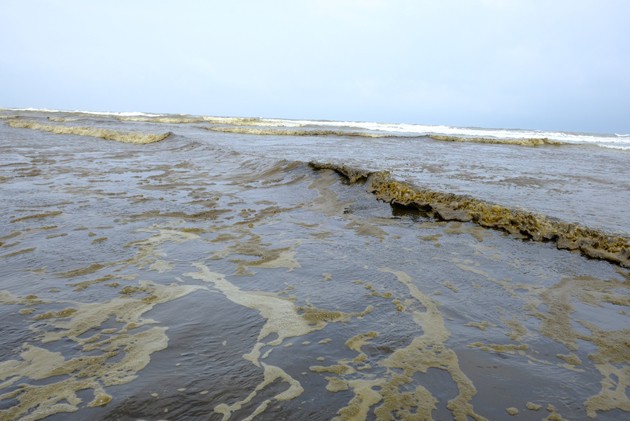
According to the Vietnam Environment Administration (VEA), change in color of seawaters in Trung An and Hai Ninh hamlets of the coastal central province of Quang Ngai was due to appearance of Silica algae with high density and lignin and tannin compounds. SGGP reports.
The number of Silica algae in phytoplankton was up to 420,700 cells per liter of seawater, of which Asterionellopsis glacialis had the highest density of up to 304,213 cells per liter. Ten out of ten inshore seawater samples had synthetic parameter of lignin and tannin compounds with average content of 0.88 milliliter per liter, the lowest level was 0.22 milliliter per liter and the highest 1.74 milliliter per liter. The VEA concluded that change in color of seawater was because of high density of Silica algae and lignin and tannin compounds.
High density of Silica algae will change the color of seawater to brown or dark green and normally will not harm marine life. At the same time, the appearance of lignin and tannin compounds in this waters caused color of seawater to change to brown or black. These compounds are usually produced from processing activities relating to wood, wood chips and pulp from wood chips.
Meanwhile, at the waters of Hao Hung port of Hao Hung Limited Company, the color of seawater also changed to black. At this area, after the Matmo and Nakri storms, rainwater impregnated from wood chip field flowed to the sea. The VEA will continue to monitor the developments.
Discover more from Vietnam Insider
Subscribe to get the latest posts sent to your email.