

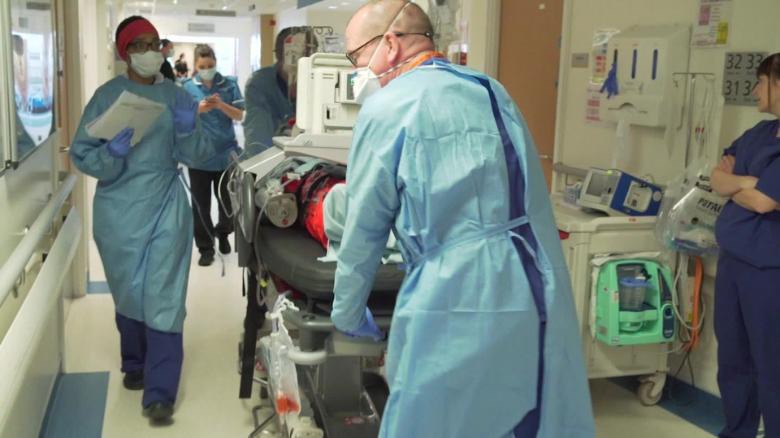
The UK has become only the second country to report more than 40,000 coronavirus deaths, according to the latest government figures.
A total of 40,261 people have died in hospitals, care homes and the wider community after testing positive for the virus, up 357 from Thursday.
Only the US, with more than 108,000 deaths, has recorded a greater loss of life in the pandemic so far.
But experts have warned full global comparisons may take months.
Under-prepared?
Of course, competent governments put plans in place to mitigate these sort of risks. Just last year a review was suggesting the UK was one of the best prepared countries for a pandemic.
The UK may have been – if it had been flu.
The procedures used in the early days – the so-called contain, delay and mitigate action plan – were based on the strategy for influenza not coronavirus. Prof Devi Sridhar, chairwoman of global public health at Edinburgh University, says this led to the assumption the virus could not be contained and instead had to be managed.
The leaders, she says, “failed to grasp the gravity of the situation”.
It takes too long to lock down?
You could argue these criticisms are being levelled with a degree of hindsight. But even if you give the UK the benefit of the doubt for the lack of preparedness, when the gravity of the situation became clear were we too slow to act?
By early March, government modellers had realised the virus was more widespread than had previously been assumed and with distressing scenes from Italy beginning to emerge, the government announced its next steps.
Some measures started to be put in place, including asking people to isolate at home if they developed symptoms. But full lockdown was not announced until 23 March.
During that time people were travelling around the country, commuters flooded in and out of London on busy trains, tubes and buses and major sporting events continued, including the Cheltenham Festival.
Prof Sir David King, a former government scientific adviser, has argued it is clear we reacted “too late”, warning every day of delay “cost lives”.
Italy, previously Europe’s worst-hit country, has recorded 33,600 deaths from those who tested positive for the virus.
Brazil has also seen fatalities rising fast, with more than 34,000 people having died after contracting the virus and daily death tolls of over 1,000 on some days.
This death toll is only one way the UK government counts the coronavirus death toll, focusing on people who have died after a positive Covid-19 test.
Figures published by the UK statistics agencies on Tuesday show an even higher toll. Up to the week ending 22 May, 48,106 people had died in the UK with Covid-19 mentioned on their death certificate.

The crisis may have contributed to a greater loss of life from other causes too, with 61,895 more deaths recorded than would be expected for this time of year, between the beginning of the outbreak and May 22.
The Office of National Statistics has said this may be due to a delay in care for other conditions, such as dementia, asthma and diabetes. Others may be unidentified coronavirus cases, it said.
The UK’s population of older people has been worst affected by Covid-19, with over-80s being 70 times more likely to die than people under 40.
Concerns have also been raised over the impact on ethnic minority communities, with people with Bangladeshi ethnicity more than twice as likely to die from coronavirus than white Britons, taking age and sex into account.
The first death from Covid-19 in the UK was reported three months ago, on 2 March.
The BBC has been collecting their personal stories – like that of Adam Brown, a 30-year-old with learning disabilities who died on 29 April.
“Despite the wonderful doctors’, nurses’, consultants’ best and desperate efforts, even going over and above to save our son’s life, Adam died alone and afraid, from the coronavirus,” said his mother, Maureen.
“We love and miss him so much, as our whole lives have always revolved around him.”
This article originally posted on the BBC
Discover more from Vietnam Insider
Subscribe to get the latest posts sent to your email.