

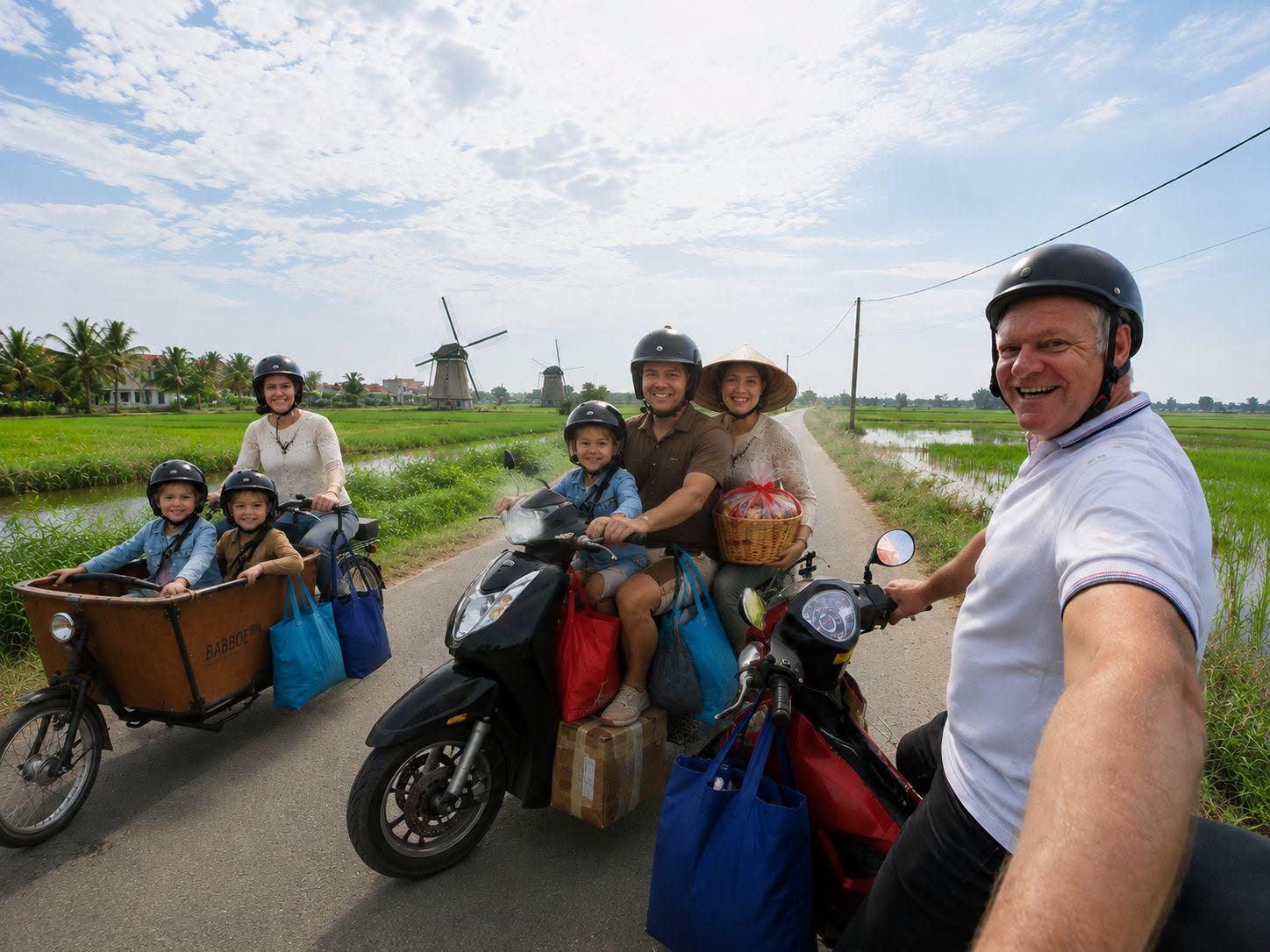
The Vietnamese express care and affection in a subtle, distinctive manner. Overt declarations like “I love you,” “parents love you,” or “I love you, mother and father” are seldom spoken aloud. Instead, affection surfaces through ordinary, everyday gestures: gently placing a savory morsel into someone’s rice bowl, a parted reminder to “travel safely,” or a seemingly routine query: “Ăn cơm chưa?” (“Have you eaten yet?”).
To the Vietnamese, questions such as “Ăn cơm chưa?” (Have you eaten yet?), “Đi đâu đấy?” (Where are you heading?), or “Mới về à?” (Just getting back?) rarely demand a literal answer. They serve primarily as warm greetings, conversation starters, and an unspoken signal: “I see you, and I care.”
This cultural greeting recently delighted an expatriate from the Netherlands. On social media, Danny Haberer recounted his early days in Vietnam and his perplexity at being persistently asked, “Ăn cơm chưa?”

Danny Haberer, an expat from the Netherlands, expressed amusement at the traditional Vietnamese greeting “Have you eaten yet?”
“When I first moved to Vietnam, neighbors asked me every single day: ‘Have you eaten yet?’ I thought they meant it literally, so I answered politely: ‘No, not yet, I’ll eat in a bit.’ The next day, they asked again. And again the day after that. I started getting worried—good heavens, do I look that gaunt?
Only later did I realize: ‘Have you eaten yet?’ isn’t an interrogation; it’s a greeting. Just like ‘Where are you off to?’ or ‘Just got home?’ In a land where grains of rice have sustained generations, asking if someone has eaten is simply a way of saying, ‘I care about you.’ I hear that when parents call their children who live far away, the very first words out of their mouths are always, ‘Have you eaten yet, child?’
Back in the Netherlands, we greet each other with: ‘Hoe gaat het?’—meaning ‘How are you?’ The Dutch inquire about your health. The Vietnamese inquire about… your belly. Come to think of it, you can only be healthy on a full stomach!
Nowadays, whenever the neighbors ask, I give them the snappy Western Delta answer: ‘Rồi!’ (‘Done!’). How about you folks—have you eaten yet today? The Mekong Delta taught me, and I listened.”


Danny Haberer’s reflection on social media.
Danny’s anecdote quickly struck a chord with Vietnamese readers. Many pointed out that “Ăn cơm chưa?” is indeed an affectionate greeting deeply woven into daily life, especially across regional communities around meal hours.
One commenter noted that “Ăn cơm chưa?” typically serves as a greeting leading up to or following lunch and dinner—roughly between 11:00 a.m.–1:00 p.m. and 6:00 p.m.–8:00 p.m. Outside those windows, people naturally pivot to situational pleasantries: “Where are you heading?”, “What are you working on?”, “Taking a break?”, “Heading out?”, “Picking up the kids?”, or “Off to school?”
For many, the inquiry represents an instinctive reflex intertwined with familial bonds. One reader shared: “I married someone far from home. Whenever my mother calls me late around 9:00 p.m., her very first question is still: ‘Have you eaten yet, my child?'”
Another echoed the sentiment, sharing that her mother poses the same question out of lifelong habit, whether phoning in the middle of the afternoon or late at night, long after conventional meal times have passed.
Others observed that the greeting is especially ubiquitous in the Mekong Delta (the Western region), where plainspoken daily inquiries cultivate immediate warmth, hospitality, and neighborly closeness.
That genuine simplicity was precisely what enabled Danny, after years in the country, not only to grasp the cultural nuance but also to embrace the authentic Southern cadence with a brisk: “Rồi!” (Done!).
A Dutchman Enchanted by Everyday Vietnamese Life
Danny Haberer currently resides in Go Cong, Tien Giang Province. During his stay in Vietnam, he has pursued diverse pursuits—gardening, photography, and vlogging—frequently chronicling his local discoveries and day-to-day encounters on his personal page. Rather than grand narratives, Danny focuses on humble routines: navigating a motorbike, cultivating vegetables, raising fish, gardening, touring rural towns, and sampling authentic Vietnamese fare. His perspective—that of a foreigner genuinely living among locals rather than passing through as an observer—has garnered a loyal Vietnamese following.
His storytelling stands out for its natural wit, seamlessly blending historical background, cultural context, and regional geography. Details taken for granted by locals take on fresh life and intrigue when viewed through his lens.
For instance, when introducing Ben Thanh Market, Danny did not merely profile a famous landmark; he transported viewers back to its historical foundations.

He previously charmed viewers with his lively account of Ben Thanh Market’s origin.
“Do you know what Ben Thanh Market was built on? A muddy swamp! Back then, the site was the Bo Ret pond, known to the French as Marais Boresse—a pool of stagnant water. They filled the swamp before breaking ground, and the market officially opened in 1914.
The inaugural celebration was extraordinary: three straight days of festivities, fireworks, festive floats, and over 100,000 attendees. During the opening ceremony, a Vietnamese woman named Vo Thi Vuong fought a real tiger from dawn until high noon—and won. Vietnamese women have been formidable since way back then! Gentlemen, think twice or thrice before arguing with your wives… who knows if she might be a descendant of Madame Vuong! Meanwhile, there I was in the middle of the market, trembling just trying to bargain in Vietnamese.”
 Danny Haberer frequently shares engaging trivia about Vietnamese landmarks and culinary traditions.
When reflecting on President Ho Chi Minh, Danny opened with genuine curiosity before presenting a figure that caught him off guard:
“Do you know how many names President Ho Chi Minh had? Let me guess: 5? 10? Wrong. According to records at the Ho Chi Minh Museum, he used 175 names, aliases, and pen names. One hundred and seventy-five! That averages out to roughly three new names for every year of his revolutionary life. Each name had its own purpose, serving the singular path of national salvation.
Consider this: penning French-language journalism under one pseudonym, sending correspondence under another, organizing across one country under one name, then crossing borders under an entirely different identity. Yet across decades, there remained a solitary, unyielding objective: national independence. 175 names, one devoted heart.
The affectionate moniker ‘Bac’ (‘Uncle’), used by the entire nation, emerged in 1941, while the name Ho Chi Minh was adopted in 1942. Reading that left me speechless. Here I am struggling to remember a single Facebook password!”
 Photo: Danny Haberer
Beyond history and culture, Danny recounts everyday moments with self-deprecating humor. After spending two years proclaiming his devotion to Vietnamese cuisine, he playfully admitted to “betraying” his palate when faced with a breakfast buffet, reflexively grabbing Dutch comfort foods:
“For two years, I told everyone I had crossed over to Team Vietnam—I couldn’t start the morning without a steaming bowl of noodles. Yet this morning at the buffet, my hand moved on autopilot, grabbing sliced bread and cheese. Exactly like a traditional Dutch breakfast! I cheated, folks!
Perhaps being away from home so long woke up the Dutch stomach inside me. In Go Cong, I eat Vietnamese food year-round without issue, but the second I see cheese at a hotel, all my promises evaporate. Forgive me this once! The moment I get back home, I’ll down a bowl of hu tieu noodle soup to make amends!”

 Danny Haberer learns to embrace everyday Vietnamese cuisine.
From deciphering “Ăn cơm chưa?” to recounting the origins of Ben Thanh Market, President Ho Chi Minh’s aliases, or a spontaneous buffet indulgence of bread and cheese, Danny’s reflections offer an affectionate lens on Vietnam. He explores the country not merely through landmark monuments, but through daily rituals, culinary bonds, and how people treat one another in ordinary life.
This grounded warmth explains why his stories resonate so deeply: when a foreign resident learns that beneath “Have you eaten yet?” lies far more than a question about sustenance—it is, in truth, an enduringly Vietnamese way to say, “You matter to me.”
(Source: kenh14.vn)
Discover more from Vietnam Insider
Subscribe to get the latest posts sent to your email.