

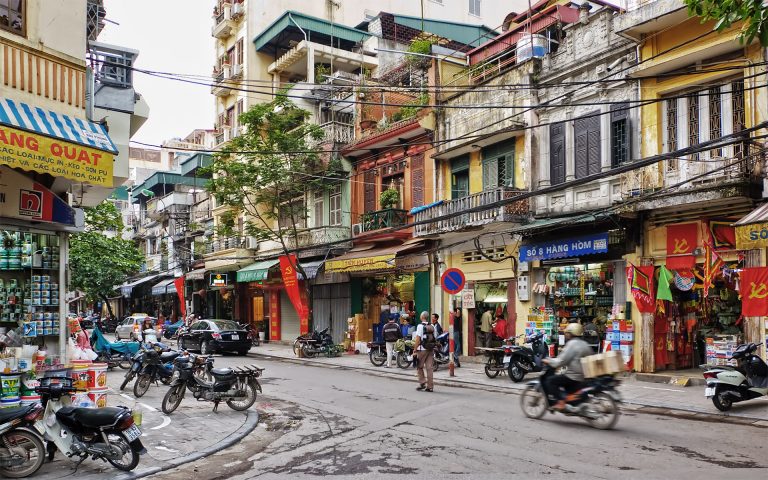
Recently, the American newspaper Insider published an article about the “tube house” architecture in Hanoi. According to author Amanda Goh, the street here attracts visitors by a special type of house, often referred to as ‘tube house’ by locals.
The typical tube houses on the streets of Vietnam’s capital are painted in a variety of colors, and they can be as little as 2 meters wide.
According to Mr. Dinh Quoc Phuong, director of the Interior Architecture Program at Swinburne University of Technology, tube houses are one of the most popular types of architecture in Vietnam today.
“Old tube houses were built before 1954, usually have two floors, stretched later with narrow facades from 2-5 meters. Still on that old ground, today’s tube houses are built higher, even up to 12 floors,” said Mr. Phuong.
According to some historical records, the type of “tube house” originated in the old quarters of Hanoi. This area is a hub for trade and commerce. Each street is named after the items that are commonly sold there such as Hang Bac street (selling jewelry, gold and silver) or Hang Gai street (selling silk).
Unlike other places, in addition to living, the “tube house” in the old town area is also a place for trading, conducting commercial transactions and is extremely important to households.
“With a multi-storey design, tube houses are often inhabited by multiple generations in a family,” said Mai Hung Trung, the architect who initiated Hanoi Ad Hoc – a study on Hanoi’s urban landscape.
According to Mr. Trung, until now it is still possible to find houses that are the residences of 5 or 6 different families in Hanoi’s Old Quarter.
Despite having a narrow facade, tube houses are often very deep. There are houses that can be up to 100 meters deep. Talking about the design origin of this type of house, Mr. Trung said that there are many theories put forward.
Firstly, this architectural style can be formed due to expensive land prices. As the population density increases, the government is forced to collect frontage taxes on the main streets, causing people to try to reduce the size of the facade. But as the number of family members increases, they need space and are forced to build from the inside out.
Mr. Trung said: “In the inner city, land is as precious as gold. Street houses used to be one of the measures to assess the wealth of the people”.
Old tube houses often have a courtyard to let in light and function as a “skylight” for natural ventilation. This is also a common place where family members gather together.
Recently, many tube houses are also designed in a “neoclassical” style like those from the French colonial period.
But regardless of the origin, author Amanda Goh affirmed that besides motorbikes, “tube houses” are one of the characteristics of Vietnamese streets, contributing to shaping the country’s urban landscape.
@ Vietnamnet
Discover more from Vietnam Insider
Subscribe to get the latest posts sent to your email.