

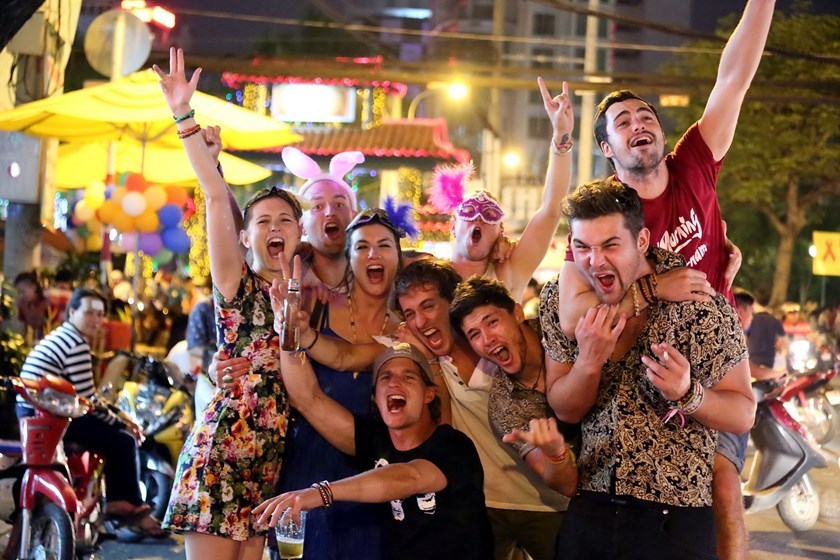
No longer a budget destination lagging behind Thailand or Bali, Vietnam is attracting Australians thanks to its blend of mid-range quality services and the vibrant cultural identity of its younger generation.
Georgia Quinn visited Vietnam 15 years ago. At the time, she observed that Vietnam was not as popular a destination as Thailand or Bali.
Currently, many of Quinn’s friends and relatives say they have traveled to Vietnam or are planning to visit. Last month, Quinn returned to Vietnam, visiting Da Nang. She compared Da Nang to Gold Coast – a modern and attractive coastal city located in Queensland, eastern Australia.
Quinn said she met many fellow Vietnamese during her two-week vacation in Vietnam. “It’s no surprise that people realize this is a wonderful place,” Quinn said.

The owner of Blue Gecko restaurant in Hoi An said that international tourists, especially from Australia, are increasingly choosing Hoi An over Bali (Indonesia) as they did before. Photo: Giang Huy
Data from the Australian Bureau of Statistics shows that 10 years ago, Vietnam was the 5th most popular destination in Southeast Asia for Australians. By 2024, Vietnam is projected to become the third most visited country in the region, surpassing Singapore and Malaysia. The number of Australians returning from short trips to Vietnam is expected to increase from 246,000 in 2016 to 528,000 in 2026.
The number of passengers flying to Vietnam via Jetstar increased by more than 30% compared to 2023, and the number of flights operated by the airline also increased by 15%. The Expedia platform recorded continuous growth in searches for accommodation in Hanoi, Ho Chi Minh City, and Phu Quoc during the 2025-2026 period.
“I’m seeing more and more Australians coming to Vietnam,” said Dr. Truc Le, a lecturer in marketing and tourism at Griffith University. She believes this trend stems from the compatibility between the needs of Australian tourists and Vietnam’s tourism products.
Amidst rising living costs, travelers tend to choose nearby destinations rather than long journeys to Paris (France) or Venice (Italy). Australian tourists are interested in the price-to-quality ratio. In Vietnam, travelers can access high-end services at mid-range prices.
Mandy Lan, 25, an event coordinator, said she chose Vietnam because of its reasonable cost. For a two-week trip at the end of 2025, Lan spent $1,500 (excluding airfare) on services including meals at Michelin-starred restaurants and a $250 custom-made outfit. For a full-package vacation with her boyfriend, Lan budgeted $6,000.

Dr. Truc Le, a lecturer at Griffith University, said that Australian tourists tend to seek authentic experiences, destinations that aren’t too crowded, and affordable options.
For Quinn, Ho Chi Minh City is a vibrant metropolis, making it easy for tourists to immerse themselves in the atmosphere. When visiting Vietnam, she often goes to fashion boutiques of local designers with a Y2K style (a cultural and fashion trend from the late 1990s and early 2000s).
Dang Duong, co-founder of Old Compass Travel, believes the Y2K trend stems from Vietnam’s young population, with an average age of 33. According to Dr. Truc Le, the younger generation is changing the way Vietnamese cultural identity is expressed through a blend of tradition and regional diversity.
The two co-founders of Urbanist Travel, Chau Nguyen and Brian Letwin, point out that there is currently an influx of Millennials (1981-1996) and Gen Z (1997-2012) returning to Vietnam to establish their own businesses. They are applying the knowledge they learned abroad to create new things in the tourism service industry.
Linh Phan, founder of Hidden Saigon Travel, said that many second-generation Vietnamese who studied abroad have returned to Vietnam to take over and change the way their family restaurants are run. This trend has created a breakthrough in the culinary, fashion, and music sectors at the destination.
According to Letwin, the cultural shift is attracting tourists. Linh Phan never thought she would see foreigners in local cafes, but now these destinations are “always packed with international visitors.”
Dr. Truc Le noted that Australians are interested in the dynamism of Vietnam’s indigenous culture. Vietnam can learn from the tourism overload in Bali (Indonesia) to better manage and develop its tourism industry. However, Linh Phan believes that popular tourist destinations in her homeland always know who their real customers are.
“Tourists come and go, but the locals are the long-term customers,” Linh Phan said.
Discover more from Vietnam Insider
Subscribe to get the latest posts sent to your email.