

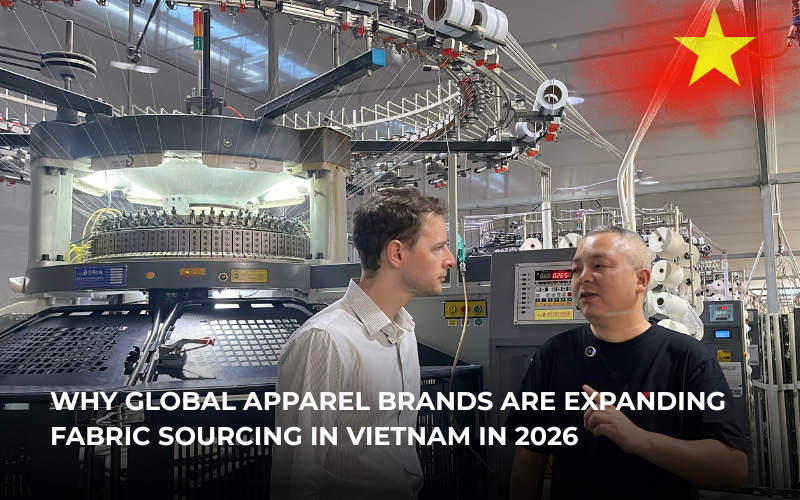
In 2026, Vietnam is no longer viewed merely as a garment manufacturing hub. The country is increasingly emerging as a strategic fabric sourcing destination, a shift driven not only by global apparel brands seeking supply chain resilience, but also by foreign textile manufacturers, including major Chinese groups, relocating upstream production into Vietnam.
The industry enters 2026 with strong momentum and clear ambition. After achieving USD 46–47 billion in export turnover in 2025, Vietnam has firmly consolidated its position as the world’s third-largest textile and apparel exporter. Building on this foundation, industry leaders are now targeting approximately USD 50 billion in export value in 2026.
This objective represents more than continued recovery. It signals a structural transformation within Vietnam’s textile ecosystem, moving beyond garment assembly toward deeper vertical integration, expanded fabric production capacity, and stronger upstream control.
While garments still account for the majority of export value, the most strategic evolution is taking place further up the value chain in: yarn production, knitting, dyeing, and textile processing.
In 2026, the leadership conversation is no longer centered on volume alone. It is increasingly focused on value chain control, resilience, and long-term competitiveness.
Why Foreign Textile Groups Are Moving Fabric Production to Vietnam
One of the most important but under-discussed developments is this:
Major foreign textile manufacturers, including Chinese groups, are actively expanding fabric production in Vietnam.
This movement is driven by three structural realities:
1. Trade Risk Mitigation
With ongoing geopolitical tensions and trade policy uncertainties, producing fabric in China for garments made in Vietnam creates origin complications for brands exporting to the US and EU. By relocating knitting, dyeing, and printing operations to Vietnam, manufacturers reduce tariff exposure and origin risks.
2. Brand Compliance Requirements
Global brands such as H&M, Old Navy, and premium houses like Cartier increasingly require traceability, sustainability documentation, and certified production environments. Vietnam offers stronger regulatory alignment and growing compliance infrastructure compared to certain inland production clusters elsewhere in Asia.
3. Proximity to Garment Manufacturing
Vietnam already hosts large-scale garment investments serving global brands. Fabric production moving closer to these garment hubs reduces lead time, improves development cycles, and strengthens vertical integration.
This explains why several foreign-owned textile groups have invested in knitting, dyeing, and printing facilities in Southern Vietnam over the past five years. The strategic logic is clear: control fabric production at the same origin as garment assembly.
This video offers a practical look at how Vietnam’s textile leadership is translating strategy into execution in 2026. From fabric development to integrated manufacturing capabilities, it highlights how Vietnamese suppliers are moving beyond CMT toward higher-value fabric production and supply chain control.
From CMT to Fabric Governance
Historically, Vietnam’s textile industry relied heavily on imported fabric and yarn, particularly from China. Garment factories operated under a CMT (Cut-Make-Trim) model with limited upstream influence.
That model is being recalibrated.
In 2026, leadership within Vietnam’s textile ecosystem is focused on:
-
Increasing domestic yarn sourcing
-
Expanding spinning capacity
-
Investing in knitting, dyeing, and digital printing technologies
-
Strengthening textile wastewater treatment infrastructure
-
Implementing lab-based quality testing and OEKO-TEX® Standard 100 compliance
A notable development is that more factories are now sourcing yarn domestically, rather than relying entirely on imports. This enhances origin qualification under trade agreements and shortens supply cycles. It also reduces exposure to cross-border volatility.
This shift represents a move from labor arbitrage to supply chain governance.
The China Factor: Competition or Strategic Extension?
The narrative is often framed as “Vietnam versus China.”
In reality, the relationship is more nuanced.
Many Chinese textile groups are not exiting the industry, they are rebalancing geographically. Vietnam is becoming an extension of regional production strategy rather than a competitor in isolation.
Chinese technical expertise in dyeing, machinery maintenance, and production engineering is often transferred into Vietnam operations. Meanwhile, Vietnam provides tariff advantages, political stability, and expanding compliance alignment.
The result is hybrid leadership: Chinese industrial capability operating within Vietnam’s trade architecture.
For global brands, this creates a new sourcing equation:
-
Comparable technical standards
-
Lower geopolitical exposure
-
Competitive but slightly premium pricing
-
Shorter lead time between fabric and garment

Guillaume Rondan, CEO of MoveToAsia, one of Vietnams’s leading sourcing agency
>> Related article: Moving Production Out of China: How to Set Up a Factory in Vietnam
Meeting Brand Expectations: Beyond Price
Major brands are not expanding sourcing in Vietnam solely for cost reasons.
In 2026, procurement strategies are influenced by:
-
Carbon footprint tracking
-
Wastewater management standards
-
Chemical control compliance
-
Speed-to-market
-
Supply chain resilience
Vietnam’s modern textile factories increasingly integrate:
-
Online fabric inspection camera systems
-
Lab dips and Pantone color approval workflows
-
Color fastness and shrinkage testing labs
-
Digital printing for lower MOQ sampling
-
Industrial wastewater treatment systems meeting environmental regulations
This operational maturity is critical for brands that must publicly report ESG metrics and supply chain transparency. Vietnam is not competing only on price. It is competing on predictability.
Vertical Integration as Strategic Leadership
The transformation of Vietnam’s textile industry in 2026 is not merely about expanding capacity — it is about redefining control through vertical integration.
1. From Fragmented Production to Coordinated Ecosystems
Historically, Vietnam’s garment sector relied heavily on imported fabrics, with dyeing, printing, and upstream processes often located in other countries. This fragmented model limited flexibility and exposed brands to logistical and geopolitical risks. Today, as fabric production, dyeing, printing, and garment assembly increasingly operate within the same country, and often within connected industrial clusters, the supply chain becomes structurally more synchronized. Development cycles move faster, technical adjustments are resolved more efficiently, and production planning becomes more predictable.

>> Related article: Vietnam Garment Manufacturing & Sourcing: Opportunities and Challenges
2. Strategic Advantages for Global Brands
For international apparel companies, vertical integration translates into tangible operational benefits. Sampling lead times are reduced because fabric and garment teams collaborate locally. Inventory risk declines as production timelines align more closely with demand forecasting. Compliance monitoring becomes more transparent under a unified regulatory framework. At the same time, brands gain clearer cost visibility across fabric processing and assembly stages, improving margin planning and pricing strategy.
3. From Manufacturing Base to Supply Chain Anchor
Most importantly, vertical integration strengthens Vietnam’s strategic positioning in the global textile hierarchy. By expanding domestic yarn sourcing and fabric production capacity, the country reduces dependency on imported inputs and enhances origin qualification under trade agreements. This shift moves Vietnam beyond a labor-driven manufacturing role toward becoming a supply chain anchor — a partner capable of contributing to resilience, governance, and long-term value creation.
Looking Ahead: Structural Expansion, Not Temporary Shift
Discover more from Vietnam Insider
Subscribe to get the latest posts sent to your email.