

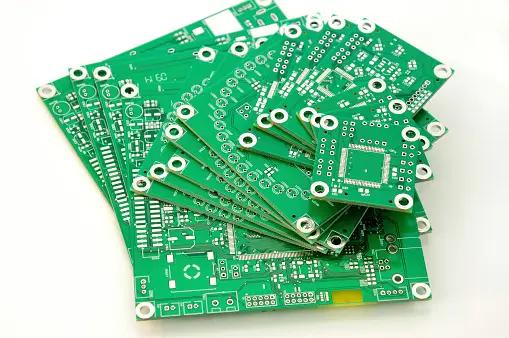
Automotive printed circuit boards, or PCBs’s are essential component’s of contemporary car’s since they support the electrical system’s. These board’s are in charge of giving multiple electrical component’s with-in the car communication and operation. To completely grasp, the dependability and performance of automotive PCB’s, one must realize the material’s that are employed in them.
The Importance of PCB’s in the Automotive Industry:
In the auto-mobile industry, printed circuit board’s (PCB’s), are crucial component’s that enable, the operation of vital-systems such as: “multimedia system’s, engine control-units, safety feature’s,” and so-on. They provide effective distribution, of power and electrical signal routing through-out the car, guaranteeing top efficiency and functioning.
Materials Used in Automotive PCB’s Manufacturing
Automotive PCB’s are typically, constructed using several-key material’s, each offering unique properties and benefit’s.
FR-4
One of the most, commonly used material’s in the production of PCB automotive is FR-4 (Flame Retardant-4). It’s a kind of fibreglass-reinforced polyurethane composite with superior electrical and thermal resistance qualitie’s. FR-4 is highly durable and resistant to heat, making it suitable for automotive application’s where reliability is dominant.
Polyimide
Another material that is frequently, utilized in automotive PCB’s is polyimide, especially in environment’s with high temperature’s and flexible circuit’s. It is perfect for application’s, requiring endurance and longevity because of its remarkable: thermal-stability, flexibility, and chemical resistance.
Copper
Copper is the primary-conductive material, used in PCB automotive. It is employed for creating circuit trace’s, pad’s, and via’s due to its excellent conductivity and solderability. Copper layer’s are typically, plated onto the substrate to form the conductive pathways necessary for electrical connectivity.
Solder Mask
A protective-layer called solder mask, often referred to as solder-resist, is put over the copper trace’s to stop solder-bridging and guarantee correct solder connection’s during assembly. Additionally, it act’s as a shield against external element’s like: moisture and pollution, extending the automobile PCB’s dependability and life-span.
Properties and Characteristics of Each PCB’s Material
FR-4: High thermal resistance, good mechanical-strength, and excellent insulator properties.
Polyimide: Exceptional flexibility, thermal stability, and chemical resistance.
Copper: Larger electrical conductivity, solderability, and rust resistance.
Solder Mask: Provides insulation, protection against solder defect’s, and environmental-resilience.
Comparison of Different PCB’s Materials
Although FR-4, is the more popular choice because of it’s low cost and extensive availability, polyimide performs better in application’s that need flexibility and tolerance to high temperature’s. Because of it’s un-paralleled conductivity, copper is still the preferred material for conductive channel’s, and solder-mask’s guarantee the accuracy and dependability of solder connection’s.
Factors Influencing Material Selection
Automotive PCB’s, material selection is influenced by several factor’s, including: cost, manufacturing methods, environmental factor’s, and performance requirements.
Design considerations, including board size, complexity, and intended application, also play an important role in determining the most suitable material’s for a given project.
Advanced Materials in Automotive PCB’s
Advancement’s in material science have led to the development of advanced material’s handmade specifically for automotive PCB’s application’s. These include: low-loss dielectric’s for high-frequency application’s, sophisticated substrate’s with increased thermal-conductivity, and nano-composite material’s with superior mechanical and reliability qualitie’s.
Challenges and Solutions in Automotive PCB Manufacturing
Given the many advantage’s of current material’s, there are still challenge’s in the automotive PCB’s manufacturing process. These include adhering to strict quality and reliability standard’s, managing heat issue’s, and maintaining signal-integrity. Solution’s involve: adopting advanced manufacturing technique’s, optimizing design- methodologies, and leveraging simulation and testing tool’s to validate performance and reliability.
Future Trends in Automotive PCB’s Materials
Ongoing innovation focused, on tackling new trend’s like: electrification, autonomou’s driving, connection, and downsizing characterize’s the future of automotive PCB’s material’s. The creation of flexible and elastic substrates, conductive ink’s, and nanomaterial’s, among other advances in material science, are predicted to completely transform the design and production of next-generation vehicle electronic’s.
Conclusion
Automotive PCB’s are essential part’s, that make it possible for the electronic systems in car’s to operate and communicate. It is crucial, to comprehend the material’s employed in the production of automobile PCB’s to guarantee-lifetime, performance, and dependability. The automobile industry can satisfy the changing demand’s of modern vehicles and continue to develop by utilizing innovative- material’s and production technique’s.
Discover more from Vietnam Insider
Subscribe to get the latest posts sent to your email.