

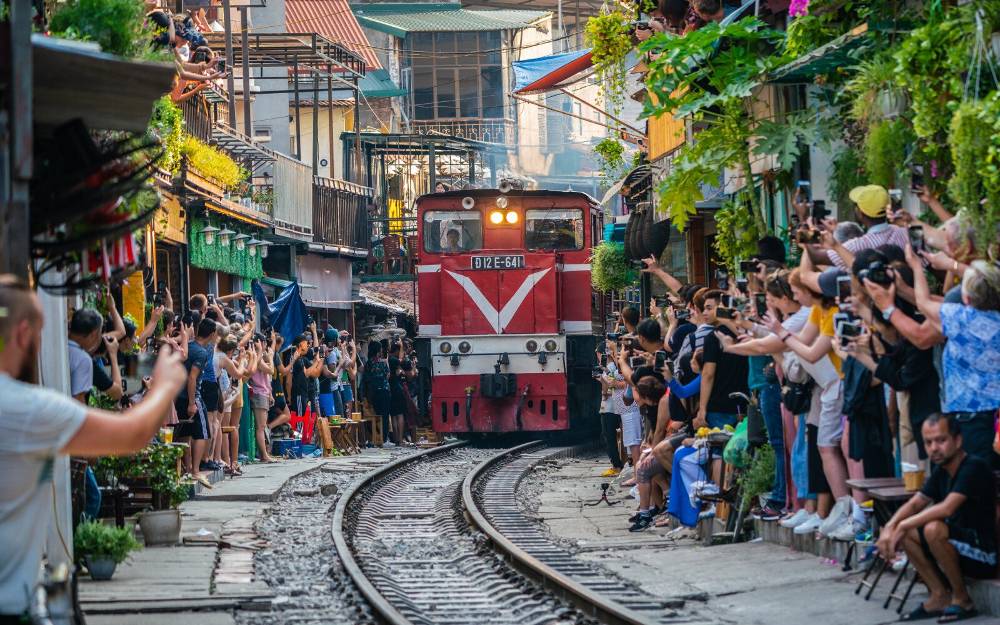
For many travelers visiting Hanoi, skipping Train Street now feels almost unthinkable, much like missing the Eiffel Tower in Paris.
That is the comparison drawn by BBC, which highlights how the narrow railway corridor has become a must visit destination driven largely by the fear of missing out. What was once a quiet residential area is now one of Vietnam’s most talked about tourist hotspots, attracting visitors eager to capture a uniquely close encounter with a passing train.
A viral attraction built on risk and spectacle


The stretch itself is only about 400 meters long, lined with tightly packed cafés and homes. Yet its visual intensity and shareability have turned it into a global social media phenomenon.
From quiet neighborhood to global hotspot
Train Street was not designed as a tourist attraction. The railway dates back to 1902, built during the French colonial era to connect Hanoi with Ho Chi Minh City.
For decades, it remained a modest residential area. By the 1970s, it was considered a low income neighborhood where residents lived with the constant rumble of passing trains.
That began to change in the 2010s.
Early photography tours introduced visitors to daily life along the tracks. Around the same time, social media platforms began prioritizing video content, amplifying the area’s visual appeal. By 2017, local residents had started opening small cafés, inviting tourists to stay and watch trains pass at close range.
What followed was rapid transformation. The once quiet alley evolved into a branded destination, complete with lanterns, drinks, and carefully timed train watching experiences.
The psychology behind the crowds
Experts point to a powerful driver behind Train Street’s popularity: the fear of missing out.
Charlotte Russell, founder of The Travel Psychologist, explains that people are naturally influenced by what others are seen enjoying online. When a location gains visibility, the desire to experience it firsthand becomes almost instinctive.
For many visitors, there is no deeper motivation beyond curiosity. Travelers often arrive simply because they have seen it on social media and feel compelled to witness it themselves.
At the same time, the element of risk adds to the appeal. For visitors from countries with strict safety regulations, the experience feels raw and unpredictable, offering a contrast to more controlled environments back home.
Safety concerns and repeated crackdowns

The rise in popularity has not come without consequences.
Authorities have attempted to shut down Train Street multiple times, including in 2019, 2022, and again in 2025 following a near miss incident involving a tourist.
Despite these efforts, visitors continue to find ways in. Social media exposure remains strong, with more than 100,000 posts tagged at the location on Instagram alone.
The tension highlights a broader challenge. While the site generates income for local residents and businesses, it also raises serious safety risks and questions about sustainable tourism management.
Economic boost versus cultural dilution
For local families, the tourism boom has created new income streams. Cafés and small businesses now rely heavily on the steady flow of international visitors.
However, some observers argue that the area’s deeper historical and cultural context is being overshadowed.
Instead of learning about the railway’s colonial origins or how residents adapted to life beside active tracks, many visitors leave with little more than a photograph.
This shift reflects a wider pattern in global tourism, where destinations become defined by their visual appeal rather than their cultural significance.
What comes next for Train Street
Some tour operators have already begun moving away from the crowded strip, redirecting visitors to quieter railway communities on the outskirts of Hanoi. These areas offer a more authentic glimpse into daily life without the same level of risk or congestion.
Yet the cycle may repeat itself. As new locations are discovered and shared online, they too can quickly transform into the next viral destination.
The bottom line
Hanoi’s Train Street is more than just a quirky attraction. It is a case study in how social media can reshape travel behavior, turning ordinary places into global icons almost overnight.
Its popularity shows no sign of fading, but its future remains uncertain as authorities balance safety, tourism demand, and cultural preservation.
For now, the experience remains as compelling as it is controversial, a place where the line between thrill and risk is only a few steps wide.