

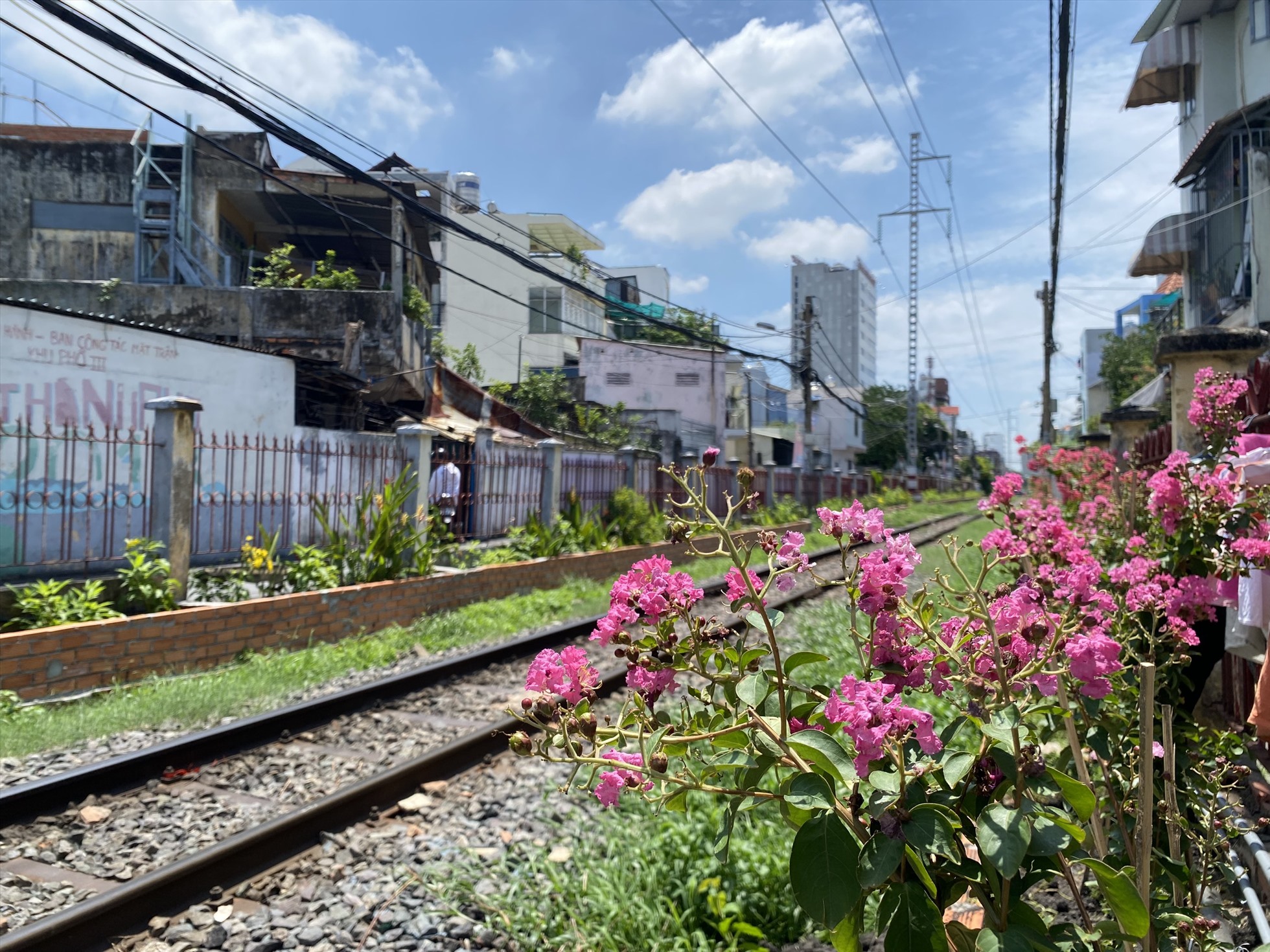
The Department of Construction has reported to the People’s Committee of Ho Chi Minh City regarding the support and coordination in implementing the “Railway – Flowers Path” movement, following the main idea of Vice Chairman of the Ho Chi Minh City People’s Committee, Bui Xuan Cuong.
Since the beginning of the year, the Vietnam Railways Corporation (VNR) has been executing a plan to transform Vietnam’s railway into the longest flower-lined path in the country’s future. This involves planting and caring for characteristic flowers from the three regions along railway lines, at train stations, and within units of this industry.

In May, the famous international travel site Lonely Planet named Vietnam’s Thong Nhat railway (North-South railway) first in the world’s 9 most spectacular train travel itineraries.
The North-South railway passes through the Ho Chi Minh City area with a length of about 14 kilometers, traversing the districts of District 3, Phu Nhuan, Go Vap, Binh Thanh, and Thu Duc. Starting from April, VNR has organized signing ceremonies to introduce the model of a “Safe, Clean, Green, and Environmentally Friendly Railway Corridor,” aiming to initiate the “Railway – Flowers Path” movement within the city.
According to the Department of Construction, the railway sector has proactively collaborated with districts across the city, signing comprehensive agreements to undertake cleaning, litter removal, weeding, and planting of trees, ornamental plants, and flowers along the railway sections passing through Binh Thanh District and Phu Nhuan District. District 3 has a plan for deployment, and Thu Duc City has conducted on-site surveys to coordinate strategies.
To support VNR in turning the concept into reality, the Department of Construction proposes that the Ho Chi Minh City People’s Committee issue directives to localities and relevant entities to collaborate in cleaning and transporting garbage and waste from the northern Saigon railway station area in Ward 11, District 3 (about 200 meters), which has been disposed of onto the railway tracks by individuals over many years. Once the area is cleared, the railway units and Ward 11 People’s Committee will establish green spaces, committing to maintaining and protecting the clean and beautiful green environment to prevent re-pollution.
Simultaneously, the People’s Committee of Ho Chi Minh City will support the planting of 300 Tabebuia rosea trees in the vacant space between the railway protection fence and the sidewalk of Pham Van Dong Street. They will also evaluate and provide resources for constructing the most beautiful flower-lined route within Phu Nhuan District, serving as a typical representation of the movement across Ho Chi Minh City.
The Department of Construction also suggests that the Ho Chi Minh City People’s Committee task the Department of Agriculture and Rural Development with collaborating alongside the People’s Committees of localities with railway lines passing through them to assist railway units in selecting and providing flower species suitable for the city’s climate and soil conditions. They should also provide guidance on caring methods and protection measures for facilitating the favorable growth of these flowers.
The Department of Tourism should promote the image of the “Railway – Flowers Path” movement through various tourism programs and tours to attract both residents and visitors.
Mr. Dang Sy Manh, General Director of VNR, expresses his expectation: “Through the train windows, passengers can admire the peach blossoms of the North, witness the vibrant paper flowers of the Central region, and see the golden apricot blossoms of the South… throughout all four seasons. We are committed to making Vietnam’s railways a flowery path and building a railway-friendly brand to attract tourists.”
@Thanhnien.vn
Discover more from Vietnam Insider
Subscribe to get the latest posts sent to your email.