

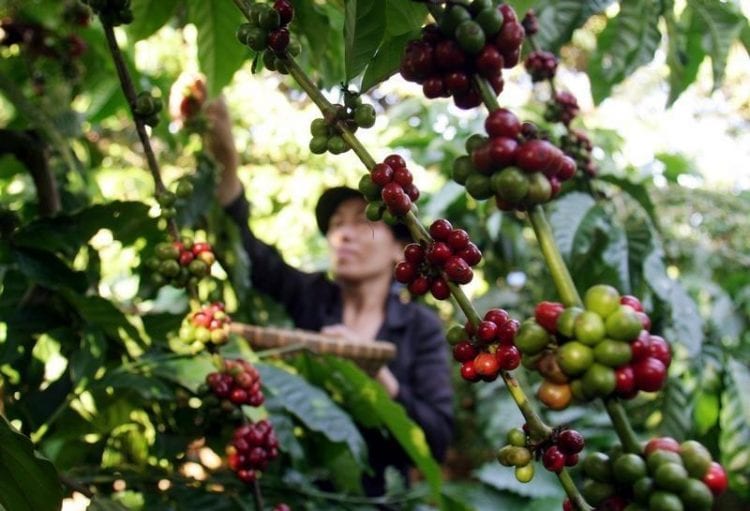
With increasing use of mechanization and other new technologies, the world’s top two coffee producers, Brazil and Vietnam, are achieving productivity growth that outstrips rivals in places such as Colombia, Central America and Africa.
They are set to tighten their grip.
A plunge in global coffee prices in recent months, to their lowest levels in 13 years, has begun to trigger a massive shake-out in the market in which only the most efficient producers will thrive, according to coffee traders and analysts. Reuters reports.
Rival producers elsewhere in the world are increasingly likely to be driven to the margins, unable to make money from a crop they have grown for generations. Some are already turning to alternative crops while others are abandoning their farms completely.
Such shifts are almost irreversible for perennial crops like coffee, as the decision to abandon or cut down trees can hit production for several years.
“Brazil and Vietnam have had consistent increases in productivity, other countries have not,” said Jeffrey Sachs, director of the Center for Sustainable Development at Columbia University, citing advances in mechanization, selective crop breeding techniques and irrigation technology.
According to Reuters, in Colombia and Central America, coffee is typically grown on hillsides where mechanization is more difficult, and hand-picking cherries has kept production costs relatively high. The African sector, meanwhile, is dominated by small-scale farmers often unable to raise the capital needed for new techniques.
Rinco bought his harvesting machine for around 600,000 reais ($155,600) and is paying the agricultural supplies company with coffee, delivering 400 bags a year over four years. This kind of bartering is common in Brazilian farming.
One such machine in Brazil replaces dozens of people in the field. Even with financing and fuel bills, farmers and machine manufacturers say there is a reduction of 40% to 60% on harvesting costs.
“Beyond the lower costs, it made my life less complicated,” said Rinco, relieved at no longer having the grueling task of hiring suitable pickers every year for the harvest at his farm in the Sao Joao da Boa Vista area.
“People don’t want to pick coffee anymore, they go to town to find something else to do.”
Brazil and Vietnam now produce more than half the world’s coffee, up from less than a third 20 years ago, and the proportion is rising, U.S. Department of Agriculture estimates show.
Leading producer Brazil alone accounts for over a third of global supply. In a clear sign of increased efficiency, it reported a record crop of 62 million bags last year and is expected to produce another record in 2020, the next on-year in the country’s biennial production cycle – despite the fact the coffee-planting area has been falling for the last six years.
Vietnam is also regularly setting production records while, by contrast, in Colombia the largest ever crop was harvested in the early 1990s and in Guatemala nearly two decades ago, USDA data shows.
In countries such as Guatemala and Honduras, growers who are increasingly abandoning farms are swelling the ranks of migrants trying to enter the United States.

Coffee cherries are seen in a plantation in the town of Sao Joao da Boa Vista, Brazil June 6, 2019. REUTERS/Amanda Perobelli
VARIETY IN VIETNAM
Arabica beans, which provide a smoother and sweeter taste, constitute nearly two-thirds of the world’s coffee. More bitter and stronger robusta beans largely make up the rest of global supply, much of them hailing from Vietnam.
A warehouse owned by Vietnamese coffee exporter Simexco Dak Lak Ltd in the town of Di An, near Ho Chi Minh City, illustrates the scale of Vietnam’s coffee operation.
Coffee is stacked in neat piles several meters high, awaiting export to Europe. The warehouse has enough capacity to store 20,000 tonnes during the harvest season.
“At the height of the harvest, having enough space to create an aisle to walk through the warehouse becomes a luxury,” said Thai Anh Tuan, who manages one of three warehouses for Simexco, which exports over 80,000 tonnes of robusta a year.
“Every tiny bit of space will be taken up by these little beans,” Tuan added. “We have to hire additional warehouses nearby for extra storage.”
Tuan also credited the steady increase of Vietnamese coffee exports over the last four to five years to an increase in innovative farming techniques, including intercropping – growing different crops together – and the use of better technology in irrigation and cultivation.
Coffee is still the key cash crop for Dak Lak, Vietnam’s largest coffee-producing province, although durians, jack fruit, mangoes and avocado trees have all been intercropped with coffee trees to maximize income in recent years, farmers told Reuters.
Ksor Tung, a coffee grower with a 10-hectare farm, said intercropping coffee with durian trees resulted in better protection from direct sunlight and pests.
“Farmers here have experimented with intercropping for nearly a decade,” Tung told Reuters.
“Peppers used to be the most popular tree when it comes to intercropping but for the past three years, with the prices falling, almost all farmers have turned to fruit trees instead,” said Tung, adding that farmers who intercrop can triple their income per hectare.
Marcelo Teixeira reported from Sao Joao da Boa Vista in BRAZIL, Phuong Nguyen from Ho Chi Minh City in VIETNAM. Writing and additional reporting by Nigel Hunt in London; Editing by Veronica Brown and Pravin Char.
Read full report on Reuters.
Discover more from Vietnam Insider
Subscribe to get the latest posts sent to your email.