

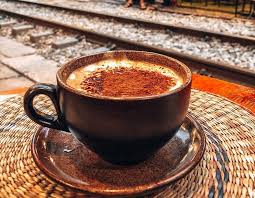
Beyond its global reputation for phở, bún, or bánh mì, Vietnam is widely considered a “coffee paradise” in the eyes of foreign visitors. From luxurious cafes to humble sidewalk carts, travelers can effortlessly find a cup of coffee on almost every street corner. What catches many by surprise is that despite its highly affordable price, Vietnamese coffee possesses a dense concentration and an exceptionally high caffeine payload, making it so strong that quite a few foreigners find themselves utterly “stunned” from their very first taste.
Recently, a post by a foreign account recounting an encounter with Vietnamese coffee went massively viral across social media networks. The write-up quickly pulled in tens of thousands of interactions due to its humorous description, which many readers claimed was not an exaggeration at all.

The original post read: “Oh my god, stay away from Vietnamese coffee. It is unnecessarily strong. I drank exactly one cup in Da Nang, and right after that, I immediately completed three client projects, launched an entire startup, and accidentally… spoke a programming language fluently.
My fingers were typing on the keyboard faster than my brain could even think. I lost consciousness without even realizing it, and when I finally woke up, a complete SaaS system was already fully built, 20 social media posts were automatically scheduled, and a Notion board was updating itself. I am not a coffee drinker. The coffee itself has ‘possessed’ me.”
Although written in jest, the post made many people laugh out loud because it holds incredibly true to the real-world experience of trying Vietnamese coffee for the first time.

Many international tourists note that Vietnamese coffee has a strong flavor. This is true for anyone who is not used to drinking it.
Right below the comments, both Vietnamese locals and international tourists stepped forward to confirm that Vietnamese coffee is indeed heavily “high-dosage,” particularly for the uninitiated. Many joked that the beverage behaves exactly like “productivity fuel,” keeping them alert enough to chase down brutal deadlines or work through consecutive hours.
A Vietnamese person living in the US shared: “So true, confirmed by a Vietnamese person themselves! I just moved to the US a few months ago and my entire suitcase was full of nothing but Vietnamese coffee (along with a coffee phin filter, too).”
Another comment made a comparison: “You have just described Vietnamese coffee as a dark ritual for boosting productivity. Truth be told, it is like drinking an elixir brewed by caffeine-addicted monks who are intimately familiar with the culture of ‘overwork.’ Each thick, slow-dripping drop of coffee does not merely wake you up, but injects the mindset of a startup founder directly into your bloodstream.”
Another person humorously wrote: “This post arrived at the exact moment I needed it most. It is 4 PM where I am, and I am terribly drowsy. I have three hours of work left, three reports to complete, and an internal presentation. My energy is completely depleted. Come to think of it, I visited Da Nang this past February. Perhaps I should return and buy out all the coffee there.”
Quite a few programmers also joined in on the fun: “Every morning I drink a cup of black coffee and then code… five projects at the same time.”


Despite the “heavy-dose” flavor, many Western guests are still very passionate about Vietnamese coffee.
Meanwhile, one traveler stated that even bạc xỉu—which contains a lot of milk and is considered a “light-dose version”—was enough to cause him insomnia: “I could not sleep after making the mistake of ordering a glass of bạc xỉu at past 6 PM. Therefore, it can be asserted that Vietnamese coffee is truly too strong, to the point that even Vietnamese people sometimes cannot stand it.”
Besides that, many netizens also enthusiastically “suggested upgrading the difficulty level” for those who want to try their hand at Vietnamese coffee. Some advised tourists to try thick black coffee, without sugar and without milk, to see how it goes. Another suggested: “Go to Trung Nguyen shop, there are up to 9 levels of coffee there if you want to challenge yourself.” Someone even admitted: “Every day I drink two cups of Vietnamese coffee and still sleep well. The funny thing is that before contracting Covid, I could not even drink coffee. In my opinion, Vietnamese coffee is the best. Trung Nguyen, Highlands, and Vinacafé are all very fine, but for the strongest, I nominate Mộc coffee.”
In reality, the fact that many tourists are “shocked” when drinking Vietnamese coffee for the first time is not too surprising. Vietnam is currently the largest Robusta coffee-producing country in the world and ranks second globally in coffee exports, trailing only Brazil. Unlike Arabica—the type of bean popular in many Western countries—Robusta has nearly double the caffeine content, a bold flavor, a strong aftertaste, and a more distinct bitterness.

Source: FireAnt
Not only standing out thanks to the raw ingredients, the traditional Vietnamese method of brewing coffee with a phin filter also contributes to creating an unmistakable flavor. Hot water drips drop by drop through a layer of finely ground coffee over several minutes, helping to fully extract the aroma and rich concentration of the coffee beans. Therefore, a cup of phin coffee or Vietnamese iced milk coffee typically has a significantly bolder flavor compared to the familiar machine-brewed coffees in many countries.

Source: Thung Lung Dasar

Source: VOVE – Dac San Ba Mien
Robusta has nearly double the caffeine content, a bold flavor, a strong aftertaste, and a more distinct bitterness.
That characteristic flavor has helped Vietnamese coffee be praised by international media many times. In 2023, the culinary website TasteAtlas ranked Vietnamese iced milk coffee in second place on the list of the best coffee drinks in the world with 4.6/5 points, equal to Italy’s Ristretto coffee. Before that, the travel magazine The Travel (Canada) also included Vietnam on the list of countries with the best coffee in the world, while CNN and The New York Times both dedicated many articles to analyzing the appeal of Vietnamese coffee culture along with its characteristic rich flavor.

Vietnamese instant coffee and coffee beans inside the suitcase of a Chinese tourist. Photo: @xiaohongshu.
Coffee is also a gift that many people buy to bring home after traveling to Vietnam.
Not only praised by the international press, Vietnamese phin coffee and iced milk coffee have also become the beverages that many heads of state, politicians, and celebrities choose to enjoy whenever they have the opportunity to visit Vietnam. Perhaps that is also why for quite a few tourists, after having been “initiated” into Vietnamese coffee, bringing a few packs of coffee along with a phin filter back home almost becomes an indispensable gift after each trip.
Discover more from Vietnam Insider
Subscribe to get the latest posts sent to your email.