Vietnam once put high hopes on automobile joint ventures, believing that foreign technologies would help develop the automobile industry. However, it now believes that it would be better not to rely on outsiders.
In the early 2000s, two Vietnamese companies had strength in the truck and passenger vehicle market segments. However, Vinaxuki went downhill and had no opportunity to recover. As for Thaco, Tran Ba Duong, its CEO, chose the correct path to development.
Starting business as a used car dealer, Thaco later began making trucks, buses and now assembles Mazda, Kia and Peugeot.
Do Huu Hao, former deputy minister of the Ministry of Industry and Trade (MOIT), commented that Thaco started with simple jobs (assembling trucks and buses) and then undertook more complicated work (sedans).
The manufacturing of buses and trucks helped Thaco accumulate experience and money to make sedans. Thaco is now a big power in the market and its sale promotion campaigns always have an impact on the market.
Thaco said Vietnam cannot compete with other countries which have been making cars for hundreds of years.
However, this is quite different for buses and trucks. In 2011, Thaco began building a factory for making buses, the first in Vietnam which has 80 percent of equipment designed by Thaco’s engineers.
Most recently, Thaco inaugurated the largest and most modern bus factory in South East Asia and signed a contract on exporting 1,150 businesses to four countries.
Meanwhile, Thanh Cong Group’s success was a surprise to many people. In 2009, Thanh Cong became the distributor of Hyundai cars. Even when Hyundai fell into Thanh Cong’s hands, few people thought Hyundai sedans would be assembled in Vietnam and exported.
The rapid growth has placed Hyundai Thanh Cong (HTC) in the top five manufacturers with the largest market share in Vietnam. Most of HTC’s models are now made at HTC’s factory in Ninh Binh province.
The third name in the ‘trio’ is Vinfast, an ambitious investor. Unlike Thaco, Vinfast, from the beginning, stated that it would make sedans with Vietnamese brand.
The manufacturer, belonging to VIngroup, a powerful conglomerate with investments in many business fields, has hired famous design centers in the world to design models ‘with a Vietnamese soul and for the Vietnamese market’.
VinFast promised that Vietnamese will have opportunities to own cars at reasonable prices and the project will help generate 25,000 workers, thus indirectly feeding 25,000 families.
The Vietnamese stock market in 2017 saw stock prices escalating, but not all investors could make money.
Tuan, a 27-year-old investor, spends most of his time watching electronic boards on securities and trading floors and calling brokers. He was surprised that the CMG share price had dropped so dramatically despite the upward trend of the market.
Two weeks ago, Tuan bought 5,000 CMG at VND37,000 per share. One week later, the price escalated to VND52,300 per share. However, it unexpectedly dropped late last week to VND34,000,
Tuan was not the only investor who took a loss even though the VN Index climbed to new highs.
“When the VN Index increases by 50 percent, this doesn’t mean that all the investors who inject VND1 billion into the market will receive VND1.5 billion,” an analyst said. “If someone can receive VND1.5 billion from the initial investment capital of VND1 billion, this means that another investor injects VND1 billion but receives VND500 million only.”
‘Too strong’, ‘crazy’ and ‘incredible’ are the words investors use to describe the rise of the stock market in 2017.
The VN Index increased by only 40 points in 2015 and by 80 points in 2016. But it has soared by 300 points so far this year and exceeded the 10-year high 950 point threshold.
In 2016, the average trading value was VND3 trillion per session and there were only a few sessions with the trading value of over VND5 trillion.
Meanwhile, VND5 trillion sessions were commonly seen in 2017.
With the growth rate of over 40 percent, Vietnam has become one of the fastest-growing markets in the world.
SSC’s (State Securities Commission) chair Tran Van Dung said the high GDP growth rate, the government’s actions, and foreign capital flow are the three factors behind the strong rise of the stock market in 2017.
Unlike 2007, when the stock market’s growth depended on domestic investors, in 2017, foreign investors have joined both the stock and bond markets.
The shift of the global capital flow which is now heading for emerging markets and the upgrade in credit ratings given by Fitch have made Vietnam a brilliant market.
One report shows that foreign investors have bought more than sold by $1.8 billion. This figure is only about secondary transactions in the stock market. In addition, there are many deals issuing shares specifically to groups of investors by Vietjet, Vincom Retail, HD Bank, VP Bank, Vinamilk and Sabeco.
Finance Asia in late November chose Vincom Retail’s stock sale as Asia Pacific’s most successful private equity investment deal in 2017, with record trading value of $741 million.
While some analysts note that a number of foreign banks have withdrawn capital from Vietnam banks, others see signs of a third investment wave from foreign investors.
The first wave of foreign investment in the banking sector occurred in 2005-2008, when bank shares were traded at sky high prices at hundreds of thousands of dong per share.
The first foreign strategic shareholders in Vietnam banks included ANZ, which acquired a 10 percent Sacombank stake in 2005, Standard Chartered which had a 9 percent ACB stake in 2005, and HSBC which bought a 10 percent Techcombank stake in 2005 and later raised its ownership ratio to 20 percent.
OCBC bought a 10 percent VP Bank stake in 2006 and later raised the ownership ratio to 15 percent, Societe General had a 20 percent SeABank stake in 2008, and BNP Paribas invested in OCB in 2009.
The second wave was seen in 2011-2014 with a number of outstanding deals such as the $60 million investment by Commonwealth Bank in VIB Bank in 2011 and the $40 million investment by IFC in An Binh Bank in the same year.
The other big deals included Mizuho pouring $576 million into Vietcombank in 2012 and Bank of Tokyo – Mitsubishi buying a 20 percent VietinBank stake at $743 million in 2013.
The stock market plunged to its bottom in 2012, but has bounced back since then. The strong rise recently of bank share prices has caused foreign investors to divest shares.
ANZ has left Sacombank after seven years, while OCBC divested from VP Bank in 2013. Since the beginning of the year, the market has seen HSBC leaving Techcombank and Standard Chartered Bank planning to leave ACB.
However, analysts say the banking sector has become attractive again, and can attract foreign investment, especially when foreign investment has been heading for Vietnam in the context of stable macroeconomic conditions and GDP growth.
On December 7, TP Bank and PYN Fund Management signed a contract under which PYN Elite Fund will own a 4.99 percent stake of TP Bank at the price of $40 million. TP Bank has announced a plan to list shares on the bourse soon.
On December 8, the OCB board of directors announced a ceiling for foreign ownership ratio at 23.66 percent.
Sources said many banks are rushing to look for foreign strategic shareholders. Vietcombank and Vietinbank, where the state still holds a controlling stake, have left open the plan to admit foreign shareholders.
Meanwhile, BIDV, another bank in the ‘big four’, is said to be planning to issue 10 percent of shares specifically to a strategic investor, a bank from South Korea.
Car dealers and buyers are ‘holding their breath’ before January 1, 2018, when car prices are expected to see big fluctuations.
Many car buyers have complained that their orders for imported cars have been cancelled.
A representative of Ford Vietnam confirmed that the manufacturer has asked sales agents to stop taking orders for Ford rangers and Explorers because it is not sure about the supply source.
This means that imports will be scarce in the first quarter of 2018 and it’s still unclear how the models would be imported in the second or third quarters.
The reason behind the short supply, according to the representative, is Decree 116 which sets very strict requirements on car imports.
Toyota Vietnam has also warned that the new policy would affect the import of its products, especially Fortuner, Yaris and Wigo.
Some Toyota’s agents have had to re-negotiate with customers about the contracts as they are not sure about the exact time when the imports will get customs clearance.
A representative of Honda Vietnam also said the manufacturer cannot specify the time when the next consignments of CR-V will arrive in Vietnam.
If provisions in Decree 116 can be clarified by the end of 2017, the company will receive imports by early March at the earliest.
Some car dealers who specialize in importing cars from Thailand have also not taken action, saying that there are paper problems related to Decree 116.
According to GDC (General Department of Customs), the less-than-9-seat imports are on a sharp decrease. In November, only 590 products were imported, much lower than 6,700 of the same period last year.
However, analysts said there is one more important reason that prompted enterprises to halt the imports. The tariff will be cut from 30 per cent to zero percent from 2018.
Tran Ba Duong, chair of Thaco, an automobile manufacturer, also thinks enterprises have halted the imports for fear that the difference in tariffs would cause the imports to be uncompetitive.
“Most enterprises still offer products, but will only take orders after January 1, 2018,” Duong said.
Meanwhile, an analyst commented that the calculation by enterprises could be a ‘double edged knife’. If they repeatedly cancel orders, they will lose customers because customers will buy domestically made products.
Domestically made products are plentiful and are also expected to see prices fall because from January 1, 2018, the tariffs on hundreds of components will be cut to zero percent.
Since November, a number of automobile manufacturers have begun applying 2018 selling prices for some domestically assembled models, priced at tens of millions of dong less.
It is not uncommon for foreign tourists to feel uncomfortable when they travel by public transportation in Vietnam, as most, if not all, of the voice announcements are made in the local language rather than English.
Except for airports, few venues in Vietnam have really acknowledged the importance of displaying signage or making voice announcements in both Vietnamese and English, so that non-Vietnamese speakers will not be left scratching heads when receiving the information.
This is a reality in Ho Chi Minh City, which welcomed more than six million international tourists in 2017, and so is it in other smaller localities.
Confusion for English-speaking tourists
It is a real challenge for foreign visitors to follow instructions or announcements made via the loudspeaker systems at bus stations, as the information is only available in Vietnamese.
In a piece sent to Tuoi Tre (Youth) newspaper last week, a reader named Xuan Dao recounted a situation she witnessed at the newly-opened river bus station in Ho Chi Minh City to illustrate how this lack of English-language information may affect international holidaymakers.
“So a station attendant was announcing via the loudspeakers that passengers departing at 11:30 am should start boarding when I noticed that a foreigner who bought that ticket stood still, unaware that the announcement was meant for him,” Dao wrote.
The reader said this is obviously not an exceptional case, as the river bus, the first of its kind in Ho Chi Minh City, has attracted not only local but also international visitors.
“Many foreigners have come to the station and were all confused and even missed the boarding announcement because the information was not delivered in English,” Dao said.
The reader went on to say that bus stops across the city also lack the English version for the route itinerary and timetable, keeping many international visitors from using the public transportation.
“An American tourist told me that he would never travel by bus in Ho Chi Minh City due to the language barrier,” Dao wrote. “He is unable to communicate with the drivers or attendants, and also fails to know when to get off as the announcement made at every stop is only available in Vietnamese.”
At the Saigon Rail Station, the guidelines for buying and returning train tickets at the box office are also lacking in an English version, Dao added.
Non-English signage, announcement everywhere
Similarly, when a new bus station was inaugurated in downtown Ho Chi Minh City late December, Mark Quinn, a frequent Tuoi Tre News reader, complained that the facility did not offer even “one word in English” in its signage or announcements. Many other venues in the southern metropolis do not, either.
“[This is] typical and then they wonder why tourists never return,” Quinn wrote.
Such a complaint is not something new from the expat community or foreign tourists in Vietnam.
In 2015, Tuoi Tre opened an online discussion on how to improve the service quality of the Vietnam Railways, and received a number of complaints about the dearth of trash cans, unhygienic restrooms and the lack of announcements in English on trains operated by the state-run company.
“With all information announced in Vietnamese, how could foreign tourists who travel on their own know what to do when there are changes to schedules or other things?” one reader said.
“If possible, the announcements should also be available in English.”
At that time, Dinh Van Sang, deputy general director of the Saigon Railways, even admitted that while announcements on trains were made in Vietnamese and English, “unexpected notices are not available in English.”
The ‘Digital Vietnamese Knowledge System’ comes at a time Vietnam has pledged to enhance control over online content.
Vietnam rolled out an online database on Monday in a bid to raise national knowledge to a new level.
The “Digital Vietnamese Knowledge System”, set up by the technology ministry, is now available at https://dev.itrithuc.vn in Vietnamese.
It contains information about government agencies, businesses, important organizations and individuals, science and culture, as well as a Q&A section which allows people to contribute to the system by raising inquiries, and a collection of apps designed by Vietnamese developers.
Minister of Science and Technology Chu Ngoc Anh said that widespread use of the knowledge platform would be the premise for raising the intelligence of people at all levels.”
Officials in charge said the project is still in its Beta version and will need a lot of public contribution.
The database is an initiative taken to enhance Vietnam’s digital potential ahead of the fourth industrial revolution, Deputy Prime Minister Vu Duc Dam said at the event.
It is a step towards “bringing internet literacy to the entire society,” said Dam. More than half of the 93.7 million people in Vietnam are now online.
The Vietnamese knowledge system was introduced at a time when the country has pledged stronger control to clean up the internet, specifically “toxic” content on social media.
In November, Deputy PM Dam told the legislative National Assembly that Vietnam encourages the development of social media, but “it has to go hand in hand with political stability, and must not distort, defame, divide or disseminate content that goes against the policies of the Party and the State, or Vietnamese culture.”
Minister of Information and Communications Truong Minh Tuan said in April that “there are good and bad people” on the internet, so to ensure accurate information, “we need social networks provided by local businesses that can replace and compete with Facebook”.
The world’s biggest social network and the most popular in Vietnam has acted upon a request by Vietnamese authorities to remove 159 anti-government accounts, Tuan said at a meeting in December.
He said Google has also removed around 4,500 videos containing bad or toxic content from YouTube out of the 5,000 videos requested to be taken down by Vietnam.
Tech-based transportation services have made deep inroads into the Ho Chi Minh City market and signified the end of a conventional mode of travel once the favorite of passengers: ‘xe om.’
The term ‘xe om’ literally translates as ‘hugging bike’ and refers to a form of motorbike taxi prevalent amongst Ho Chi Minh City passengers for the past five decades or so.
But the job is going to the dogs as city people are turning to bike-calling mobile applications.
‘Xe om’ made debut in Saigon, the former name of the city still favored now, around the 1960s.
According to anecdotal evidence from a U.S.-based Vietnamese expat, it originally served to get American troops around town.
In no time, it had won the hearts of the locals, but violent clashes with the well-established taxis and cyclos broke out.
Cyclos, now banned except some for city tours operated by licensed firms, are three-wheeled pedal-powered passenger carts with drivers behind.
Now the clashes are back, but this time amongst people using the same means of transport: conventional ‘xe om’ drivers vs. Uber motorcyclists and Grab bikers.
A GrabBiker is pictured picking up stuff for a passenger in District 1, Ho Chi Minh City, May 11, 2017. Photo: Tien Bui/Tuoi Tre News
The popularity of ‘xe om’
Why in the first place, then, has the motorbike taxi been such a popular option for citizens of the southern metropolis?
To the passenger, it is a door-to-door service, and a very fast one at that.
In the maze of alleys the width of which only bikes can slither through, ‘xe om’ drivers gain the upper hand over taxis and cyclos.
They can maneuver their way in the winding ‘hem,’ the local word for an alley, picking up and dropping off people right at their doorsteps.
Also, ‘xe om’ can be much faster for those in a hurry or stuck in bumper-to-bumper traffic.
Motorcyclists have the advantage of flexible movement, for they may well trespass on sidewalks and easily scramble their way forward, switching lanes at will and running the lights with flying colors.
To the driver, doing the ‘xe om’ job can mean easy cash. Drivers often operate around markets, hospitals, schools, bus and train stations, and busy crossroads.
Seated watchfully on their vehicles, they are quick to raise an index finger at any potential hailer, signaling to offer their service at a nod.
To ‘join the business,’ it takes nothing but a bike, a good sense of bearings, and a mental map of the city. Earnings for diligent ‘hugging bikers’ can amount to US$25 per day.
Charges in fact vary by weather conditions, times of day, and most often by the drivers themselves. They tend to overcharge, but are still open to persistent bargaining.
Small-scale ward-level attempts to standardize pricing and service have been made in District 1.
A number of ‘xe om’ drivers here operate in self-established groups, aiming to bring the best services to domestic and international passengers.
Clearly, it has always been at the back of passengers’ minds that ‘xe om’ drivers have been let loose for too long, but it never came to a head. Not until GrabBike came along.
The rise of a formidable rival
Three years ago, giant Malaysia-based Grab and U.S.-based Uber vehicle-calling apps penetrated the Vietnamese market. In Ho Chi Minh City, the initial charges for customers were basically next to nothing.
A female university lecturer based in District 6 only had to pay less than 50 cents for an 11km GrabBike ride to work. Sharing her story with colleagues, she sparked curiosity, and an eagerness to put the rock-bottom service to the test.
The trend grew, and such services exploded like an atomic bomb, taking the whole city by storm. The local mindset clearly was ready for a big change.
Such features that Grab and Uber offer as fare estimates and low rates have instilled in Ho Chi Minh City residents a sense of being in control, and have raised their eyebrows over the financial validity of long-standing ‘xe om’ services.
One thing to note, though, is that the need for a GrabBiker is not one of pure transportation purposes. The premium line of fancy riders dressed up in smart outfits and riding elite scooters have been primarily catering for choosy party-going female passengers in dire need of high-class chauffeurs.
On their part, GrabBikers and Uber motorcyclists have been enjoying the flexibility of work hours and the stability of decent income that no ‘xe om’ drivers have seen.
Even college students are doing the job in their spare hours, with some earning as much as $20 on a daily basis, quite enough to cover their living expenses.
More importantly, the so-called ‘hi-tech xe om drivers’ are not subject to the passiveness by which their stand-their-post counterparts are bound.
A GrabBiker on 3 Thang 2 Street in Ho Chi Minh City, November 30, 2017. Photo: Tien Bui/Tuoi Tre News
With apps connecting hailers and drivers, they can be constantly on the move, with money constantly rolling in.
With tens of thousands of contracted drivers, Uber and Grab definitely are redefining the way the motorbike taxi is perceived.
A savage blow to the ‘bowl of rice’
In Vietnamese, ‘chen com,’ or a ‘bowl of rice,’ refers to the earnings people make. ‘Kicking one’s bowl of rice’ thus means stealing their income, for example by luring their customers away.
‘Xe om’ drivers are both frustrated and outraged to see their regular passengers now ignoring their index finger, but fixated instead on their tiny phone screens trying to match the license number there with the right one among the dozens of green coated GrabBikers.
At the end of their tether, some conventional ‘xe om’ riders have resorted to violence. A team of ‘xe om’ drivers at the An Suong bus station in suburban Ho Chi Minh City ganged up against a lone GrabBiker late September this year.
There were previous reports of violent confrontations at other bus stations and Tan Son Nhat International Airport, and 65 filed cases of fighting ignited by ‘xe om’ drivers in 2016, according to Grab Vietnam’s representatives.
Others have taken a more peaceful, almost pathetic, approach by begging people to ‘support them’ and promising to charge lower than the apps.
But factual figures tell the fullest story.
For a 6.7 km ride from the Notre-Dame Cathedral Basilica of Saigon in District 1 to Tan Son Nhat International Airport, the fares for UberMOTO, GrabBike, and GrabBike Premium are $1.59, $1.33 and $2.30.
A ‘xe om’ driver opposite the grand church asked for $ 3.54-4.43 when your correspondent approached.
The customer is always right. And smart
The tech-savvy and well-informed generations of the city cherish the security brought about by transparent pricing and professional attitudes.
While some may keep using the service of ‘xe om’ out of compassion, the majority might recoil at the thought of paying through the nose for a trip worth only half the price.
Ride-hailing apps have drastically altered the city’s perception of motorbike taxis.
The image of old and shabby-clothed ‘xe om’ drivers heavily tanned by perpetual exposure to sunshine is being replaced with the concept of youthful and uniformed, sometimes shiny and elegant, bikers.
If they refuse to renew themselves, ‘hugging bike’ riders might lose their ‘huggers’ for good.
With iPhone users in some countries having filing lawsuits against Apple over its intentionally slowing down older devices as their batteries have aged, Vietnamese consumers are pondering over whether they could take similar legal actions against the U.S. tech titan.
In mid-December, Apple confirmed that it had slowed down the iPhone 6, 6 Plus, 6S, 6S Plus, and SE through a software update that it said was meant to “smooth out the instantaneous peaks only when needed to prevent the [devices] from unexpectedly shutting down.”
The smartphone maker cited lithium-ion batteries, which are used in iPhones, as the reason behind this feature.
“[Lithium-ion batteries] become less capable of supplying peak current demands when in cold conditions, have a low battery charge, or as they age over time, which can result in the [devices] unexpectedly shutting down to protect [their] electronic components,” Apple said, claiming that the software update prevented this from happening.
iPhone users around the world were not happy with this confession from Apple. Many lawsuits against this deliberate action from Tim Cook’s company have been filed over the past week, with the latest brought about by five iPhone users in New York on Tuesday.
The five iPhone owners claimed that their phones had slowed down after updating to new versions of iOS, prompting all of them to buy newer models of the flagship Apple handset.
Just like other lawsuits, these users argued that had they known their batteries were to blame for the slowdown, they would have replaced them instead of buying a new phone.
The reaction is no different from Vietnamese users, who have expressed both anger and disappointment at the U.S. company.
“I feel like I was betrayed,” Son Luong from Ho Chi Minh City, who bought an iPhone 7 in February, told Tuoi Tre (Youth) newspaper.
Son echoed the view of other iPhone owners that Apple should have at least let users know that their devices may become slower following an iOS upgrade.
“And Apple should have let users decide whether to enable the feature that will slow down their device to ‘save’ its battery,” he said.
Lawsuits possible for Vietnamese users
From a legal perspective, lawyer Tran Hong Phong from the Ho Chi Minh City Bar Association, said iPhone users in Vietnam can file a complaint or a lawsuit against Apple over this scandal.
However, Phong underlined that a complaint is a more viable solution, as it is not easy to take Apple to court, especially in the U.S.
“A legal challenge would be costly and complicated in terms of protocols and legal frameworks,” Phong told Tuoi Tre. “This is not to mention that you would have to hire U.S. lawyers for the case.”
Another challenge, Phong added, is that it is difficult to prove how much damage Apple’s slowing down of the iPhones has caused to its users.
Now that Apple already has a representative office in Vietnam, local iPhone owners can choose to take it to a domestic court, according to the lawyer.
“But the case would remain complex as international law must be applied and this kind of lawsuit is unprecedented in Vietnam,” Phong noted.
Apple apology
Following global outrage from iPhone users, Apple officially apologized for its reducing older iPhones’ performance to compensate for dying batteries on Thursday, but addressing the scandal as a “misunderstanding.”
“We know that some of you feel Apple has let you down. We apologize. There’s been a lot of misunderstanding about this issue, so we would like to clarify and let you know about some changes we’re making,” the company said in a letter to consumers posted on its website.
“First and foremost, we have never — and would never — do anything to intentionally shorten the life of any Apple product, or degrade the user experience to drive customer upgrades.
“Our goal has always been to create products that our customers love, and making iPhones last as long as possible is an important part of that.”
The explanation is followed by a lengthy part in which Apple elaborated on how batteries age and what users can do about it.
The company said from January 2018 until the end of the year, anyone who owns an iPhone 6 or newer model can get a phone-battery replacement for just US$29, instead of the normal price of $79.
Apple added that it will issue an iOS-software update early in 2018 so that users can see information about the health of their iPhone battery.
Records tumbled this year as the economy grew from strength to strength.
Needless to say, Vietnam has been through its ups and downs over the past year, and there remains a lot of room for improvement, but in terms of the economy, the country has done a great job and records have continued to tumble throughout the year.
Speaking at a government meeting on Friday, Prime Minister Nguyen Xuan Phuc said 2017 had been a record-breaking year for the economy.
The country has either reached or surpassed the targets set for the year, which “is not only a good result but a great experience for 2018,” he said.
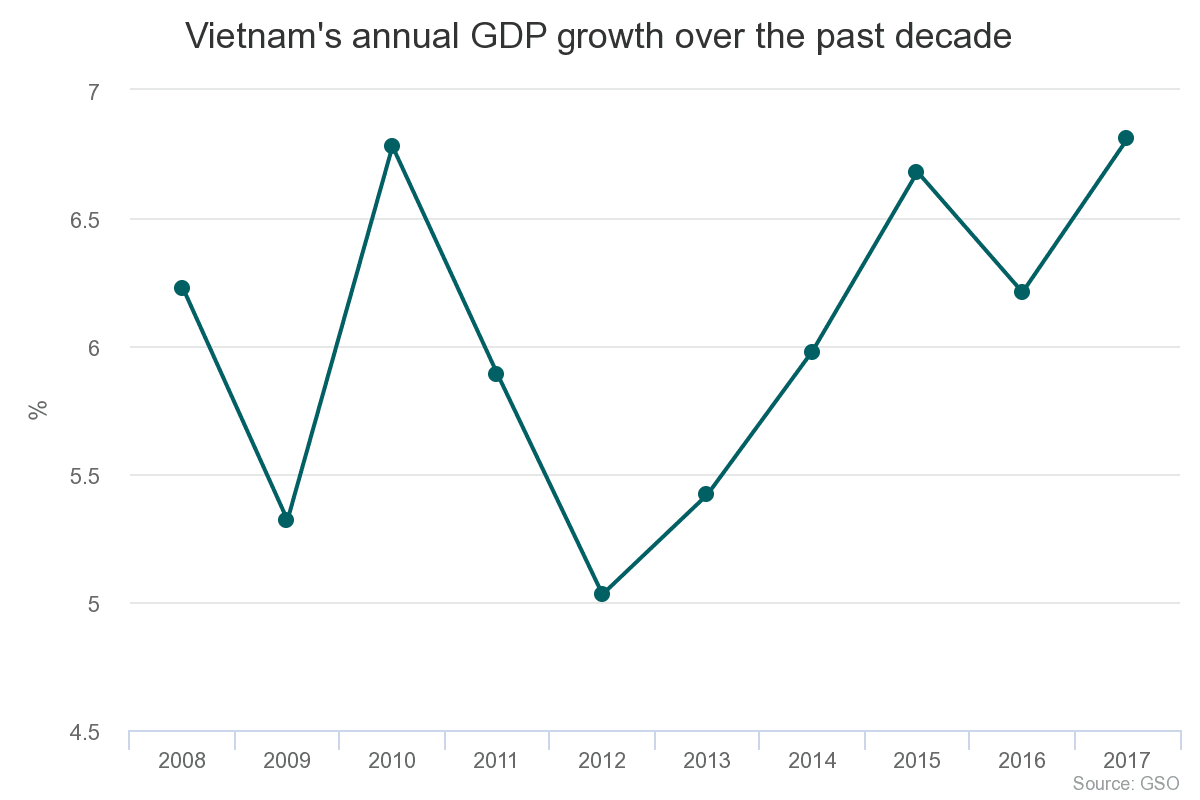
According to the General Statistics Office (GSO), Vietnam reached its highest economic growth in 10 years by expanding 6.81 percent in 2017, slightly higher than the target of 6.7 percent set by the legislative National Assembly.
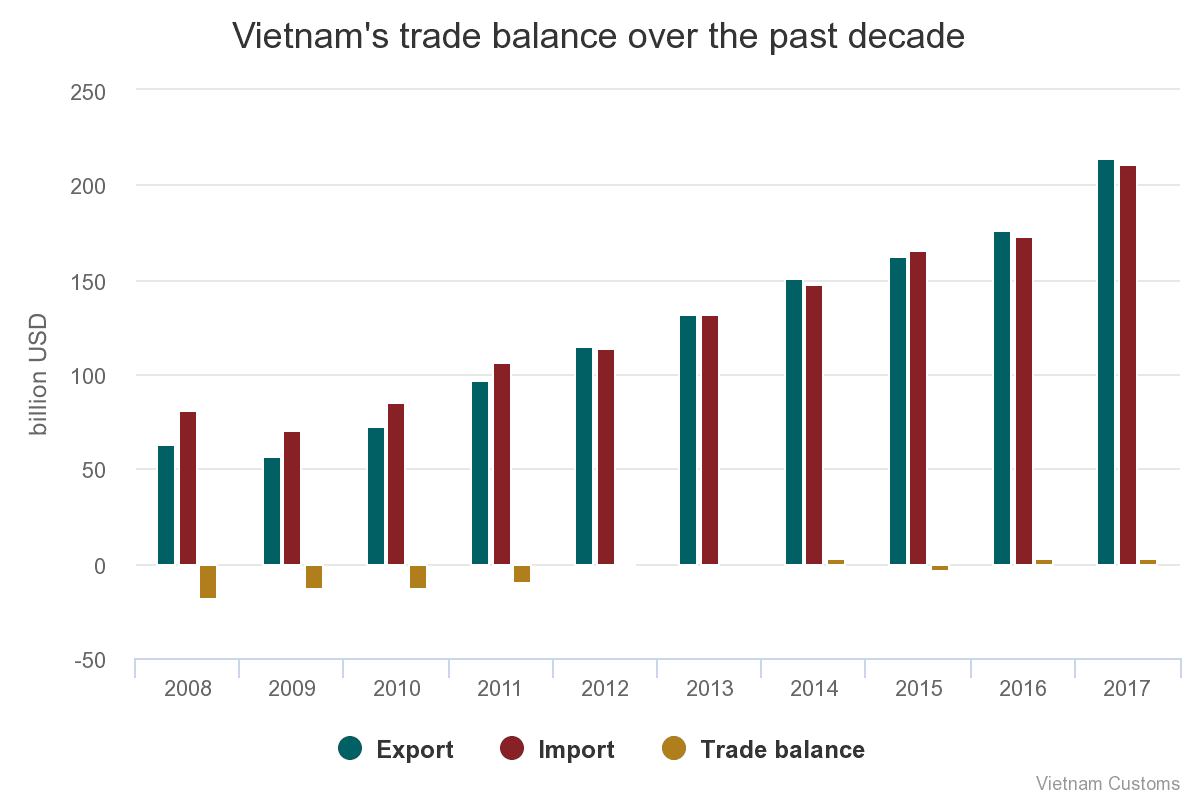
The country also posted its strongest export growth in the past five years, with revenue expanding by 21 percent against 2016 to $213.7 billion, data from the General Department of Vietnam Customs shows.
This has led to a trade surplus of $2.7 billion, the highest since 2008.
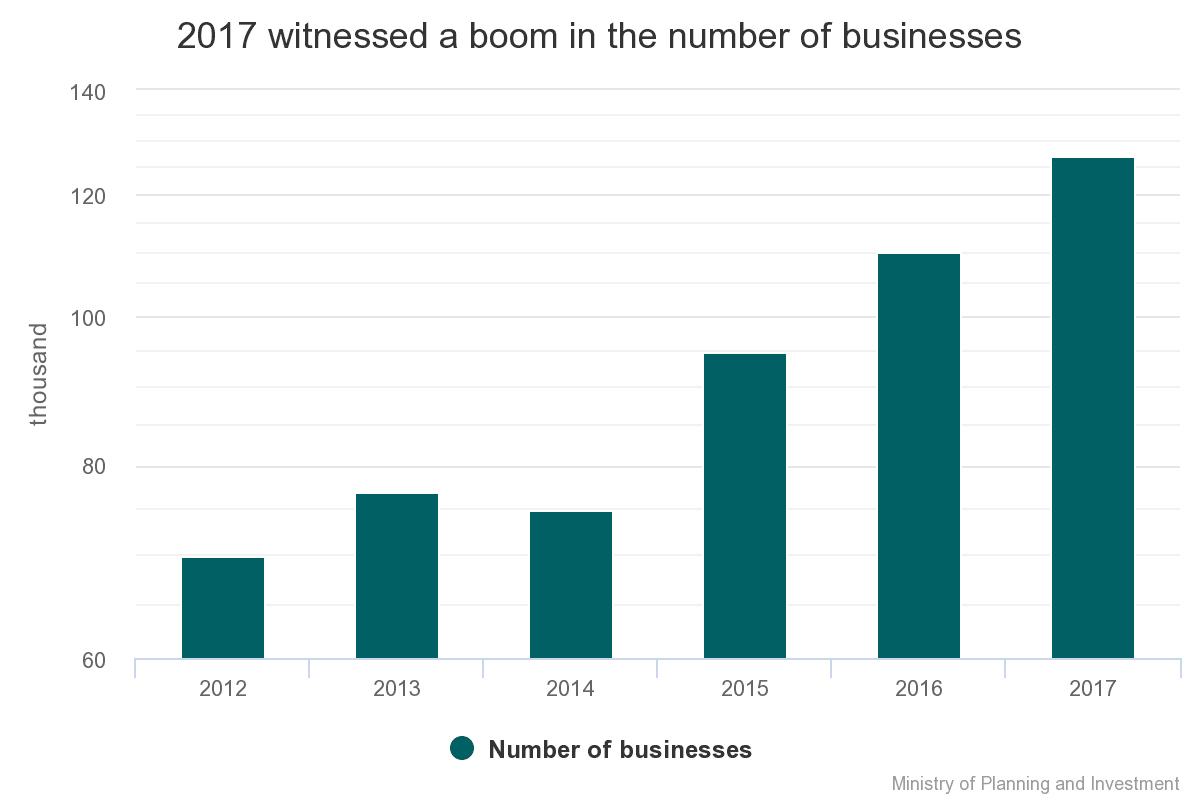
2017 also witnessed a boom in new businesses with the number of new companies hitting a record high of 127,000, well above the record of 110,000 firms set last year, said the GSO.
Vietnamese stocks hit a 10-year high this year, reaching 984.24 points at the last trading session of 2017 on Friday.
Ho Chi Minh City’s VN-Index has not broken the 800-point barrier since 2008.
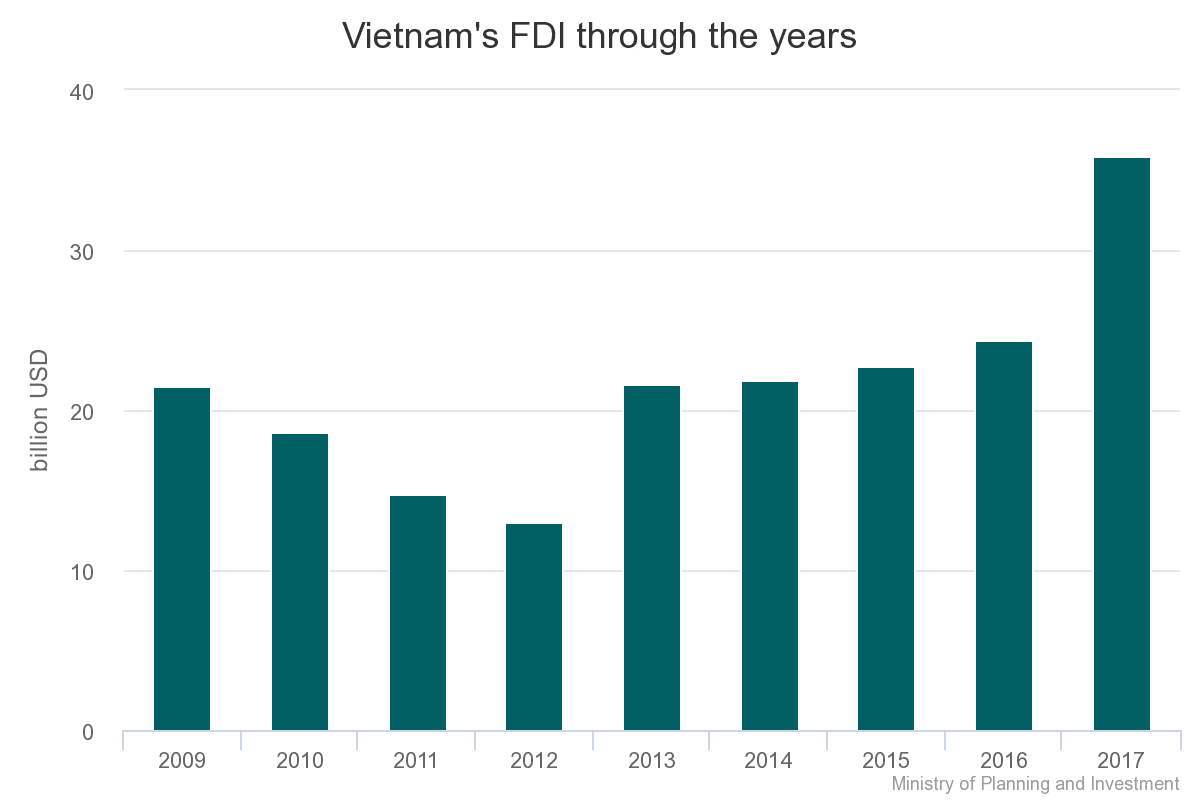
Another 10-year record that Vietnam achieved this year was foreign direct investment (FDI) inflow, standing at $35.88 billion, up 44 percent against 2016, according to the Ministry of Planning and Investment.
HCM City Real Estate Association has proposed the State Bank of Viet Nam should raise a stimulus package similar to its previous VND30 trillion (US$1.3 billion) preferential home loan package.
The package should aim to provide preferential loans for the purchase of affordable apartments, with prices of around VND1 billion per unit.
Since the VND30 trillion housing stimulus package ended in 2016, no similar packages were released, while demand remained high, the association said.
The association said a sum of VND1 trillion out of VND2 trillion, allocated to the Viet Nam Bank for Social Policies to support social housing projects, should be transferred to four credit institutions – Vietcombank, Vietinbank, Agribank and BIDV – to provide preferential loans for social housing purchases.
In addition, the State budget should spend some VND1-2 trillion annually in the 2018-20 period to provide loans for affordable home purchases at the preferential interest rate of 4.8 per cent per year.
The association also proposed mechanisms to be put in place to ensure the preferential lending package is used for the right purposes.
Further, preferential credits should also be provided to social housing developers to lower housing prices.
The VND30 trillion housing stimulus package was introduced in 2013 when the real estate market faced high inventories and bad debts after the 2008-09 freeze.
Some 70 per cent of the package was provided to home buyers at preferential interest rates. The package helped more than 56,000 low-income earners to own homes.
After a strong rally of 30 per cent in stock price over the past four months, Mobile World Group (ticker MWG) saw back-to-back divestments from numerous of foreign funds.
As confirmed by the Ho Chi Minh City Stock Exchange (HSX), CDH Electric Bee Limited recently registered to divest a total of 1.23 million shares through a negotiable instrument aiming at investment banking restructuring. The divestment transaction is scheduled for January 2-3, 2018, leaving roughly 1.24 million shares in CDH Electric Bee Limited’s hands, equivalent to 0.4 per cent of Mobile World’s charter capital.
Previously, on October 26, CDH Electric Bee earned more than VND62 billion ($2.7 million) from divesting a total of 479,630 shares.
In late July, CDH transferred two million MWG shares to member funds under the management of Dragon Capital, gaining around VND202 billion ($8.9 million).
Between October 12 and November 10, private equity fund Mekong Enterprise Fund II (MEF II) completed the divestment of three million MWG shares.
Additionally, on November 30, HSX announced that another foreign equity fund called PYN Elite Fund was no longer a major shareholder of Mobile World after selling 2.2 million shares.
On December 19, the Board of Directors (BOD) at Mobile World Group approved of the 2018 business plan, which would be presented at the annual general meeting (AGM) scheduled in March 2018. In particular, the consumer electronics retailer set the target revenue of VND86.39 trillion ($3.8 billion) and the target post-tax profit of VND2.6 trillion ($114.9 million), equivalent to respectively 36.5 and 18.3 per cent increases on-year.
However, the specific business plan for thegioididong.com, Dien May Xanh, and Bach Hoa Xanh, has not yet been unveiled.
Mobile World expects a hefty revenue of $3.8 billion in 2018 (Source: thegioididong.com)
Over the last four months, MWG’s stock showed a drastic upturn of 30 per cent in price, from VND102,000 to VND130,000 ($4.49-5.73) per share at the close on December 27.
To date, MWG was reported to achieve a total revenue of VND58.9 trillion ($2.5 billion) for eleven months of 2017, posting a whopping 124 per cent growth in the revenue gained from consumer electronics retail business and 14 per cent growth in revenue from the mobile phone retail business. Besides, after-tax profit was recorded at VND1.9 trillion ($87.8 million), up 38 per cent against 2016. Consequently, for eleven months of 2017, the firm accomplished 93 per cent of its revenue and 91 per cent of its profit target.
‘We know that some of you feel Apple has let you down,’ Apple said in a posting. ‘We apologize.’
Facing lawsuits and consumer outrage after it said it slowed older iPhones with flagging batteries, Apple Inc is slashing prices for battery replacements and will change its software to show users whether their phone battery is good.
In a posting on its website Thursday, Apple apologized over its handling of the battery issue and said it would make a number of changes for customers “to recognize their loyalty and to regain the trust of anyone who may have doubted Apple’s intentions.”
Apple made the move to address concerns about the quality and durability of its products at a time when it is charging $999 for its newest flagship model, the iPhone X.
The company said it would cut the price of an out-of-warranty battery replacement from $79 to $29 for an iPhone 6 or later, starting next month. The company also will update its iOS operating system to let users see whether their battery is in poor health and is affecting the phone’s performance.’
“We know that some of you feel Apple has let you down,” Apple said in its posting. “We apologize.”
On Dec. 20, Apple acknowledged that iPhone software has the effect of slowing down some phones with battery problems. Apple said the problem was that aging lithium batteries delivered power unevenly, which could cause iPhones to shutdown unexpectedly to protect the delicate circuits inside.
“We know that some of you feel Apple has let you down,” Apple said in its posting. “We apologize.”
On Dec. 20, Apple acknowledged that iPhone software has the effect of slowing down some phones with battery problems. Apple said the problem was that aging lithium batteries delivered power unevenly, which could cause iPhones to shutdown unexpectedly to protect the delicate circuits inside.
The annual ‘bikini’ calendar has gone viral online.
Vietnam’s VietJet Aviation said on Thursday it was standing by a controversial “bikini” calendar, a marketing ploy featuring scantily clad female models that has prompted criticism in conservative Southeast Asia and beyond.
The annual calendar, which has gone viral online, is part of a broader marketing push by VietJet that has propelled the start-up airline’s rapid growth, as it has taken market share from Vietnam Airlines.
The publication of the 2018 calendar – which critics say overly sexualizes the image of flight attendants and other airline staff – comes as there is a growing debate in the global airlines industry about sexual harassment and in-flight assault of both passengers and employees.
VietJet, founded by Nguyen Thi Phuong Thao – Vietnam’s first female billionaire and one of a handful of women running a major airline globally – said the calendar emphasized free choice of people to wear whatever they wanted.
“We are not upset when people associate us with the bikini image. If that makes people delighted and happy, then we’ll be happy,” Luu Duc Khanh, VietJet’s managing director, said in emailed comments to Reuters.
When asked about the views of Thao, Khanh said the CEO thought people “have the right to wear whatever they like, bikini or traditional ao dai”, referring to the traditional Vietnamese long dress.
Thao was unavailable for interview.
VietJet Air CEO Nguyen Thi Phuong Thao attends an interview in her office in Ho Chi Minh City, Vietnam, January 10, 2017. Photo by Reuters/Kham
Back in time
The calendar has caused an online storm in Vietnam, with some people criticizing and others defending the campaign. The 2018 calendar and a YouTube video of the photo shoot have been viewed more than 910,000 times since first appearing at the end of last month.
“I think (the calendar) is beautiful, not unpleasant at all,” one user posted on Facebook under the avatar Mai Co. Another person, named as Van Nhi, said the airline was “creating scandal to gain attention. It’s getting more unpleasant.”
Critics say VietJet’s risqué marketing, including the calendar and bikini fashion shows on board planes, presented an archaic and sexist image of cabin crew, even as the risk of harassment and assault go widely underreported.
VietJet is “taking us back 50 years by hyper-sexualizing a female dominated work group in order to make a few bucks off a couple of cheesy calendars,” said Heather Poole, a veteran U.S. flight attendant and author of a book about working the not-always-friendly skies.
“Women have to work so hard to be taken seriously, and in this case it’s a woman in charge taking us back to the days of ‘Coffee, Tea or Me?’,” she added, alluding to a 1960s book about two fictitious female flight attendants that emphasized their sexual appetite.
Khanh said Vietjet flight attendants have been trained to handle sexual harassment situations.
VietJet is not the first firm to use racy calendars to raise its profile. Italian tire maker Pirelli – known for its calendars of glamorous female models – has overhauled the annual offering in recent years with less of a focus on nudity.
Irish budget carrier Ryanair Holdings PLC in 2014 scrapped an annual charity calendar featuring female cabin crew posing in bikinis in favor of more family-friendly images.
Khanh, who said the proceeds from sales of the VietJet calendar go to charity, acknowledged that there could be big changes in the content for the next version.
“Male models is a good idea for us to introduce in our calendars next year,” he said.
Driving down sidewalks and promenades has become common practice for motorcyclists in the southern hub.
Sidewalks across Ho Chi Minh City are being continuously degraded by motorcyclists.
Driving down sidewalks and promenades has become common practice for motorcyclists in the southern hub, causing considerable damage to the walkways.
According to the observation of Tuoi Tre (Youth) newspaper reporters, sidewalks along many sections of Pham Van Dong Street in Thu Duc, Binh Thanh, and Go Vap Districts are in serious need of upgrades only four years after the road opened to traffic.
At the intersection of Phan Van Tri with Le Quang Dinh Streets in Binh Thanh District, countless sidewalk tiles along the streets are broken or separated from the ground, forcing pedestrians to navigate their way through uneven pathways and hidden traps.
Tiles on the promenade of Pasteur Street are broken into pieces. Photo: Tuoi Tre
Nguyen Thai Son Roundabout in Go Vap District and Cong Hoa and Truong Chinh Streets in Tan Binh District are, unfortunately, in a similar state.
To prevent injuries to pedestrians, local residents have filled many of the gaps with cement and placed broken sidewalk tiles against nearby trees, creating an eyesore for the neighborhood.
Sidewalks along major streets such as Nam Ky Khoi Nghia and Pasteur in District 1 and District 3, despite being paved with high-quality granite tiles, are also in a state of disrepair.
The problem is mainly attributed to the hundreds, if not thousands, of commuters who often ride their motorcycles on promenades, particularly near major intersections.
Rather than wait in long lines at traffic lights, many commuters traveling through busy intersections drive onto the sidewalk to cut the line and shorten their commute.
Broken tiles are gathered at a tree on a sidewalk in Ho Chi Minh City. Photo: Tuoi Tre
The situation is exacerbated during rush hours and other times when many of the city’s streets are prone to extreme congestion.
The presence of traffic police on heavily congested roads is no deterrence for sidewalk drivers.
As sidewalks are not designed to endure pressure from such a large number of motorbikes, the tiles break quite quickly.
According to Nguyen Tan Dat, a resident on Pham Van Dong Street, the damage to the sidewalk is caused mostly by inconsiderate motorcyclists.
Some shops and diners along the street let their customers park their motorbikes on the footpaths, which destroys the walkways, Dat added.
Uneven footpaths pose hidden threats for local residents. Photo: Tuoi Tre
Vo Khanh Hung, deputy director of the municipal Department of Transport, stated that sidewalks are managed by authorities of their corresponding districts.
Local businesses are typically permitted to use certain areas of the sidewalk, while the rest is meant to be used exclusively for pedestrians, Hung said.
However, some people choose to violate the regulations and occupy the entire promenades.
“The transport department has ordered a comprehensive inspection to deal with the issue,” the official continued.
According to the current law, those who ride their motorbikes on sidewalks shall be fined VND300,000 (US$13.22) to VND400,000 ($17.62).