Saigon welcomes its six millionth foreign visitor this year

Advertisements

Vietnam’s biggest city is on the right track to meet its annual target of receiving 6.3 million international tourists.

Saigon on Friday marked the arrival of its 6 millionth foreign visitor with pomp and circumstance as Vietnam’s biggest city is on the right track to meet the annual target of receiving 6.3 million international tourists this year.

Upon landing at Tan Son Nhat International Airport, Australian businessman David Michener was greeted with flowers and a Vietnam Airlines business class voucher from Bui Ta Hoang Vu, the director of the city’s tourism department.

Two other visitors on the flight that arrived right before and after Michener were also surprised with a Vietnam Airlines economic class voucher each at the welcoming ceremony.

Tuoi Tre (Youth) newspaper quoted Haisman Jamesrobin, who arrived right before Michener, as saying that this is his first time visiting the city and he would return to Vietnam.

Saigon, Vietnam’s biggest commercial center, is one of the most popular destinations in the country.

The city is expecting to receive a total of 6.3 million foreign visitors this year, a 23 percent increase from last year, according to the city’s tourism department.

Source: Staff Reporters

​Cars temporarily banned from Saigon River tunnel due to congestion

Advertisements

Ho Chi Minh City traffic authorities temporarily prohibited all four-wheel vehicles from traveling through the Saigon River tunnel during Wednesday’s morning rush hour.

Congestion at both entrances of the Thu Thiem Tunnel was caused by the growing number of vehicles dependent on the tunnel for their daily commute.

The Management Center of Saigon River Tunnel and local traffic police units limited use of the tunnel to two-wheel vehicles in order to solve the issue.

Similar measures are expected to be applied should the situation recur.

Specialized units will be posted around the clock at tollgates on both ends of the tunnel to control traffic if necessary, Le Minh Triet, director of the tunnel’s management center, said.

Traffic light timers at nearby intersections, namely Mai Chi Tho-Nguyen Co Thach and Vo Van Kiet-Ky Con, will also be adjusted to ease congestion, Triet added.

Traffic police officers will allow motorcyclists to travel in additional lanes if necessary in order to mitigate traffic buildup.

Gridlock mainly occurs at the Thu Thiem Tunnel during morning rush hours when large numbers of motorcycle riders use the tunnel for their daily commute, the director continued.

Traffic volume at the tunnel between September and November was recorded at 270,000 motorbikes per day, a year-on-year increase of 40,000.

The tunnel management center plans to ask the municipal Department of Transport to prohibit cars exiting the tunnel onto Vo Van Kiet Avenue from entering the mixed traffic lane between 6:00 am and 9:00 am, and 4:00 pm and 7:00 pm.

Between 5:00 pm and 7:00 pm, access to the tunnel from the Calmette Bridge off-ramp will be blocked to automobiles.

Carlsberg moves closer to Habeco deal in Vietnam

Advertisements

The Danish brewer is now a step towards its priority purchase rights with the Vietnamese goverment.

Danish brewer Carlsberg has edged closer to reaching an agreement with the Vietnamese government to increase its stake in Habeco, one of Vietnam’s biggest brewers, which it hopes will speed up the process.

Vietnam has one of the world’s most attractive beer markets and the biggest in Southeast Asia, buoyed by a young population that consumed nearly 4 billion liters last year. The government wants to fully divest its majority stake in Habeco and also in rival Sabeco.

Carlsberg, which already owns 17.3 percent of shares in Habeco, has been discussing its priority purchase rights with the Vietnamese government for years.

“Carlsberg, the Vietnamese government and Habeco have reached a common understanding on a number of issues during the negotiations, and we expect this will accelerate the process,” a Carlsberg spokesman said.

Most recently, Carlsberg has acknowledged its long-term obligations in Vietnam with regards to Habeco and the oldest beer brand in Hanoi, he said without elaborating.

The government said last month it expects a stake sale in Habeco to be completed in the first quarter of 2018.

The government is pushing ahead with a privatization process against the backdrop of a rally in Vietnam’s broader equity market.

Source:  Reuters/Jacob Gronholt-Pedersen

Vietnamese taxi drivers cut fares to lure airport customers back from Uber, Grab

Advertisements

Airport fares used to be a major source of income for drivers, but now that’s a thing of the past.

Taxi drivers in Vietnam are trying to win back airport passengers from the hands of foreign ride-hailing firms Uber and Grab by lowering fares and sending spam messages to let customers know about the latest promotions.

Airport customers used to be a major source of income for many taxi drivers, but that story has changed dramatically since U.S.-based Uber and Malaysia-based Grab made landfall in Vietnam in 2014.

Hoa, a driver who drives a traditional taxi in Ho Chi Minh City, said he used to earn up to VND250,000 ($11) per day from carrying passengers to Tan Son Nhat International Airport, but that revenue has dropped to under VND150,000.

“Customers only use traditional taxi firms during bad weather now because that’s when Uber and Grab double or even triple their fares,” he said.

In an effort to help them back on track, Hoa and his fellow drivers have decided to stop sitting back and waiting for bookings.

Thanh, a local in HCMC’s District 10, said he received spam messages from taxi drivers almost every day and the fares they advertised were much lower than before.

The same method has been applied in Da Nang, Hanoi and Nha Trang with discounts of around 30 percent offered by drivers willing to make less of a profit.

But it looks like Uber and Grab still have all the answers.

Hoa from HCMC’s District 5 said she used to pay VND200,000 for a traditional taxi to travel 12 kilometers (7.5 miles) from her place to Tan Son Nhat, but then Uber and Grab arrived offering a fare of only VND150,000.

For more than a month now, Uber and Grab fares have been lowered even further, and promotions mean that Hoa pays less than VND100,000 sometimes.

Nam, an Uber driver in the city, explained that discounts on routes to the airport follow an increase in the number of drivers.

We can make a good living working for Uber thanks to the company’s bonus policy, he said.

Uber drivers are awarded at least VND500,000 per week if they complete more rides than their allocated quota.

“A hardworking driver can easily earn several million dong in bonuses per month,” Nam said.

Ta Long Hy, chairman of the HCMC Taxi Association and vice chief executive officer of taxi giant Vinasun, said that lowering fares in order to compete is not a sustainable solution, and it may lead to losses for their companies.

Commenting on Uber and Grab, he said if the two foreign firms continue to offer lower fares than market prices, traditional firms will gradually disappear.

“If that happens we will become completely reliant on foreign ride-hailing firms, and it is the customers who will suffer because those firms will be able to charge whatever they want,” he said.

As for Vinasun, Hy said the volume of airport passengers his firm carries has fallen 20-30 percent, but “it’s not worrying”.

We will improve service quality and reconsider fares to make them competitive and reasonable, said Hy.

Currently, 39 traditional taxi firms are operating in HCMC and there are 50 in Hanoi.

Source: Hong Chau

Monthly salaries in Vietnam rise fastest in Southeast Asia: survey

Advertisements

The growth is expected to continue as recruitment demand rises.

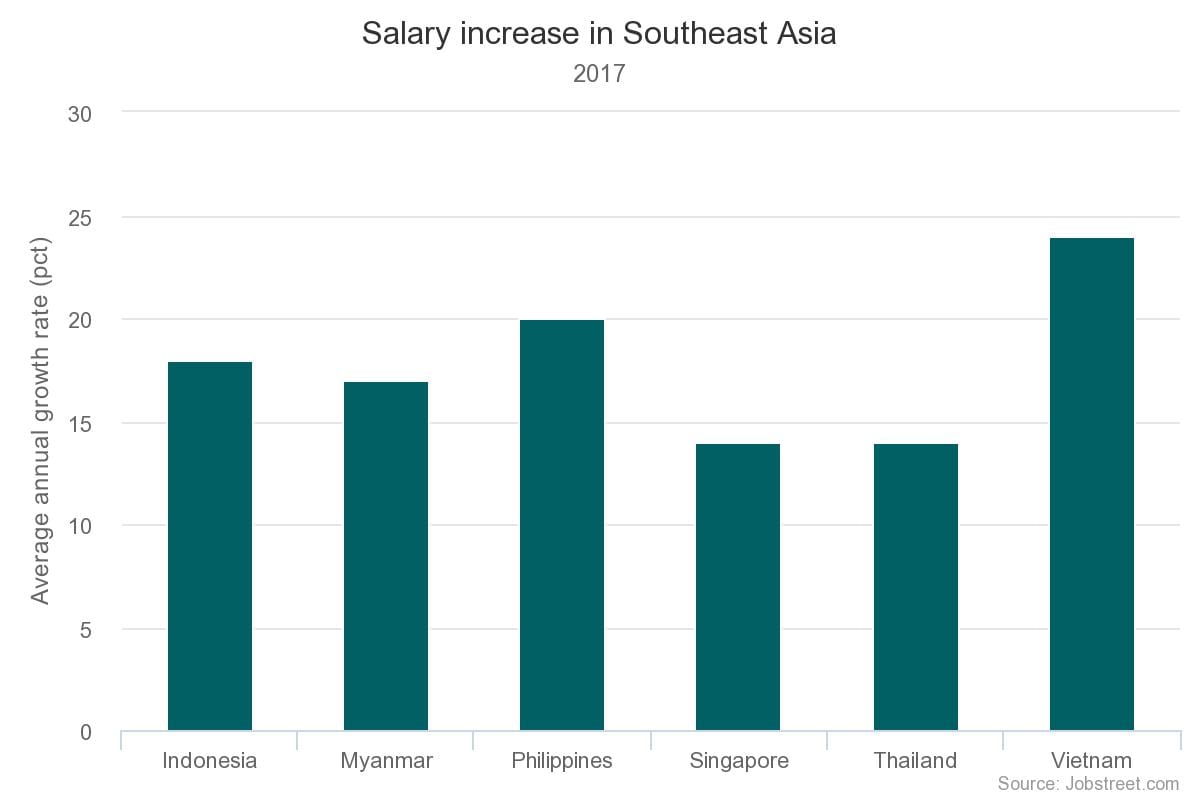
Salaries in Vietnam are rising faster than in any other Southeast Asian country, according to a recent survey released by employment website Jobstreet.com.

The average annual growth rate of Vietnam’s payroll stands at 20-24 percent, compared to 14-20 percent in Thailand, the Philippines, Indonesia, Myanmar and Singapore.

In Vietnam, management and executive salaries grew fastest, at 26 and 35 percent respectively.

The survey found that 68 percent of companies operating in Vietnam want to expand their businesses in the future, so they have high recruitment demands. Jobstreet forecast that salary growth will continue with this demand.

Vietnam’s minimum wage, however, doesn’t enjoy such a large jump. On Monday, the prime minister signed off on a decree raising the minimum wage for 2018 by 6.5 percent, the lowest nominal bump in 11 years.

The rise brings the minimum wage for Region I to VND3.98 million ($175) a month. Region II to VND3.53 million, Region III to VND3.09 million and Region IV to VND2.76 million.

In Vietnam, there are four different minimum wage regions, which are supposed to reflect the cost of living in each area. Region I, including Hanoi and Ho Chi Minh City, has the highest minimum wage, while region IV, which is for rural areas, has the lowest.

Source: Minh Nga

HCMC scraps proposed ban on jeans in public offices following opposition

Advertisements

The megacity has reconsidered the proposal after some people called it ‘rigid’ and ‘silly.’

Ho Chi Minh City has announced it will not be banning public servants from wearing jeans and T-shirts in the workplace following backlash at the proposal.

The city’s government said that the idea of a no-jeans office had received divided opinions, local media reported late on Wednesday.

In October, the city’s Department of Home Affairs proposed the ban on jeans and T-shirts as part of an etiquette code for public servants. The proposal was made a month after the same ban took effect in the southern city of Can Tho, the country’s fifth largest after Hanoi, HCMC, Da Nang and Hai Phong.

The code requires public servants to be polite and respectful at work, in their neighborhoods and in public places.

Although some people agreed that public offices should be a place for smart uniforms, others said jeans and T-shirts have become so common that saying they are not smart enough is not a convincing argument.

Some people called the proposed ban “rigid” and “silly”.

They said they support clothes that make workers feel active and comfortable providing they have a good attitude when dealing with the public.

HCMC is set to launch its etiquette code by December 25.

Source: Staff Reporters

Vietnam set to kick off Lunar New Year break on Valentine’s Day

Advertisements

The government’s preferred option would have the 7-day holiday start on February 14.

Vietnam’s Government Office on Thursday announced the government is favoring a proposal that would have the upcoming Lunar New Year (Tet) break start two days before New Year’s Day, which falls on February 16, 2018.

“The holiday would start on [December] 29 and people would go to work from [January] 6,” said Mai Tien Dung, Minister, Chief of Office of the Government Office, referring to the dates in the lunar calendar. The holiday would accordingly be from February 14-20.

“We should not have a short break so public servants can visit their hometown, family, relatives and friends, but the break should not be too long either,” Dung said.

This option is the first of the two 7-day options proposed by the labor ministry in September. Under the second option, the holiday will start on February 15, a day before Tet, and run until February 21, the sixth day of the New Year.

Schools and other businesses across the country usually follow the same break as government offices.

The government approved a seven-day break last year.

Tet is a time for family reunions in Vietnam with droves of migrant workers flocking home before Lunar New Year’s Eve.

The labor ministry has also submitted plans for other public holidays in 2018.

Accordingly, employees will have a total of 18 public holidays in 2018, including three days for New Year (December 30, 2017 to January 1, 2018), one day for the Hung Kings’ Festival (April 25), four days for Reunification Day and Labor Day (April 28 to May 1), and three days for Independence Day (September 1-3).

Source: Hoang Thuy

Saigon Beer Draws Thai Bidder — WSJ

Advertisements

SINGAPORE — One of Thailand’s richest tycoons is looking to buy a quarter of Vietnam’s largest beer maker in a deal worth at least $2.25 billion, making his company the sole bidder wanting to buy a substantial stake.

If successful, it would be one of the largest foreign investments in the Asian frontier market and could boost foreign investor confidence in the communist government’s reforms planned for its state-owned enterprises.

Vietnam Beverage Co., a unit of Singapore-listed Thai Beverage PCL, has submitted a bid to acquire at least a 25% stake in state-owned Saigon Beer Alcohol Beverage Corp., known as Sabeco, according to a statement from Vietnam’s Ministry of Industry and Trade on Tuesday.

In its statement, the ministry said that, as of Monday, Vietnam Beverage was the “one investor registered” to buy a large volume for Sabeco’s share.

Thai Bev is owned by billionaire Charoen Sirivadhanabhakdi. The tycoon has been on an acquisition spree in recent years, buying stakes in companies from hypermarkets to milk producers.

By P.R. Venkat, http://www.foxbusiness.com/features/2017/12/13/saigon-beer-draws-thai-bidder-wsj.html

Vietnamese resorts win top prizes at World Travel Awards 2017

Advertisements

Two Sun Group resorts were honored at the 24th World Travel Awards (WTA) 2017 in Phu Quoc Island on December 10.

Two resorts in Vietnam’s popular beach destinations Da Nang and Phu Quoc won top prizes at the 24th World Travel Awards on Sunday as voted for by experts and executives in the resort and hospitality field from more than 140 countries and territories.

In Phu Quoc Island, the JW Marriott Phu Quoc Emerald Bay Resort won the World’s Leading New Resort 2017.

Its Chanterelle – Spa also won the World’s Best New Resort Spa 2017 award.

Up north in Da Nang, the InterContinental Da Nang Sun Peninsula Resort in the namesake central resort town set an unprecedented record in the history of the World Travel Awards (WTA) by being honored as the World’s Leading Luxury Resort for the fourth consecutive time.

The Da Nang resort beat more than 30 outstanding nominees to claim the award, including Four Seasons Resort Dubai at Jumeirah Beach, Ritz Carlton Laguna Niguel and Ayada Maldives. The number of contestants in the category was nearly three times higher than last year, making the victory a resounding success.

Its La Maison 1888 Restaurant also received the World’s Leading Fine Dining Hotel Restaurant award and its Harnn Heritage Spa was crowned Asia’s Best Resort Spa 2017 and Vietnam’s Best Resort Spa 2017.

Graham Cooke, WTA president and founder, said that honoring a resort as the world’s most luxurious for fourth consecutive year is unprecedented event in the history of the WTA’s 24 years.

The InterContinental Da Nang Sun Peninsula Resort has set a record that is unlikely to ever be broken, even in the years to come, he said.

Dang Minh Truong, Vice Chairman of the Board of Directors cum General Director of Sun Group, expressed his pride at winnning the top two awards – considered the “Oscars” of the global travel industry. He added the awards would inspire Sun Group to continue to create high-class buildings that contribute to the development of Vietnam’s tourism industry.

Sitting on Son Tra Peninsula, the InterContinental Da Nang Sun Peninsula Resort was designed by world famous architect Bill Bensley with 200 rooms featuring typical Vietnamese architectural and cultural values. The resort hosted the 2017 APEC Economic Leaders’ Week last November.

The JW Marriott Phu Quoc Emerald Bay Resort, which opened in January 2017 on Vietnam’s biggest island, is another Bensley design, inspired by the legend of a fictional former university for French colonists – Lamarck University, with 240 rooms and villas, as well as interior decorations arranged as a miniature museum of more than 5,000 antiques that Bensley collected from 40 European countries.

The World Travel Awards is held every year and considered the most prestigious, comprehensive and sought after awards program in the global travel and tourism industry.

Source: Staff Reporters

World Bank raises Vietnam’s growth forecast for 2017

Advertisements

Stronger domestic demand and robust export-oriented manufacturing are driving Vietnam’s economy.

The World Bank (WB) has increased its growth forecast for Vietnam this year from the 6.3 percent it projected in October to 6.7 percent, matching the government’s annual target following steady progress during the first nine months.

Stronger domestic demand, robust export-oriented manufacturing and a gradual recovery of the agricultural sector are driving Vietnam’s economy, according to Taking Stock, the World Bank’s bi-annual economic report released on Monday.

The manufacturing and services sectors respectively grew by 12.8 percent and 7.3 percent between January and September, the report said.

“Growth momentum picked up across major economies and global trade recovered in 2017,” said Ousmane Dione, World Bank Country Director for Vietnam. “With incomes rising and poverty falling, Vietnam’s economy had another good year of strong growth and broad macroeconomic stability.”

Vietnam expects economic growth of 6.5-6.7 percent next year, and thinks that the target of 6.7 percent set for this year is within reach, Prime Minister Nguyen Xuan Phuc said at a recent session of the legislative National Assembly.

Low inflation and rising wages sustained buoyant domestic demand and private consumption, while the stronger global economy has helped Vietnam’s export-oriented manufacturing and agricultural sectors.

Job growth has continued, with 1.6 million new jobs added in the manufacturing sector over the past three years, and 700,000 additional jobs in the construction, retail, and hospitality sectors, leading to higher aggregate labor productivity.

Despite progress in resolving non-performing loans, risks remain, including the lack of robust capital buffers in some banks, especially amidst rapid credit growth.

Fiscal tightening is underway, according to the report, and has led to a leaner budget deficit and containment of public debt accumulation. However, the decline in public investment – falling to 16 percent of total spending in the first nine months of 2017 compared with an average of 25 percent in recent years – may not be sustainable over time, as Vietnam needs significant investment in infrastructure to support future growth.

A slow-down in structural reforms could also impact the ongoing recovery, especially given the weaker growth in investment. Enhancing macroeconomic resilience and structural reforms could lift Vietnam’s growth potential over the medium term.

“Structural reform remains a central priority in view of tepid productivity growth,” said Sebastian Eckardt, the World Bank Lead Economist for Vietnam.

“Building on progress already made, Vietnam can further lift productivity growth through investments in needed infrastructure and skills as well as deeper reforms of the business environment, state-owned enterprise (SOE) and banking sector.”

Over the medium term, growth is projected to stabilize at around 6.5 percent, while inflation is projected to remain low.

Source: Ngan Anh

Thai Beverage unit to bid for at least 25 percent of Vietnam’s Sabeco

Advertisements

The auction of up to 54 percent of Sabeco worth at least $5 billion is set for December 18.

A unit of Thai Beverage (TBEV.SI) has emerged as the only prospective bidder for state-owned shares in Sabeco (SAB.HM) that has declared that it could lead to it owning 25 percent or more of Vietnam’s biggest brewer, the Trade Ministry said on Monday.

The auction of up to 54 percent of Sabeco worth at least $5 billion, in what is set to be Vietnam’s biggest privatization, offers brewers access to a fast-growing market with a youthful population and beer drinking culture.

Investors who want shares that would lead to an ownership of 25 percent or more in Sabeco have to inform the local authorities and publicize the information a week before the auction date, which is set for December 18, according to the rules of the offer.

Other brewing groups including Anheuser-Busch InBev and Kirin Holdings have been preparing to bid for a stake, people familiar with the matter have said.

But the trade ministry said in a statement on its website that as of 1100 GMT on Monday the one prospective investor which has registered an interest in buying 25 percent or more of Sabeco that has publicized the information is Vietnam Beverage Company Limited.

Vietnam Beverage Company Limited is owned by Vietnam F&B Alliance Investment Company, which is 49-percent owned by BeerCo Limited, an indirect but wholly-owned subsidiary of Thai Beverage, official documents about the companies showed.

Foreign ownership in Sabeco is limited to 49 percent. That means overseas bidders can only bid for a minority stake of as much as 39 percent as foreign entities already own 10 percent.

Lack of control and the unorthodox way in which the Sabeco stake is being sold could put off some possible bidders, bankers, investors and lawyers familiar with the matter said.

The Vietnam trade ministry, which represents state shares in Sabeco, said foreign investors can link up with Vietnamese firms to buy shares in Sabeco, but have to comply with local laws and regulations.

Source: Reuters

Vietnam fuel distributors to shift to ethanol blend this week

Advertisements

The country has been pushing for the E5 mixture as ethanol can be produced from cassava, making it renewable.

Vietnam’s biggest fuel distributors said they would complete a shift to an ethanol-blended product by Friday as part of a government program to promote a more eco-friendly fuel.

State-owned PetroVietnam Oil Corp (PV Oil), which sells oil and fuels, will replace RON 92 fuel at all of its fuel stations with E5, a mixture of 95 percent of RON 92 and 5 percent of ethanol, by December 15, its parent firm PetroVietnam said on its website on Monday.

Top fuel importer and distributor Petrolimex said on its website last week that its 2,400 stations across the country would have shifted to the ethanol-blended fuel by the end of this week.

Vietnam has been pushing for the E5 mixture as ethanol can be produced from cassava, making it renewable. Several factories have been set up specifically to process cassava into ethanol.

But critics and drivers argue the mixture could cause fire or damage vehicles’ engines and parts. The government has said the mixture is safe, adding that drivers should use vehicles from a certain year of production, depending on the model, to ensure they are safe.

Another type of non-ethanol fuel, RON 95, is still on sale, but in smaller volumes.

Vietnam plans to complete the shift to the E5 mixer across all fuel stations by January 1 next year.

Source: Reuters

100 percent of meat samples in Saigon, southern neighbors infected with E. coli: study

Advertisements

150 duck, chicken and pork samples contained levels of the dangerous bacterium beyond the national safety limits.

Sweeping food hygiene tests in Saigon and four neighboring provinces revealed that all the samples of meat taken contained excessive amounts of the highly dangerous bacterium E. coli.

The research team took 150 duck, chicken and pork samples as well as 147 samples of bivalvia mollusks including clams and oysters from markets in the city and its neighbors Ba Ria-Vung Vau, Binh Duong, Binh Phuoc and Dong Nai between April and August this year.

They found the E. coli levels exceeded the national safety limit in all the meat samples and 64 percent of the clam samples.

The team from the Pasteur Institute in Saigon revealed the results at a recent conference, saying the tests demonstrate a massive threat from fresh and raw food sold at wet markets in the region.

They suggested that the whole supply chain from the slaughterhouses to the processors and vendors has poor hygiene protocols, and that authorities need to enhance surveillance of these practices.

Consumers are advised to cook their food thoroughly to reduce the risk of infection, they said.

E. coli is a rod-shaped, coliform bacterium of the genus Escherichia that is commonly found in the lower intestine of warm-blooded organisms. Most E. coli strains are harmless, but virulent strains can cause serious food poisoning, urinary tract infections, neonatal meningitis or hemorrhagic colitis.

Food safety is a national concern in Vietnam.

Official government data showed food poisoning killed 22 people and hospitalized 3,147 others in the first 11 months this year, almost twice the figure from a year ago.

Source: Staff Reporters

Karaoke sessions crank up the volume and tensions in Saigon’s neighborhoods

Advertisements

When the love and passion for music goes wrong, karaoke at max volume can become an instrument of torture.

VnExpress received a letter on Tuesday from a man at his wit’s end over a karaoke dispute with his neighbor that has led to his wife being threatened for asking for the volume to be turned down a notch or two.

“My child has to study while my wife and I need to rest after we finish work,” Le Thanh Tung wrote in his letter, “but our neighbors have been singing on the microphone from 6 to 10 every night for more than a year now.”

“We just can’t stand the noise any longer.”

His wife asked the neighbors to turn the volume down, but that led to threats of violence, with the neighbors arguing that they can sing however they want before 10 p.m.

On Monday, Son Huynh, another reader, related to a similar story of how his neighbors’ karaoke sessions are “torturing” his family.

It turns out that the two men are not the only ones suffering from the problem in Saigon, Vietnam’s biggest city now packed with 6,200 people per square kilometer.

Fair enough, many people love music and singing their favorite songs, and it’s true that listening to a good voice at a reasonable level can be a treat. But when the love and passion for music goes wrong, karaoke at max volume can become an instrument of torture.

Commenting on these stories, many VnExpress readers said they have experienced the same kind of “noise pollution” created by karaoke sessions around their apartments for years, but still have no solutions to the situation because the law says only those making noise in residential areas after 10 p.m. are considered to be violating regulations.

Lots of readers said there is no way the miserable listeners will be able to convince their neighbors to stop the show or turn down the volume, so they suggested the two authors fight back with louder speakers. Some said the method has already worked for them, and their neighbors had given up when the decibels were ramped up.

This solution received applause from many readers, who said it might be the best choice because it’s difficult to get the authorities involved.

Thanh Hung said he realized the local authorities would not help him when they told him to either move or try to endure the noise. Hung said when he tried to report the matter to higher authorities, officials in his commune even disciplined him for damaging their reputation.

They did ask his neighbors to turn the music down, but the peace was short-lived and life returned to normal in the neighborhood after just three weeks, according to Hung.

Just last weekend, a big fight broke out after a man asked a group of workers near his home in the city’s Binh Tan District to turn down their karaoke speakers.

The argument quickly escalated and both men and women attacked one another with weapons, causing serious injuries on both sides.

The bloody aftermath of the fight has set alarm bells ringing among people who love to entertain themselves at the expense of their neighbors.

In Vietnam, noise pollution has become a serious threat.

A study conducted by the Institute of Occupational Health and the Environment in July found that out of the 52 million people working in Vietnam, between 10 million to 15 million have to deal with excessive noise.

Noise levels on 12 major streets and junctions in Hanoi were measured at between 77.8 and 78.1 decibels during the day, way beyond the safe level of 70, according to the study. The average noise level at night also exceeded limits by 20-40 percent, it said.

In HCMC, eight out of 14 spots also violated acceptable levels, according to measurements recorded in June.

The problem is even worse in industrial zones, officials said.

Doan Ngoc Hai, the director of the institute, said that noise pollution can have long-term impacts, such as loss of hearing. It can also lead to sleeping disorders and high blood pressure, while children can suffer cognitive impairment, he said.

Source: Minh Nga

Are young, urban Vietnamese spending too much?

Advertisements

Vietnamese Generation Z grew up during an economic boom, does it justify their ‘urge to splurge’?

Young Vietnamese, especially those born from the mid-1990s, or Generation Z, prefer to spend rather than save, unlike their older generations who are known to be thrifty.

A recent poll of 16,000 respondents in Vietnam’s three biggest cities – Hanoi, Da Nang and Ho Chi Minh City – by Decision Lab showed that Vietnam’s Generation Z, which accounts for 15 percent of a population of roughly 93 million, spend on average VND890,000 ($40) a month eating out.

The HCMC-based market research firm said 56 percent of respondents earned no money or made less than VND3 million ($132) per month, and only 35 percent of them made between VND3 million and VND7.5 million a month.

Fast food restaurants were the most frequented diners, making up 25 percent of the venues of choice, followed by roadside restaurants with 18 percent and convenience stores with 17 percent.

Bubble tea is the queen of drinks, compared to coffee and alcoholic drinks that were preferred by older generations.

In a recent interview with VnExpress International, a group of four 19-year olds who meet up everyday in cafés defended their lifestyle, saying in Hanoi where public spaces are scarce, it’s the best way to maintain their friendship, which is “invaluable.”

One member of the group, Trung Hieu, put it bluntly: “I don’t think bubble tea is expensive. I only need to work for two hours to pay for it.”

The older generations see it differently. To them, it’s wasteful because a cup of bubble tea costs VND50,000-60,000, twice that of a typical office lunch.

Such contrast in perspectives could be explained by differences in the economic and social contexts of their upbringing.

Those born from the late 1970s to the early 1990s, grew up in a transitionary period when traditional Confucian values still largely shaped lifestyles and moral standards. These were tough times economically and belt-tightening was part of life, even a worthy “trait”. This generation was also the first to access the internet and western cultures and ideals.

But those born from the mid 1990s onward have welcomed a strong cultural wave that carried the concepts of freedom, individuality and right to indulge along with an economic boom.

The “bubble tea” generation “feel they are part of this booming wealth, more so than in the earlier days of austerity,” said Phan Tuong Yen, a psychologist at Hoa Sen University in Ho Chi Minh City. “Therefore, the notion of freedom between these two generations somewhat differs, and so does the concept of cautious spending.”

Also, psychologist say teenagers and twenty-somethings have always wanted to prove themselves through talent, character or social status.

“A decade ago, hip hop, Converse shoes and smartphones were considered cool,” said Yen. “Today, it’s the experience you get from fancy services.”

But is Generation Z crossing the line of what is acceptable level of spending? Are they taking sufficient responsibility over how they spend their money?

Let us know by casting your vote and leaving a comment.

Source: Editorial

Exit mobile version