There are a lot of fun things to do during the Christmas season that don’t cost a lot. Here are six fun things to do during the Christmas season:
Go to a local parade – Most local communities have a Christmas parade during the month of December that’s free to attend and watch. You can usually watch from the comfort of home on your TV as well.
DIY Christmas light tour – Drive around while taking in all the lights and decorations you see outside. If you know the location of houses that are highly decorated make a list and visit each one.
Watch your favorite Christmas movie and make hot cocoa – There are so many Christmas movies to choose from, including classics like “A Christmas Story”, “How the Grinch Stole Christmas”, “A Miracle on 34th Street”, “National Lampoons Christmas Vacation”, “Rudolph the Red-Nosed Reindeer”, and “Home Alone”. Pick from all of your favorite Christmas movies to watch and make some hot cocoa.
Make a gingerbread house, a dough ornament, cookies, or a holiday craft – There are a lot of options to choose from here as well. Get together with family or friends and bake cookies, make a gingerbread house and ornaments with your children, or pick another holiday craft to make. You could try making a homemade gift for your spouse, children, friends, or neighbors.
Participate in Angel Tree, Operation Christmas Child, or volunteer your time – Participate in the Angel Tree program with your family to help another family and provide gifts for them. Participate in Operation Christmas Child, which provides gifts to children all over the world. If you would rather donate your time then volunteer at a local soup kitchen, homeless shelter, food bank, or other organization that needs help during the holiday season.
Visit a living nativity or Christmas play at a church – Visit a living nativity or a Christmas play at a local church. Many churches offer nativities, plays, and other activities during the Christmas season.
Bonus ideas: Listen to Christmas music while decorating your Christmas tree, sing Christmas carols, make a Christmas card for a soldier, get family pictures taken.
A Vietnamese affiliate of Thai Beverage has bought 53 per cent of Sabeco in today’s auction, together with a Vietnamese individual who owns another 0.003 per cent of Vietnam’s leading brewery.
The highly anticipated stake sale of Sabeco, commonly known as Saigon Beer, has taken place this afternoon with only two participating investors, both of whom went home with shares in their pockets.
The first winner is Vietnam Beverage Company Limited, a Vietnam-incorporated unit of Thai Beverage. The investor bought 343 million shares, or 53.58 per cent, at VND320,000 ($14.09) apiece. This means Vietnam Beverage spent VND109 trillion ($4.9 billion) for a controlling stake at Sabeco.
The second buyer in the auction is Ngo Vinh Hien, a Vietnamese individual from Hanoi. Hien owns 0.003 per cent of Sabeco, after spending VND6.4 billion ($281,600) for 20,000 shares.
Speaking to the media, Hien denied having any relationships with Thai Beverage. The investor said he joined in the sale of his own accord.
“I made a bid in this auction because it was difficult to buy Sabeco’s shares on the public market, and I believe in the growth potential of Vietnam’s largest beer firm,” said Hien.
The Vietnamese Ministry of Industry and Trade (MoIT), the seller in this auction, told the media that Sabeco’s general meeting will decide the number of people that Thai Beverage can nominate to sit on its management board.
MoIT, who still has 36 per cent of the stakes at Sabeco after the sale, also refused to say whether it has any concrete plans for further divestments.
In a note prior to the auction, analyst Soh Lin Sin from Phillip Securities (Singapore) said that the purchase is in line with Thai Beverage’s goal to boost its presence in the ASEAN market. The Thai beer giant recently forked out $742 million to take over two leading beer brands in Myanmar.
The shares of Sabeco on the stock exchange closed at VND309,200 ($13.6) today.
Mu Cang Chai, a rural town in the northern province of Yen Bai lined with mesmerizing terraced rice fields, has been named one of the 19 most picturesque peaks on earth by US travel site Insider.
Also on the list are Japan’s Mount Fuji, Peru’s Rainbow Mountain, Iceland’s Kirkjufell Mountain, which was used to shoot “Game of Thrones”, the world’s longest continental mountain range, the Andes in Bolivia, Europe’s largest mountain chain, the Alps, and the active volcano Mount Rainier in Washington State in the US.
Mu Cang Chai was called “a hidden gem” by Insider, where “terraced rice fields are a shade of green so deep you’ll feel like you’ve stepped into a painting.”
Depending on the month, the fields’ colors can vary from emerald green to golden yellow to light brown.
Mu Cang Chai is around a seven-hour drive northwest of Hanoi. It sits at 1,000 meters (3,300 feet) above sea level at the foot of the Hoang Lien Son Mountain Range. People from the H’Mong ethnic minority group began carving rice terraces into the mountain range centuries ago and are still harvesting them today.
It resembles a picture from nature, with seasonally-changing colors showing its charm when the new crop begins, green rice grows, and yellow rice ripens.
In April and May, when local people water their fields to prepare for a new crop, the surface of the terraced rice fields shine like a mirror, reflecting the contrast of the reddish brown of soil, the deep blue of the sky, and the green of the surrounding forests. Embankments surrounding the terraces look like threads softly lined by nature.
In June and July, the fields, with fully-grown paddy rice, and forests blanket the entire area with green, from the foot of the mountains to the peak, where it disappears into the mist. The green of the paddy rice grown on the fields may make visitors think of them as a hand-made creation of uniqueness that cannot be found anywhere else.
Visiting Mu Cang Chai in September and October, when autumn ends, visitors will see prosperity all over the area, as the rice ripens and turns a shade of gold. At this time, the terraced rice fields look like golden silk scarves flying in the breeze, making the mountainous landscape astonishingly beautiful.
The terraced rice fields in Mu Cang Chai coupled with the distinctive cultural practices of local ethnic minority groups have given the locality a certain uniqueness.
Surrounding mountain paths are both a challenge and attraction to visitors. The Khau Pha Mountain Pass has become an ideal destination for paragliding, praised by many paragliders as one of the world’s most beautiful locations. In September, a Paragliding Festival is held at Khau Pha Pass, allowing members of paragliding clubs and Vietwings Hanoi and international visitors who also love paragliding to take beautiful shots while gliding around the area.
The local government in Yen Bai province has paid major attention to promoting Mu Cang Chai’s tourism, holding annual festivals and building good roads and travel facilities such as hotels, restaurants, and community-based travel services like homestays.
Google Maps has rolled out a new feature that will send an app notification to users when it is time to get off the bus or train.
It is designed to give public transport users the same step-by-step instructions that often accompany GPS systems for drivers.
“You can track your progress along the way just like you can in driving, walking or biking directions,” said Google in a blog post on Thursday (Dec 14).
According to Google’s blog post, the feature is available on Google Maps for Android. A report on the Express, however, noted that for now, only Android phones running on the 8.0 Oreo operating system have access to it.
While Google did not mention Apple devices, it appears iPhone users already have access to something similar.
This new feature could be useful to commuters who tend to doze off or lose track of time while using other apps. All they have to do is to opt to receive notifications on their Android phone about crucial transit points like when to transfer to another train platform or get off the bus.
Users will be able to tap on a “start” button at the bottom of their screens after choosing their destination. They will then start to receive notifications about their journey.
It may also make the commute easier for tourists or those travelling to somewhere new.
People are rushing to buy bitcoin mining machines. Bitcoin ATMs can be found at some cafes in HCMC. Numerous calls for investments in bitcoin have appeared on the internet. And some travel firms accept payments in bitcoin.
When reporters visited bitcoin mining machines on Nguyen Phuc Chu street in Tan Binh district, HCMC, they were told that the machine had run out because of high demand.
“Some years ago, we could sell 1-2 machines every month. But now, the machines are selling like hot cakes,” the owner of the shop said.
“We have one batch of machines (each batch contains about 100 machines) for sale every month. Most of them are delivered to those who have paid a deposit,” he said.
The reporters said they wanted to order one machine and pay in advance, but the shop owner said he could not take the order because he was not sure when the machines would be available.
However, he suggested upgrading normal computers into ‘super computers’ to use them to mine bitcoin.
A bitcoin ATM in HCMC (Photo: Zing.vn)
In HCMC, it is easy to find ‘consultants’ who give advice to beginners. Giang, a consultant, said investment in bitcoins can bring ‘super-profits’.
“You just need to spend VND700 million on 10 systems of computers to mine bitcoin. You’ll take back the investment capital after six months. After that, you can earn VND100 million at least a month,” Giang said.
At a café on Bui Vien street in district 1, called ‘pho Tay’ (street of foreigners), in HCMC, green and red numerals change regularly on the electronic board.
Vo Le Thanh, a bitcoin investor, said he surfed 10 investment deals within one afternoon. With two bitcoins in his wallet, Thanh can earn VND6-10 million in each deal.
Many bitcoin ATMs have been installed in HCMC. The manager of an ATM in district 8 said users can come to ATMs to buy and sell bitcoins. At some ATMs, they can buy bitcoin but cannot sell.
The number of bitcoin ATMs in HCMC is so high that their positions can be found easily on the internet. There are many videos which show how to make transactions on ATMs, and consultants are ready to help beginners carry out operations.
Nguyen Hoang Minh, deputy director of the State Bank HCMC branch, said that to date no bitcoin ATM had been licensed.
‘Lending’ is a familiar name among bitcoin investors. The group specializing in mobilizing bitcoins and paying interest on bitcoin deposits operates under a multi-level mode.
However, Nguyen Anh Duc, a well-known bitcoin miner and trader, said the investment is risky.
“Lending accepts bitcoin deposits at a high interest rate, but it is very risky because players lend bitcoins based on faith,” he said.
Traffic jams and pollution are the reasons behind the plan, even though the city has yet to initiate a previous plan that involves bicycles.
Locals and visitors in downtown Ho Chi Minh City will no longer have to trek on foot between bus stations if a plan tabled by a private company to make electric bikes available to the public is approved.
According to the plan, 1,000 electric bikes worth VND15.5 billion ($683,000) will be positioned around bus stations in District 1.
Commuters with a regular demand for the bikes will be able to install an app on their smartphones to create an account for the service.
Users will have to scan QR codes to unlock the vehicles. The fee, which stands at VND3,000 (13 cents) for the first 10 minutes and VND1,500 for each next five minutes, will be subtracted from users’ accounts after every ride.
The plan aims to encourage more people to switch to public transport and cut the number of private vehicles, the main reasons for worsening traffic congestion and air pollution in Vietnam’s biggest city.
If the plan proves a success, it will be expanded to other districts around the city with 50,000 motorcycles.
In April, a similar plan to make bicycles available was also put forward, but that appears to have been shelved.
The city’s mayor, Nguyen Thanh Phong, said in August that up to 7.6 million motorbikes and 700,000 cars were being used in the city.
Maintaining the Vietnamese tradition of revering one’s parents may fall on the shoulders of the parents themselves
Data from the Department of Family Issues under the Ministry of Culture, Sports and Tourism revealed that 14,017 cases of elderly abuse were reported from 2011 to 2015, accounting for 8.91 percent of the 157,859 cases of domestic violence recorded during the period.
Commenting on the opinion that the general morality of Vietnamese seems to be declining, Dr. Ly Tung Hieu, a lecturer at the Ho Chi Minh City University of Social Sciences and Humanity, said that materialism has seeped into the Vietnamese way of life, turning any filial affection from an honor to a duty.
Associate Professor Doctor Huynh Van Son, vice-rector of the Ho Chi Minh City University of Education, voiced a similar opinion.
“As individualism rises, a lack of filial affection has made its way into the mindsets of young people,” Dr. Son said.
Children accompany parents at a pagoda during the Vu Lan Festival in Vietnam. Photo: Tuoi Tre
Keeping familial affection in tune
Despite the growing sentiment of filial detachment, there are many who cling to a tradition of unshakeable love toward familial elders.
“There are serious large-scale problems with social morality, but filial affection still reigns,” said Le Van Thanh, head of the Bureau of Culture and Society, Ho Chi Minh City Institute for Development Studies, in response to stories of ‘bad children.’
“The Vu Lan Festival, for example, helps spread the image of good children,” he added.
The Vu Lan Festival is a Buddhist ceremony held in the seventh month of the lunar year to promote the love of children for their parents.
Thanh’s point is further illustrated by the large proportion of Vietnamese children who still host their aging parents despite the growing availability of nursing homes and elderly care services in Vietnam.
However, he notes that familial love is a two-way street.
“Children in the modern age might be buried in their digital devices and the cyber world, but that doesn’t excuse parents from giving them the much-needed attention they deserve,” he said.
Thanh suggested parents spend more time caring for their children while children focus their efforts on providing for their elders.
Nguyen Hung (R), 43, feeds his 81-year-old mother, in Da Nang, central Vietnam. Photo: Tuoi Tre
One good deed deservers another
Echoing Thanh’s opinion, Tran Van Tam, a 67-year-old resident of Go Vap District, Ho Chi Minh City, stresses the importance of education in preserving family bonds.
From his perspective, parents need to take the lead and be a good example, following the Vietnamese proverb, “The next wave follows the path of the first.”
“If we want our children to love us, then we must love our own parents. If we set a good example, our children will follow suit,” Tam said.
The annual ‘Best Elderly’ festival is just one of the ways the local municipal leaders are attempting to celebrate the importance of parental modeling.
“This celebration is significant as it teaches younger generations how to be good children. It also shows that if parents want respect, first they must behave themselves,” commented Chau Minh Ti, a representative from the Ho Chi Minh City Association of the Elderly.
He further explained that, in this day and age, it is out of the question to ask busy children to tend to their parents 24/7, so parents themselves must spark the flame of familial love in a proactive manner.
Trinh Thi Lan (R), 13, cares for her mentally ill mother in Thanh Hoa Province, Vietnam. Photo: Tuoi Tre
Is blood thicker than in-laws?
Bui Duc Than, a 61-year-old self-employed carpenter living in Thong Nhat District, Dong Nai Province, helped care for his mother-in-law for years before she passed away last December at the age of 83.
He and his wife took their mother into their home after her health began to decline.
They enjoyed family meals every single day, and Than cleared part of his to ensure ample space for the elderly woman.
During the Tet (Lunar New Year) holiday and the Catholic All Souls’ Day on November 2, the couple took their mother to the cemetery in Dinh Quan District, about 13km from Thong Nhat, to pay respects to their deceased family members.
“My dad never made the smallest complaint. I feel a strong urge to be a good child myself,” Than’s son shared.
The devoted son-in-law best illustrates how parental modeling can instill a profound sense of filial love in children.
E-commerce giant Amazon is proceeding with its ambitious business plan in Việt Nam, following Alibaba’s footsteps, said Nguyễn Thanh Hưng, chairman of the Việt Nam E-commerce Association (VECOM).
According to a source from VECOM, during a meeting between VECOM and representatives of the Amazon Group held last week, the firm’s spokesperson revealed that they had set their eyes on the new up-and-coming market in Southeast Asia, as well as walked delegates through the firm’s strategy to approach customers in the country.
“Amazon’s strategy consists of two steps. They want to export goods to Việt Nam and then import goods from the country. They also want to support Vietnamese small and medium enterprises (SMEs) to export on Amazon,” Hưng said, adding that this move should be considered as a good sign for the Vietnamese SME community.
Earlier in November, during his Việt Nam visit, Chinese billionaire, Jack Ma, who is the Executive Chairman of Chinese online marketplace Alibaba, also expressed his desire to assist Việt Nam to develop e-commerce and science technology, fields in which the country holds high growth potential.
Alibaba striking a deal to acquire a controlling stake in Lazada Group SA, the popular Vietnamese e-commerce website, showed Alibaba’s willingness to further participate in the Vietnamese e-commerce market.
Hưng said that the participation of foreign e-commerce businesses, especially Lazada, is making the e-commerce market more competitive than ever. With the strong support of Alibaba, Lazada has a great opportunity to become the leading e-commerce platform in Việt Nam.
Innovation
Nguyễn Thị Hạnh, Deputy Director of the Sellers Centre under Red Lotus Trade and Investment Joint Stock Company, told the business news website cafef.vn that according to VECOM, Việt Nam business-to-consumer (B2C), e-commerce retail sales in 2016 reached US$5 billion, accounting for 3 per cent of the country’s total retail products.
E-commerce businesses must together strive harder to bring about a higher percentage of sales, to some 5 to 10 per cent.
Trần Ngọc Thái Sơn, CEO of local e-commerce site Tiki.vn, said he was not really worried about foreign competitors in the e-commerce market, adding that the appearance of strong foreign rivals had led to a large investment capital in the country’s market, creating necessary motivation for local businesses to strive.
“Tiki was doing very well at the time of Alibaba’s acquisition of Lazada,” Sơn said.
Đinh Thị Mỹ Loan, Chairman of the Việt Nam Association of Retailers, said that Vietnamese retailers faced great difficulties and challenges while competing in the market.
Therefore, retail businesses must be active, creative and innovative, she said.
Vietnam Railway, the operator of the north-to-south rail link, has put to use automated fare collection systems at its Hanoi and Saigon stations in an attempt to improve passengers’ experience and security.
In Hanoi, ten automated barrier gates have been installed, while the Saigon Railway Station in Ho Chi Minh City got five.
The gates operate by scanning a QR code printed on a passenger’s ticket or sent to their smartphone to confirm the ticket’s validity before opening up to let the ticketholder through.
An integrated LED and audio response system will let the passenger know if their ticket is invalid, upon which they can seek help from station attendants nearby.
The employees are available at all time to assist first-time users of the automated fare collection as well as the elderly and disabled, and pregnant women who might need help carrying their luggage across the barriers.
Phung Thi Ly Ha, deputy general director of Hanoi Railway Transport Company, said the new system was expected to improve the overall safety, order and security of the busy stations, while creating a more civilized and friendly atmosphere for passengers to enjoy.
“In the upcoming time, we will welcome any feedback from passengers concerning the automated system to rectify any shortcomings,” Ha said.
Cao Le Duc Anh, a 20-year-old passenger from Hanoi, said the first time using the system could be a little time-consuming, but that he believed it would be much more convenient in the long run for everybody.
The search engine also reveals that Vietnamese care about storms, education and the sexiest women alive.
The No.1 Google search in Vietnam in 2017 was “Ways to log into Facebook”.
The social network did not arrive in Vietnam particularly late; it just never stops adding new users.
More than a million new Facebook accounts were opened in rural parts of Vietnam in the past year, according to data released by global performance management company Nielsen last month.
The country of 92 million people now boasts more than 52 million active accounts, Reuters has reported, citing social media agencies We Are Social and Hootsuite.
In July, a We Are Social report said the Vietnamese are the seventh biggest group of Facebook users in the world.
More than 50 million people in Vietnam are online, which is above the global average and makes the country one of most internet-active populations in Asia.
According to Google’s year-end trends, Vietnamese are not just into social media, they’re also hooked on entertainment.
The second top search was “Princess Agents”, a Chinese drama series about an ancient Chinese female warrior. The show has achieved overwhelming success and is currently the most watched Chinese drama of all time.
Vietnamese drama series “Song Chung Voi Me Chong” (Living with Mother-in-Law) came in at third, and “Nguoi Phan Xu”, which is a crime drama series based on Israel’s “The Arbitrator”, claimed fifth position.
They flanked “Lac troi” (Afloat) by Vietnamese pop star Son Tung M-TP. The music video was released on January 1 and set a record in Vietnam by attracting nearly 5 million views on the first day.
Online game app Mod Skin took sixth, followed by Vietlott, the operator of the American-style computerized lottery Mega 6/45 that launched in Vietnam in January last year and has remained a popular search for people hoping to become a billionaire.
Football match schedules for the SEA Games finished in eighth, while Google Translate took ninth.
“The Legend of the Blue Sea,” a South Korean television series about fishermen and mermaids, completed the top 10.
Along with all the fanfare surrounding pop culture, Vietnamese still closely follow real life drama, according to the report.
Google’s stats show that of the domestic news issues in 2017, Vietnamese cared most about the controversial toll station in the southern province of Tien Giang, where drivers protested for months for it to be closed.
Storms and education, including the high school graduation exams and university enrollment, were the next most followed events.
Cryptocurrencies and sports dominated international searches by Vietnamese, although the top 10 also included Black Friday, the NASA spacecraft Cassini which ended its 13-year journey to Saturn last September, and the “sexiest women alive”.
Vietnam’s biggest city is on the right track to meet its annual target of receiving 6.3 million international tourists.
Saigon on Friday marked the arrival of its 6 millionth foreign visitor with pomp and circumstance as Vietnam’s biggest city is on the right track to meet the annual target of receiving 6.3 million international tourists this year.
Upon landing at Tan Son Nhat International Airport, Australian businessman David Michener was greeted with flowers and a Vietnam Airlines business class voucher from Bui Ta Hoang Vu, the director of the city’s tourism department.
Two other visitors on the flight that arrived right before and after Michener were also surprised with a Vietnam Airlines economic class voucher each at the welcoming ceremony.
Tuoi Tre (Youth) newspaper quoted Haisman Jamesrobin, who arrived right before Michener, as saying that this is his first time visiting the city and he would return to Vietnam.
Saigon, Vietnam’s biggest commercial center, is one of the most popular destinations in the country.
The city is expecting to receive a total of 6.3 million foreign visitors this year, a 23 percent increase from last year, according to the city’s tourism department.
Ho Chi Minh City traffic authorities temporarily prohibited all four-wheel vehicles from traveling through the Saigon River tunnel during Wednesday’s morning rush hour.
Congestion at both entrances of the Thu Thiem Tunnel was caused by the growing number of vehicles dependent on the tunnel for their daily commute.
The Management Center of Saigon River Tunnel and local traffic police units limited use of the tunnel to two-wheel vehicles in order to solve the issue.
Similar measures are expected to be applied should the situation recur.
Specialized units will be posted around the clock at tollgates on both ends of the tunnel to control traffic if necessary, Le Minh Triet, director of the tunnel’s management center, said.
Traffic light timers at nearby intersections, namely Mai Chi Tho-Nguyen Co Thach and Vo Van Kiet-Ky Con, will also be adjusted to ease congestion, Triet added.
Traffic police officers will allow motorcyclists to travel in additional lanes if necessary in order to mitigate traffic buildup.
Gridlock mainly occurs at the Thu Thiem Tunnel during morning rush hours when large numbers of motorcycle riders use the tunnel for their daily commute, the director continued.
Traffic volume at the tunnel between September and November was recorded at 270,000 motorbikes per day, a year-on-year increase of 40,000.
The tunnel management center plans to ask the municipal Department of Transport to prohibit cars exiting the tunnel onto Vo Van Kiet Avenue from entering the mixed traffic lane between 6:00 am and 9:00 am, and 4:00 pm and 7:00 pm.
Between 5:00 pm and 7:00 pm, access to the tunnel from the Calmette Bridge off-ramp will be blocked to automobiles.
The Danish brewer is now a step towards its priority purchase rights with the Vietnamese goverment.
Danish brewer Carlsberg has edged closer to reaching an agreement with the Vietnamese government to increase its stake in Habeco, one of Vietnam’s biggest brewers, which it hopes will speed up the process.
Vietnam has one of the world’s most attractive beer markets and the biggest in Southeast Asia, buoyed by a young population that consumed nearly 4 billion liters last year. The government wants to fully divest its majority stake in Habeco and also in rival Sabeco.
Carlsberg, which already owns 17.3 percent of shares in Habeco, has been discussing its priority purchase rights with the Vietnamese government for years.
“Carlsberg, the Vietnamese government and Habeco have reached a common understanding on a number of issues during the negotiations, and we expect this will accelerate the process,” a Carlsberg spokesman said.
Most recently, Carlsberg has acknowledged its long-term obligations in Vietnam with regards to Habeco and the oldest beer brand in Hanoi, he said without elaborating.
The government said last month it expects a stake sale in Habeco to be completed in the first quarter of 2018.
The government is pushing ahead with a privatization process against the backdrop of a rally in Vietnam’s broader equity market.
Airport fares used to be a major source of income for drivers, but now that’s a thing of the past.
Taxi drivers in Vietnam are trying to win back airport passengers from the hands of foreign ride-hailing firms Uber and Grab by lowering fares and sending spam messages to let customers know about the latest promotions.
Airport customers used to be a major source of income for many taxi drivers, but that story has changed dramatically since U.S.-based Uber and Malaysia-based Grab made landfall in Vietnam in 2014.
Hoa, a driver who drives a traditional taxi in Ho Chi Minh City, said he used to earn up to VND250,000 ($11) per day from carrying passengers to Tan Son Nhat International Airport, but that revenue has dropped to under VND150,000.
“Customers only use traditional taxi firms during bad weather now because that’s when Uber and Grab double or even triple their fares,” he said.
In an effort to help them back on track, Hoa and his fellow drivers have decided to stop sitting back and waiting for bookings.
Thanh, a local in HCMC’s District 10, said he received spam messages from taxi drivers almost every day and the fares they advertised were much lower than before.
The same method has been applied in Da Nang, Hanoi and Nha Trang with discounts of around 30 percent offered by drivers willing to make less of a profit.
But it looks like Uber and Grab still have all the answers.
Hoa from HCMC’s District 5 said she used to pay VND200,000 for a traditional taxi to travel 12 kilometers (7.5 miles) from her place to Tan Son Nhat, but then Uber and Grab arrived offering a fare of only VND150,000.
For more than a month now, Uber and Grab fares have been lowered even further, and promotions mean that Hoa pays less than VND100,000 sometimes.
Nam, an Uber driver in the city, explained that discounts on routes to the airport follow an increase in the number of drivers.
We can make a good living working for Uber thanks to the company’s bonus policy, he said.
Uber drivers are awarded at least VND500,000 per week if they complete more rides than their allocated quota.
“A hardworking driver can easily earn several million dong in bonuses per month,” Nam said.
Ta Long Hy, chairman of the HCMC Taxi Association and vice chief executive officer of taxi giant Vinasun, said that lowering fares in order to compete is not a sustainable solution, and it may lead to losses for their companies.
Commenting on Uber and Grab, he said if the two foreign firms continue to offer lower fares than market prices, traditional firms will gradually disappear.
“If that happens we will become completely reliant on foreign ride-hailing firms, and it is the customers who will suffer because those firms will be able to charge whatever they want,” he said.
As for Vinasun, Hy said the volume of airport passengers his firm carries has fallen 20-30 percent, but “it’s not worrying”.
We will improve service quality and reconsider fares to make them competitive and reasonable, said Hy.
Currently, 39 traditional taxi firms are operating in HCMC and there are 50 in Hanoi.
The growth is expected to continue as recruitment demand rises.
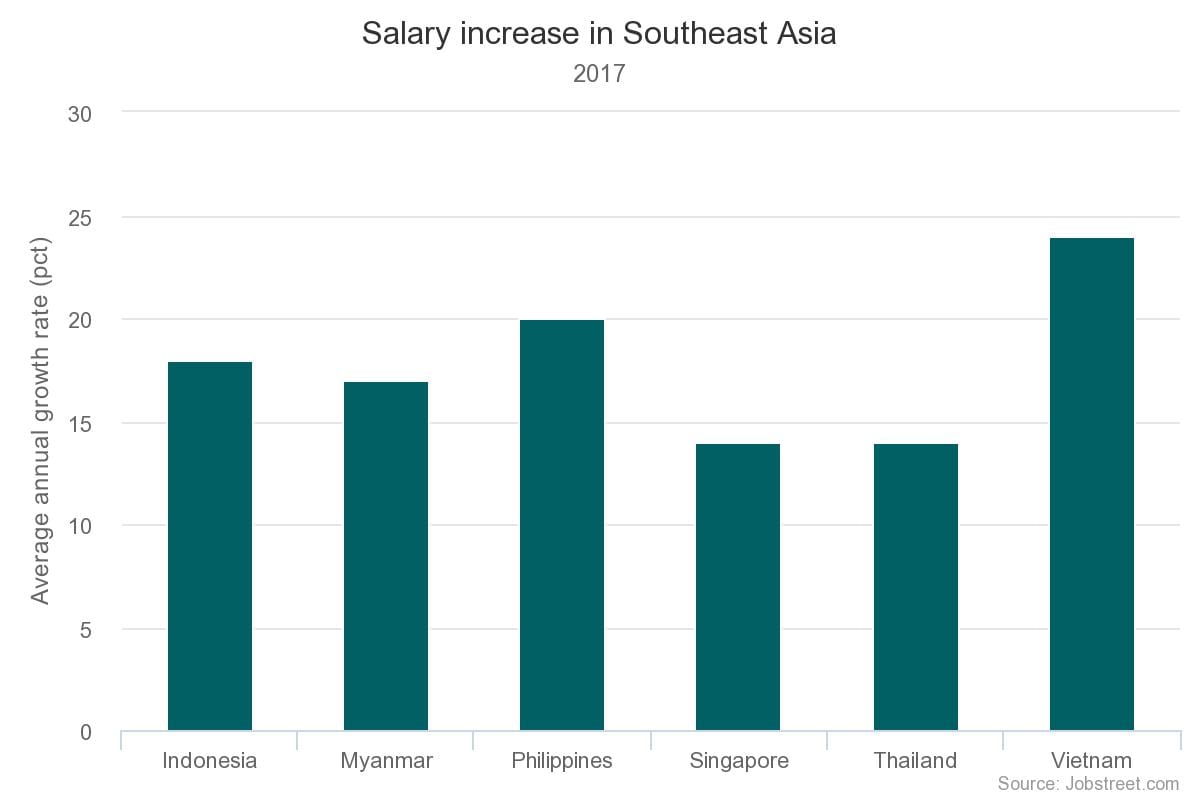
Salaries in Vietnam are rising faster than in any other Southeast Asian country, according to a recent survey released by employment website Jobstreet.com.
The average annual growth rate of Vietnam’s payroll stands at 20-24 percent, compared to 14-20 percent in Thailand, the Philippines, Indonesia, Myanmar and Singapore.
In Vietnam, management and executive salaries grew fastest, at 26 and 35 percent respectively.
The survey found that 68 percent of companies operating in Vietnam want to expand their businesses in the future, so they have high recruitment demands. Jobstreet forecast that salary growth will continue with this demand.
Vietnam’s minimum wage, however, doesn’t enjoy such a large jump. On Monday, the prime minister signed off on a decree raising the minimum wage for 2018 by 6.5 percent, the lowest nominal bump in 11 years.
The rise brings the minimum wage for Region I to VND3.98 million ($175) a month. Region II to VND3.53 million, Region III to VND3.09 million and Region IV to VND2.76 million.
In Vietnam, there are four different minimum wage regions, which are supposed to reflect the cost of living in each area. Region I, including Hanoi and Ho Chi Minh City, has the highest minimum wage, while region IV, which is for rural areas, has the lowest.