Why Vietnam Loves Trump

Advertisements

Vietnam — Before every shift at a Domino’s Pizza store in central Hanoi, Van Nguyen Hai, 20, puts on a uniform in the colors of the American flag. Then she takes up her position behind the register, in front of a wall decorated with a collection of images that represents milestones in the history of Domino’s: the flag of Panama, where the chain’s 8,000th store opened in 2006; a steaming brownie, in honor of a dessert the chain introduced that same year; and the logo for “The Apprentice,” which held a Domino’s-related challenge in 2005, featuring a tie-clad Donald J. Trump.

“It’s my honor for him to come to Vietnam,” Hai says of President Trump’s upcoming visit on November 10-12. “Trump can change America, and if America changes, the world will have change, and Vietnam will have change.”

In the country where thousands lined the streets to chant “Obama, Obama” in 2016, many Vietnamese like Hai are also eagerly awaiting Trump’s upcoming visit to attend the Asia-Pacific Economic Cooperation meeting in Da Nang and meet with President Tran Dai Quang and other Vietnamese officials in Hanoi. In fact, when Trump lands on Friday in Da Nang—at an airport where U.S.-Vietnam teams are still finalizing efforts to clean up dioxin contamination left by American Agent Orange during the Vietnam War—he will enter one of the only countries on earth where he, and the country he leads, are both popular.

According to the Pew Research Center, Vietnam is among seven out of 37 surveyed countries where a majority of the population says they like Trump: 58 percent of Vietnamese told Pew earlier this year that they have “confidence in Trump to do the right thing when it comes to international affairs,” compared with the global median of 22 percent. (The other countries with pro-Trump majorities were Israel, Kenya, Nigeria, the Philippines, Russia and Tanzania.)

What does this communist country see in the real estate mogul-TV star who now serves as the 45th president? Trump’s strong support in Vietnam is partially borne of his own policies and personality: His campaign trail tough talk on China resonated with a Vietnamese public deeply suspicious of their northern neighbor’s rise, and Trump’s business experience is appealing to many in a country where break-neck economic growth has recently fueled entrepreneurial dreams. His visit here is eagerly awaited—both by those excited to see a leader they admire, and by those hoping that concerns about Trump’s commitment to Vietnam will be assuaged.

Before he became president, Trump was well-known in Vietnam as a successful businessman. In the three decades since the country began market reforms known as Doi Moi, entrepreneurs have been celebrated as engines of growth; almost 20 percent of the adult population in Vietnam owns their own business, the third-highest rate of 60 countries surveyed by the Global Entrepreneurship Monitor.

Many of Trump’s books, including The Art of the Deal, Never Give Up and Crippled America: How to Make America Great Again, have been translated into Vietnamese and found a dedicated following among those seeking business insights from “the great teacher Donald Trump,” as the publishing house Nha Xuat Ban Tre describes him. Miss Universe, which Trump owned at the time, was held in the beach resort town of Nha Trang in 2008 (though Donald Trump Jr. attended in place of his father). And Pham Nhat Vuong, head of the real estate conglomerate Vingroup and Vietnam’s first billionaire, is known as the “Donald Trump of Vietnam.” (A similar admiration for Trump’s business acumen exists among the aspirational classes in Japan, South Korea and China, where Trump has been well-received over the past week.)

The 20-year-old founder of the Vietnamese for Donald Trump Facebook page—15,000 followers and counting—is among those drawn to Trump’s business background. (He requested anonymity because his Trump fan page, which he also describes as “a fan page for American conservatism,” contains some criticism of the government.) To this young man, who calls himself a “Vietnamese deplorable,” Trump represents the best of America—“capitalism, freedom and God,” he said in a telephone interview from his home in Ho Chi Minh City.

To be fair, Trump is not as popular as his predecessor in Vietnam: Pew found support for Trump is 13 percentage points lower than it was for Barack Obama. But even among those who are wary of Trump, a positive view of the United States prevails: 84 percent of Vietnamese view America favorably, according to Pew, the highest figure in any country surveyed, and up 6 percentage points from the end of the Obama years. “The relationship between the U.S. and Vietnam has been in a new phase” as war memories are replaced by shared strategic and economic interests, says Tran Le Thuy, founder and director of the Center for Media and Development Initiatives in Hanoi, a nonprofit that conducts research on Vietnamese media. “So the coverage of the U.S. is quite positive. It almost doesn’t matter who the president is.”

Still, there is hope here that Trump’s visit—marking the first time the president of the United States has been to Vietnam two years in a row—will confirm that American interest in Vietnam will outlast the Obama administration. Professor Nguyen Thi Thanh Thuy, head of the Americas studies division at the University of Social Sciences and Humanities in Hanoi, says expectations are high that Trump’s address at APEC—which the White House has said will outline “the United States’ vision of a free and open Indo-Pacific region”—will clarify the Trump administration’s commitment to Vietnam.

“I think the Vietnamese people and many people in other countries expect more from the U.S. in order to counterbalance the Chinese policy in the region,” she says.

For Vietnam, the United States is an increasingly critical strategic partner as China builds islands and military facilities in the South China Sea. Obama’s 2016 visit confirmed the growing scope of the relationship as the United States lifted the decades-old ban on arms sales to Vietnam. And part of the Obama administration’s “pivot to Asia” strategy relied on pushing forward the Trans-Pacific Partnership, from which Vietnam would have been among the biggest beneficiaries.

Trump, of course, withdrew the United States from the pact on his first full day in office. But he has also harshly criticized China for taking American jobs and previously called the country a “currency manipulator” (a charge he later took back). Hoang Phuong, a 37-year-old Hanoian architect and guitarist in an AC/DC cover band, is among those in Vietnam who admire Trump’s harsh rhetoric against China. Phuong was initially puzzled when Trump ran for president; he had read several of Trump’s books in Vietnamese, and knew him as a successful businessman, not a politician. But he was happy when Trump won the White House for one main reason: “He says he doesn’t like China.”

After Trump’s TPP withdrawal, the Vietnamese government issued a polite response pledging to continue to work for regional economic integration. But Le Dang Doanh, a member of the Committee for Development Policy of the United Nations and one of Vietnam’s leading economists, says, “We regret deeply the step of the president of the United States to withdraw from TPP.” Still, Carlyle Thayer, an expert in southeast Asian politics and emeritus professor at the University of New South Wales, says Vietnamese officials have moved on from the disappointment: “They’re pragmatists. It’s done.” The remaining 11 countries have continued negotiations, and Le is among those who hopes those countries will reach a final agreement at the APEC meeting in Da Nang.

The White House visit in May by Vietnamese Prime Minister Nguyen Xuan Phuc, the first by a southeast Asian leader, helped quell Vietnamese concerns that Trump would abandon the Obama administration’s concerted efforts to strengthen the U.S.-Vietnam relationship. But uncertainty lingers. As the lovefest between Trump and Chinese President Xi Jinping in Beijing earlier this week illustrated, Trump has not displayed a strong interest in countering China in the South China Sea, in part because he needs China’s support in curtailing North Korea’s nuclear ambitions.

And while some Vietnamese saw Trump’s campaign bravado on China as reassuring, even exciting, others are nervous about his harsh words, his view of international affairs as a zero-sum game and his lack of political experience. “President Trump thinks he can stand up to China. That goes well with ordinary Vietnamese popular opinion,” says Ngo Vinh Long, a professor of history at the University of Maine who studies Vietnam and regional politics. “But this kind of attitude is scary to many people who are well educated or who are in the government because they think that, inadvertently, President Trump might provoke something with China that Vietnam itself cannot contain.”

One reason Trump remains popular despite all that is because he and the United States are covered very carefully by media outlets here, which are strictly controlled by the government. Thuy, the director of MDI, says that the long-term importance of the U.S.-Vietnam relationship leads Vietnamese state-run media to cover Trump positively or neutrally.
While Vietnamese newspapers have published stories about special counsel Robert Mueller’s probe into possible campaign collusion with Russia and the criticism of Trump from Senators Jeff Flake and Bob Corker, for instance, those stories are relatively few. “I think mainstream media [in Vietnam] avoids covering stories about personal issues to avoid insulting the U.S.,” she says. “They don’t want to cause any diplomatic troubles.”

Still, Thuy says she saw more “analysis and a lot more obvious positive expectations” in the coverage ahead of Obama’s 2016 visit, while the reporting on Trump’s trip has been more neutral and fact-based. (According to MDI data, one of the most widely shared stories in Vietnamese media relating to Trump’s visit so far detailed the arrival on October 30 of the Boeing C-17 Globemaster III at Hanoi’s Noi Bai airport carrying armored limousines for Trump’s entourage; the vehicles got similar coverage under Obama.)

As for how much, or whether, Trump will interact with the Vietnamese people, expectations seem to be lower than for past presidents. Bill Clinton’s visit was a milestone in Vietnam’s international integration. “I remember when Bill Clinton walked around here and went into the shops like a normal person,” Bac Hai, 70, told me recently, sitting by Hoan Kiem Lake, where Clinton strolled in 2000. She preferred Hillary Clinton during the presidential election but has come to think Trump’s business experiences should equip him to appreciate how much Vietnam has developed since market reforms began in 1986.

Last year, Obama ate with Anthony Bourdain at Bun Cha Huong Lien, a small, cheap noodle restaurant. Their meal of Hanoi’s most iconic dish—grilled pork patties served with vermicelli rice noodles and fresh herbs—became the most memorable moment of his visit for locals. And the restaurant—where the walls are decorated with photographs of Obama and staff members, and the menu now offers the Obama combo—has seen a business boom ever since. “When Obama came to eat bun cha, people came to see him, because the most powerful man in the world was acting like a normal person, with no safeguards,” Bac Hai says.

There’s not much hope that Trump, a self-described “germaphobe,” will venture to Bun Cha Huong Lien or a similar restaurant. The U.S. Embassy in Hanoi referred to a White House news release saying only that Trump will meet with President Quang and other senior leaders.

Back at Domino’s, Van Nguyen Hai and her co-workers recently debated Trump as the image of his face gazed down from the wall. Tran Tran Pham, 19, said Trump seemed unkind, imperious and unwilling to work with other countries. Hai agreed partly, but she still said she preferred Trump to Obama because of the power he projects. She said she was a little surprised he is coming to Hanoi, given the length of his Asia trip, but has high hopes.

“When Obama came out of the bun cha restaurant, he shook hands and smiled,” Hai said. “Everyone wanted to see the president of the United States. I really regret that I didn’t go see him. So, I hope that this time, with Trump, I hope I can see him.”

Isabelle Taft

Source: https://www.politico.com/magazine/story/2017/11/09/waiting-for-trump-in-hanoi-215809

Franchise restaurants boom in Vietnam

Advertisements

Not only are Vietnamese restaurateur reaching out to foreign brands to import their business models, global franchisors now view Vietnam as a huge potential market to expand their network.

Popular global franchise brands like Little Caesars, Jumbo Group, The Boiling Crab, and Element Fresh have all sat down with Vietnamese partners in preparation for their entry into the 94-million-strong market.

Presently, Vietnam is already home to 71 foreign restaurant franchises, including ‘big players’ like McDonald’s, Starbucks, Burger King, and BBQ Chicken.

Most of these franchises are currently flourishing in the country’s largest hubs of Hanoi and Ho Chi Minh City, but others are beginning to target growing cities such as Da Nang and Hai Phong to further cement their foothold.

William Schreiber, vice-president of international development for U.S. pizza chain Little Caesars, said he had traveled to Vietnam 15 times in search of opportunities to ink franchising deals with local businesses.

The third-largest pizza chain in the U.S., Little Caesars already has over 5,000 locations in 18 countries, but Vietnam is looking like the first country in Southeast Asia to earn a franchising deal with the company.

Recently, Singaporean seafood restaurant group Jumbo also partnered with a Vietnamese company to launch the franchise locally, having made successful entrances in China and Japan.

Other popular franchises like Grimaldi’s Pizzeria, Boiling Crab and Presotea have announced their intention to open stores here.

A KFC restaurant in Hanoi. Photo: Tuoi Tre

A lucrative business

With prices that target middle-income earners, restaurant franchises are becoming increasingly popular with the younger generation in Vietnam as a go-to place for dining, hanging out with friends, and meeting with business partners.

Vietnam-based Golden Gate Group, one of the first in the country to conduct business with foreign franchisors, has until now successfully imported and operated 22 restaurant franchises ranging from barbecue, hot pot to beer clubs.

In 2016, the firm reported revenue of VND2,628 billion (US$115.77 million), a 524-percent growth rate on 2013.

With its current network of 201 locations across Vietnam, it is estimated that the firm will reach 400 locations by as early as 2018.

According to Hoang Tung, owner of the Vietnamese pizza chain Pizza Home, the cost of franchising a popular brand can amount to VND1 billion ($44,000), not to mention a percentage of revenue paid regularly to the franchise owner.

People line up outside Vietnam’s first Starbucks restaurant in Ho Chi Minh City on its opening day, February 1, 2013. Photo: Tuoi Tre

A cut-throat race

Despite the overwhelming number of success stories in Vietnam, in reality many brands have been forced to depart the market after finding themselves falling behind in a dog-eat-dog environment.

Examples include fast-food restaurant Subway and coffee houses such as Gloria Jean’s Coffees, The Coffee Bean & Tea Leaf and N.Y.D.C.

“Not many Vietnamese franchisees have the experience to run restaurant franchises on a large scale, which often results in fatal mismanagement once the number of locations reaches the hundreds,” an official from the Ministry of Industry and Trade asserted.

“They still have a lot to learn from foreign restaurateurs.”

Source: Tuoi Tre News

Ho Chi Minh City to install CCTV in kindergartens to prevent child abuse

Advertisements

Ho Chi Minh City authorities are set to apply specific measures, including the installation of surveillance cameras, to end the physical abuse of children at local kindergartens and childcare facilities.

The municipal People’s Committee convened a meeting with relevant agencies on Monday afternoon to seek solutions to child abuse, following a recent article by Tuoi Tre (Youth) newspaper.

The story shined the spotlight on the Mam Xanh childcare facility in Distinct 12, where its manager and employees had been discovered beating children aged two to five on a daily basis.

Speaking at the gathering, Bui Thi Diem Thu, deputy director of the city’s Department of Education and Training, said that daycare centers have mushroomed across the southern hub due to increasing demand in recent years.

However, the oversight of these venues is still limited, Thu assessed.

“The local education sector is responsible for letting such a serious case develop,” the official remarked.

In a bid to prevent similar cases, Thu suggested the installation of CCTV cameras at local kindergartens and childcare facilities.

The proposal was backed by the municipal Department of Police as surveillance cameras provide close monitoring of the situation at these places.

However, the locations of such devices should be taken into careful consideration in order not to violate human rights, another police official stated.

Following the discussion, the municipal education department was tasked with formulating a detailed plan for the installation of CCTV cameras at kindergartens across the city.

The cameras will be added to all rooms except for bathrooms and other sensitive areas.

In addition to existing safety requirements, new childcare centers will need to have surveillance cameras installed in order to be granted a legitimate license.

In another relevant development, the Ho Chi Minh City Party Committee on Monday ordered a comprehensive inspection of non-public childcare facilities across the metropolis.

Any action that violates the law and well-being of children must be severely punished, Deputy Secretary of the city’s Party Committee Tat Thanh Cang said in a statement.

Source: Tuoi Tre News

Internet brings bright future to young Vietnamese: former minister

Advertisements

The young generation in Vietnam will have a bright future thanks to the Internet, former Minister of Information and Communications Mai Liem Truc remarked during a forum in Hanoi on Monday morning.

The Vietnam Internet Forum 2017 (VIF 2017) attracted some 200 participants, including 30 speakers from Vietnam and other countries, experts on information technology and cybersecurity, business representatives, and local university students.

The event was organized by the Embassy of Sweden in Vietnam and the Ministry of Information and Communications at the Hanoi Museum on November 27 and 28, on the occasion of the 20th anniversary of the Internet in the Southeast Asian nation.

Centered on ‘Digital For Food,’ the VIF 2017 included discussions on how to use the Internet as a means to exchange information, boost social development, and open new opportunities for the community.

Speaking at the gathering, former Minister of Information and Communications Truc stated that young people have been enthusiastic about the Internet and its various benefits.

The young generation has a bright future ahead thanks to the international computer network, Truc continued, adding that the network is a new economic form that requires the knowledge of young people.

Swedish Ambassador to Vietnam Pereric Högberg asserted that via the VIF 2017, organizers hoped to promote the openness, transparency, ease, and safety of information access for everyone, especially young generations.

According to Vu The Binh, general secretary of the Vietnam Internet Association, the presence of the Internet in Vietnam during the past 20 years has helped build reliable technological and information infrastructure in every aspect of life, both socially and economically.

It gives birth to a series of business innovations and new economic modalities, while public agencies have also become more open, transparent and accountable.

Source: Tuoi Tre News

Facebook users on the rise in rural Vietnam: survey

Advertisements

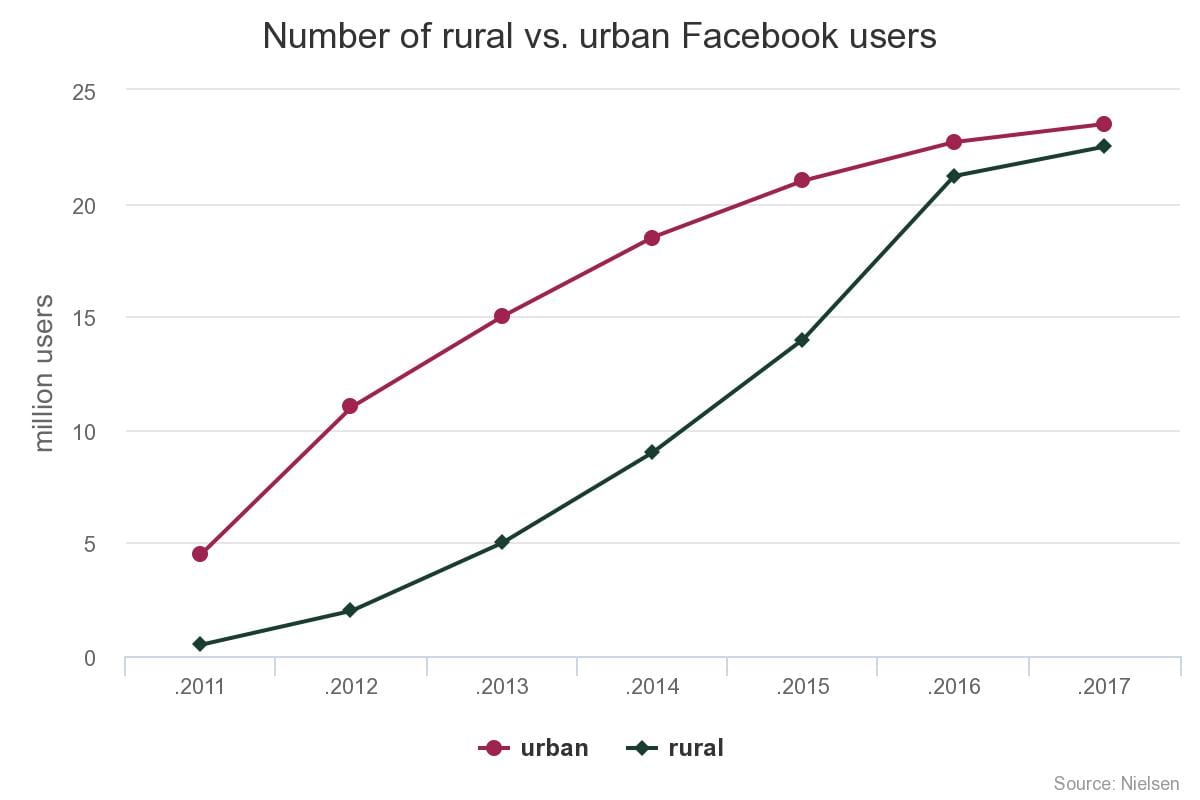
Cheap smartphones are connecting the countryside nearly as much as in Vietnam’s cities now.

More than a million new Facebook accounts were opened in rural parts of Vietnam in the past year, promoting the social network’s status as a key platform for information, entertainment and communication, according to data recently released by global performance management company Nielsen.

The increase has played an instrumental role in media consumption shifting beyond traditional formats such as broadcast and cable TV, and also beyond traditional hours, said Doan Duy Khoa, director of Consumer Insights for Nielsen Vietnam.

“For media owners and advertisers, it is becoming increasingly important to understand both urban and rural consumers’ viewing habits in order to deliver the right content at the right time,” he said.

The increasing number of Facebook users in rural areas is partly due to more smartphones. Up to 89 percent of the rural population own a mobile phone, and 68 percent of them have a smartphone, according to the Nielsen Vietnam Smartphone Insights Report 2017.

Across the whole country, the ratio of people using smartphones among mobile phone subscribers reached 84 percent in 2017, increasing from 78 percent a year ago

The rapid up-take of connected devices, especially smartphones and tablets, demonstrates that tech brands are offering consumers a range of choices at affordable prices. Another reason is that consumers are enjoying better living standards and expressing their desire for connectivity anytime, anywhere, Khoa said.

Vietnam now boasts more than 52 million active accounts to advertisers, Reuters has reported, citing social media agencies We Are Social and Hootsuite. More than half of Vietnam’s population of nearly 92 million people are online.

Coc Coc updates 1.2m service points

Advertisements

Coc Coc, a Vietnamese web browser and search engine, has updated information on about 1.2 million service locations on its digital map — Coc Coc Map. The map runs on both PCs and mobile phones.

The locations include any places having services (excluding private houses), such as restaurants, shops, pharmacies, petrol stations or ATMs.

They are defined by Coc Coc as points of interest (POIs). The developer has built a POI database in 60 out of 63 cities and provinces nationwide.

There are about 260,000 POIs in Ha Noi, 400,000 in HCM City and nearly 80,000 in Da Nang.

According to the company’s statistics, the total length of streets collected by Coc Coc’s employees so far has reached about 90,000 kilometres, twice the length of the equator.

The developers said they built Coc Coc Map with criteria different to similar services on the market.

They chose to enter “niche market” which had not been “occupied” by foreign companies.

“When looking for services on Coc Coc Map, users will see the results returned as locations with specific addresses, accompanied by actual snapshots. The locations all have detailed information whether it is just a very small POI such as a tra da (ice tea) shop,” a Coc Coc representative said.

Coc Coc said it hoped the map would become a useful tool for domestic users, not just tourists.

In 2013, Coc Coc Map has completed the initial goal of collecting information of about 500,000 POIs.

However, the team later discovered that the database collected had changed significantly in just a few months.

The reason was related to the fluctation of Vietnamese enterprises, especially small and micro-sized enterprises.

Therefore, to ensure the accuracy, the map’s database is directly collected and updated regularly by the Coc Coc team themselves.

The data is updated every two or three months in Ha Noi and HCM City and monthly for Da Nang.

Source: VNS

M&A in Vietnam – Attractive investment channel

Advertisements

Mergers & Acquisitions (M&A) activities in Vietnam has become an attractive investment channel for enterprises planning to expand business activities, as well as looking for new way of doing business.

Recently, the scale of M&A activities has become bigger with positive impact from the global integration process.

According to the Director of Vietnam M&A Forum Dang Xuan Minh, in 2016, total M&A deals in Vietnam was 500 deals, contributing to 5% of total M&A deals in South East Asia with value of 5.8 billion USD.

In which, investors are mainly from Singapore, Japan, Korea, and Hong Kong, with Korea in the top 4 of highest M&A deals in Vietnam.

As such, fields such as consumption, retail, industrial production, real estate, education, media and finance are attracting huge amount of financial resources; and on top is M&A in retail sector.

Many investors are planning to acquire Vietnamese companies to expand market shares, namely Thailand’s investors acquiring Metro, BigC and Nguyen Kim. In real estate, Korea has some big M&A deals such as the take over of Kangnam building and Hanoi-Deawoo Hotel.

“Recently, Vietnam’s government has eased regulation on the limit number of assets owned by foreign investors. As such, there are big opportunities for foreign investors during the process of state owned enterprises equitization” – Minh said.

Vice Director of Korea’s M&A Center of Korea Trade – Investment Promotion Agency (KOTRA) Mchael D. Choi said, recently, many Korean enterprises are showing interest in M&A deals in Vietnam.

As such, the two countries can cooperate efficiently through M&A deals. At present, Korean investors are negotiating with 12 Vietnamese enterprises in fields of food production, pharmacy, and finance.

From expert’s perspective, in order for M&A activities to be more efficient, and contributes more to the economic growth, it is necessary to have appropriate mechanism and policies to support.

For example, it may be the policies to facilitate the equitization process of SOEs, speeding up the divestment process for foreign investors, supporting domestic enterprises mobilizing financial resources in foreign stock markets.

Besdies, the government need to pay attention and create more chances for foreign investors taking part in M&A deals in Vietnam.

According to Michael D. Choi, Korea are giving priority to allocate financial resources for investment fund focusing on M&A deals.

In Korea, there are 14 organizations and investment funds with capital of up to 1 billion USD.

Therefore, in order to have more M&A deals between Korea and Vietnam, Vietnamese enterprises need to have more accurate information and issuing financial report in a timely manner.

Statistics from the State Capital Investment Corporation (SCIC) showed that, in 2017, SCIC will divest the government fund from 114 out of 132 SOEs.

At present, this process is completed in 30 enterprises, with the remaining enterprises are expected to be complete by the end of this year.

Despite the limited time left, but there are high chances that it will be success with many big SOEs such as Sa Giang, Tien Phong Plastic, Binh Minh Plastic, Bao Minh Insurance and FPT Group.

Source: Ha Noi Times

Saigon: A city on motorbikes

Advertisements

The first sound anyone living in Ho Chi Minh City might hear each morning is unlikely to be that of a rooster, but rather that of a motorbike accelerating, be it from afar or just next door.

Statistics from the Ho Chi Minh City Department of Transport reveal that in March 2017, there were 7.3 million motorbikes in the city.

Data from the General Statistics Office of Vietnam (GSO) shows that the city’s official population in 2016 was 8.3 million.

The rationale

With US$700 to $2,000, even Saigonese earning average incomes can afford a brand new bike.

Keeping one is also economical. With a week’s worth of gas costing around $3.5, parking costing around 22 cents, and $25 or so for year-round maintenance, it might amount to an annual expenditure of around $200, still modest compared to the average annual income per capita of $5,400 for Saigonese, according to GSO figures.

Bikes are parked along the street with riders sitting on them. Photo: Tuoi Tre

The choice of motorbikes is also based on multiple factors. Some would prefer a huge trunk with sufficient in-scooter space to store their stuff, be it a schoolbag with a laptop or other belongings.

Buyers might also choose between automatic or manual gear, with female riders tending to prefer an automatic ‘hop-on-and-ride’ version more manageable.

But it is the flexibility of a motorbike that makes it tick.

Tien, a university lecturer in his late 20s residing in Binh Thanh District, gets through his day using his 15-month old scooter.

He rides his two-wheeler to buy a loaf of bread only 500 meters away, to hit the barber’s about one kilometer away, and to buy his wife some bubble tea from around the corner.

Riding his scooter, he can stop wherever he wishes: at a roadside convenience store, or at a vendor on the street.

There are also detours he can make as his vehicle is allowed on all public roads, with the exception of the pedestrian precinct in District 1.

Street peddlers at work. Photo: Tuoi Tre

This kind of flexibility can also result in uniquely Vietnamese scenes: a brand new Yamaha Classico carrying up to three adult passengers, a decades-old ramshackle Honda Wave struggling under gigantic piles of stuff firmly fastened round the backseat, or a generous scooter driver leg-pushing his fellow rider with mechanical problems through a sea of traffic.

Street vendors also cling onto vehicles, selling all kinds of products directly from their backseat, like banh mi (Vietnamese sandwich), porridge, ice-cream, rice paper cakes and coffee.

However, too much flexibility can give rise to recklessness. Every minute or so there is a motorcyclist steering into a car lane, overtaking by a hair’s breadth, maneuvering on the pavement, jumping the lights, turning without signaling, and making illegal U-turns.

Parking: another winning point

Compared with car drivers, motorcyclists are at a huge advantage regarding where, how, and when to park.

Before locating the car keys to drive to the city center for some weekend fun, car owners might well already be pondering their parking options, as this can be a frustrating experience.

A man rides a ramshackle motorbike pulling bags on a cart as part of his daily job. Photo: Tuoi Tre

In Saigon, as Ho Chi Minh City is still called by many, motorbikes have the upper hand. Riders have the tacit privilege of parking at will: on the pavement, in the middle of the road, in front of a street-side coffee shop. The distance between parking and destinations, therefore, becomes minimized.

On the pathways of parks and riverside public spaces, parked bikes prove even more functional: they can serve as seats for couples going on low-cost dates.

The foreigner experience

Foreign visitors to Saigon might find themselves staring at death’s door.

Eric, one 35-year-old American who has lived in the city for three years, tells of his first day finding his feet around the southern city: “I was thrilled. But my wife was scared to bits.”

“It was a bit hard to figure out where those scooters were going, but after a while I learned that no one was going to hit us,” he adds.

When asked what advice he would give to fellow foreigners, he laughs: “Keep calm and go with the flow. Blend in with the Saigonese motorcyclists and you’ll see their bark is far worse than their bite.” Eric considers himself a competent rider.

Overseas visitors not familiar with the idea of balancing their way forward on a two-wheeler can put themselves to the test with ‘Motorbike for Rent’ services available everywhere in the downtown area, including the backpackers’ hub of Bui Vien Street.

Riders have to walk their bikes through knee-deep water in Ho Chi Minh City. Photo: Tuoi Tre

Vulnerable to weather

The bike is also an open-air travel option, which means riders are at the mercy of the weather conditions.

On a hot day, motorcyclists must bear the cramped sensation of wearing a helmet, while the harsh sunshine beats down on them, scorching hot air that strikes the face, and all the protective clothing, like shades, gloves, socks, coats, and all the usual gear that cover many ladies from top to toe.

Conversely, during the wet season, riders may end up wading and pushing their dead engines through ‘aromatic’ knee-deep water for kilometers.

Despite all these potential drawbacks, bikes in Saigon are here to stay.

Source: Duc Tien / Tuoi Tre News

Freelance tour guides claim Vietnam’s new tourism law railroads them into trap

Advertisements

It looks like most of them will have no choice but to pay to join a new association if they want to work legally.

Freelance tour guides in Vietnam are railing against a new law that will ban them from doing their jobs independently from next year.

In order to continue working as tour guides, they will have to either secure contracts with authorized travel companies or tour agencies, or join the Vietnam Association of Tour Guides, which was established early this month, under the amended Law on Tourism.

Nguyen Nam, a tour guide, told VnExpress that not many travel companies are willing to hire tour guides as permanent employees because it means they have to pay them monthly salaries and cover compensation and benefits packages.

Lo Kim Tuyen, another tour guide, also said it is difficult to find full-time work for travel companies at the moment.

Only big companies can afford salaried tour guides, and small firms are only capable of hiring freelancers when people book tours.

Freelancers work for small companies like “mercenaries”, Tuyen said.

They also said there are huge numbers of freelance tour guides ready to work at any time, so small companies do not have to worry about running short of collaborators.

Official government data shows almost 90 percent of the 20,000 tour guides in Vietnam are freelancers.

“I think now it’s impossible for small companies to pay for permanent tour guides. It means freelance tour guides have only one choice left: pay the fee and join the tour guide association,” Tuyen said.

Tour guide Dang Thanh lamented the fees, which include VND500,000 ($22) to sign up and an annual payment of VND1 million to keep the association running, given the fact that freelancers do not have a monthly salary and usually work seasonally.

Under current regulations, freelance tour guides in Vietnam only need a license to operate, but the new law means they will lose their self-employed status if they want to work legally.

“I studied for four years in college before spending a significant amount of time and money on training to obtain my license to guide foreign tourists,” a tour guide who wanted to remain anonymous said. “But it looks like that license is nothing compared to the association’s membership card.”

Many freelance guides have said the law is trying to force them to join the association, which is unfair because they should have the right to decide whether they want to join or not.

According to the Vietnam National Administration of Tourism, the establishment of the association is “timely and necessary to help create jobs for freelance tour guides, support them and protect their benefits, as well as allow authorities to easily oversee tour their operations.”

In 1999, a degree guiding the implementation of Vietnam’s Tourism Ordinance said tour guides should be allowed to work freely, according to Vu The Binh, vice chairman of the association.

When the ordinance was upgraded to a law in 2005, the regulation was kept unchanged.

But since then the number of freelance guides has spiraled out of control, and cases of tour guides disappearing as soon as they’ve been paid or taking tourists to shops with inflated prices have been reported, he told Tuoi Tre (Youth) newspaper in a Monday report.

The association will allow tourists to offer both positive and negative feedback on their guides and that information will be available for visitors to view, he said.

Vietnam has selected tourism as a pillar of economic growth. At a meeting of the legislative National Assembly last month, Deputy Prime Minister Vuong Dinh Hue said Vietnam needs to stop relying on crude oil and focus on tourism to ensure its economic growth, saying mining output of fossil fuels has been falling for the past two years.

Now “it is better to welcome one million tourists than trying to find one million tons of crude oil because tourism is more eco-friendly and safe for the economy,” Hue said.

Official data shows Vietnam received more than 9.4 million foreign visitors in the first nine months of this year, up 28.4 percent against the same period last year.

Source: Vy An

Teenage Vietnamese boxer wins historic Women’s Youth World Championship silver

Advertisements

Do Hong Ngoc will go down in history as the first-ever Vietnamese boxer to win a silver medal at the AIBA Women’s Youth World Championships, after a brave final match in India on Sunday night.

Ngoc, 17, was fearless in her bout against Shashi Chopra in the 57kg final in Guwahati, but that did not stop four out of the five referees eventually announcing home favourite Chopri the winner after three tough rounds.

The silver medal is a great achievement by the young Vietnamese woman, given her previous best result was gold at the 2017 Southeast Asian youth championships.

To reach Sunday’s finale, Ngoc defeated multiple strong rivals, including Turkey’s En Havanur, Martinez Roma Linda from the U.S., and China’s Hu Cailling.

The championships in India, hosted by the International Boxing Association (AIBA), attracted more than 150 boxers from 38 countries and territories, with ten divisions, from 48kg to more than 81kg.

Do Hong Ngoc, born in the Mekong Delta city of Can Tho, was the only Vietnamese representative, making her achievement even more special.

Source: Tuoi Tre News

​Kirin Holdings says considering buying stake in Vietnam’s Sabeco

Advertisements

Kirin Holdings Co is considering buying a stake in Vietnam’s largest beer maker, Sabeco, a spokesman for the Japanese beer maker said on Monday.

The Vietnamese government is due to publish details soon of a divestment plan for its nearly 90 percent stake in Saigon Beer Alcohol Beverage Corp, as the brewer is formally called.

Kirin Holdings will determine how big a stake it wants to buy once the details of the sale are disclosed, the spokesman said.

Sabeco, valued at $9 billion at current prices, has received a strong response from potential suitors at an investors’ roadshow in Singapore, its chairman Vo Thanh Ha said.

Source: Reuters

​Binh Duong accelerates development of smart city

Advertisements

Close cooperation between the state, educational institutions and businesses is the backbone of Binh Duong’s master plan to turn the province into a ‘smart city’.

On Monday, the Binh Duong administration and the Dutch Consulate General in Ho Chi Minh City launched the Binh Duong Smart City Summit 2017, which is expected to attract more than 1,000 representatives from both domestic and international enterprises, as well as universities and research institutes.

The summit will brief delegates on the latest Binh Duong Smart City developments which began in 2016, and open discussions on action plans and next steps in its implementation.

The event will also feature a business forum and an exhibition of technology and innovation, aimed at attracting investment and smart city development solutions.

Binh Duong authorities said the key to its successful development was to mobilize resources from both the state and private sector, via a model built around three main arms; government, educational institutions and private firms.

Searching for breakthroughs

On the sidelines of the Binh Duong Smart City Summit, an app development contest is being held at the Eastern International University, seeking breakthrough community applications.

Hundreds of high school and college students have participated in the contest, with winners granted investment to establish startups in the area.

A ‘startup incubator’ has been inaugurated at the Eastern International University campus, offering a 2,000-square-meter work space to encourage innovation.

Nguyen Thanh Trung, a specialist at the incubator, said the facility does more than just offering a work space for young people who “dare to dream and dare to do.” What is more important is to create an environment that connects innovative ideas and encourages young people.

In close proximity to the ‘startup incubator’ is a lighting lab, funded by the Netherlands.

Phan Van Vinh, a university lecturer and a staff member at the lab, said most streets are less frequented by commuters after midnight, so a smart lighting system that can automatically turn on and off or adjust its own level can reduce energy costs by 40-50 percent.

Mai Hung Dung, standing deputy chairman of the Binh Duong administration, said educational institutions, including universities and research institutes, are one of three key factors, besides the state and private enterprises, in finding solutions and unearthing breakthrough ideas in smart city development.

Binh Duong is only 20 years into its development but the province is already considered an active location, with foreign investment worth billions of dollars every year, according to Dung.

The province is now home to some 3,000 foreign enterprises, with a total registered capital of more than US$30 billion.

However, turning these huge investments into an overall improvement in locals’ standard of living is important, Dung said, adding that the solution rests with the implementation of a smart city scheme.

Students are seen at the lighting lab at the Eastern International University in Binh Duong, southern Vietnam. Photo: Tuoi Tre

Mobilizing social resources

According to the Binh Duong administration, the concept of a ‘smart city’ is all about smart solutions that serve local citizens.

The administration will therefore create programs and mechanisms that allow universities and research institutes to achieve specific targets and cooperate with the state, rather than wait for investment from local budgets.

Peter Portheine, program director for the Netherlands-based technology firm Brainport, a partner of the Binh Duong Smart City Scheme, said the Dutch city of Eindhoven had harnessed cooperation between the state, educational institutions and private enterprises in its own smart city a few years ago.

Strong cooperation between the three parties allowed Eindhoven to form a robust business community capable of employing various technologies to improve productivity. Consequently, Eindhoven’s GRDP regularly outstrips that of other Dutch cities.

Nguyen Van Hung, general director of Becamex IDC, run by the Binh Duong administration, said that while Binh Duong and the southeastern region are Vietnam’s most active economic zones, there are unresolved issues including several delayed development projects and poor traffic infrastructure.

Citing one example, Hung said that 60-70 percent of goods manufactured in Binh Duong are being transported to both Ho Chi Minh City and deepwater seaports in Ba Ria-Vung Tau and Dong Nai Provinces, however the roads are overloaded and regularly marred by congestion.

In addition, Binh Duong remains connected to these provinces via the Dong Nai and Saigon Rivers, but it is not easy to utilize sea transport, given the rocky reefs surrounding the former waterway, and low bridge clearances.

Ba Ria-Vung Tau is currently home to the Cai Mep-Thi Vai seaport, and the new Long Thanh International Airport will be developed in Dong Nai.

“How to transport goods smoothly from Binh Duong to these two provinces, and vice versa, is a problem the Binh Duong administration must solve in its bid to create a smart city,” Hung said.

Soure: Tuoi Tre News

Vietnam brewer Sabeco gets strong response at Singapore investor roadshow: chairman

Advertisements

The sale has attracted interest from investors seeking access to one of Asia’s most-promising beer markets.

Vietnam’s biggest brewer Sabeco SAB.HM has received a strong response from potential suitors at an investors’ roadshow in Singapore, its chairman said, as the government moves closer to finalizing a stake sale in the $9 billion maker of Bia Saigon and 333 brews.

Vo Thanh Ha said the government is due shortly to publish details of a divestment plan for its nearly 90 percent stake in Saigon Beer Alcohol Beverage Corp, as the brewer is formally called, as part of a lengthy fund-raising exercise.

The sale has attracted interest from brewers seeking access to one of Asia’s most-promising beer markets, which is already the second-most profitable for Dutch brewer Heineken NV (HEIN.AS). Vietnam’s per capita beer consumption is forecast to become one of Asia’s highest within the next couple of years.

The sale could also provide a template for more planned privatizations including that of peer Habeco BHN.HM.

“We met a number of very high-profile investors – strategic investors and industry players,” Ha said in an interview in Singapore.

“We’ve received very good feedback from investors that they consider Sabeco as an extremely good company with high potential to grow,” Ha said, in comments translated from Vietnamese by an adviser for the roadshow.

Attendees at the Singapore roadshow included representatives of Japanese pair Kirin Holdings Co Ltd and Asahi Group Holdings Ltd, said Ha, who has been chairman for two years. He said representatives of Vietnam’s Ministry of Industry and Trade were also present.

“The divestment is on schedule. The government will be publishing the plan to divest very soon,” said Ha, speaking in a private bus en route to Changi Airport.

The roadshow will next move to London and Ho Chi Minh City this week.

The government said this month it aims to complete a stake sale in December, though it has yet to disclose a size or price. Complicating the process is a near-trebling of Sabeco’s share price over the past year to 318,800 dong ($14), compared with a 40 percent rise in the benchmark index VNI to 10-year highs.

“The price is determined by the market,” said Ha, when asked to comment on the surge.

Some investors said a small free float has inflated Sabeco’s market value.

Sabeco dominates Vietnam’s beer market where its main rivals are Heineken and state-owned Hanoi Beer Alcohol & Beverage JSC BHN.HM. Heineken owns 5 percent of Sabeco.

Sabeco expects the introduction of premium products to help it maintain a market share of 40 to 42 percent over the next two or three years, Ha said.

Soure: Mai Nguyen

Conference seeks ways for Italian products to enter Vietnam

Advertisements

Vietnamese consumption trend, potential customers and competitive capacity of Italian businesses were discussed at a conference held in Turin, the capital city of the Piedmont region in northwest Italy on November 24.

The event provided crucial information for Italian firms who are interested in the Vietnamese market and especially those are exporting agricultural products and food which are strengths of the Piedmont region.

Vietnamese Ambassador to Italy Cao Chinh Thien updated participants on the latest information about the Vietnamese market while appraised efforts made by the Italy-Vietnam Trade Chamber in promoting trade and investment between the two countries.

According to Walter Cavrenghi, General Secretary of the Italy-Vietnam Trade Chamber, a delegation of businesses from Piedmont will study and seek investment opportunities in Vietnam in March 2018.

Talking with the Vietnam News Agency’s correspondent, President of the Chamber Fulvio Albano said that his organisation will continue to sustainably enhance trade and investment between businesses from Italy and Vietnam.

On the occasion, the Vietnamese ambassador visited some agricultural production establishments in the Piedmont region.

The same day, Thien worked with leaders of the Italian Social Security Administration in Piedmont. They agreed that Vietnam and Italy can share experience in social insurance management.

He lauded the administration’s initiative to organise a meeting to popularise information about insurance’s benefits, responsibilities and regulations among Vietnamese people working and studying in the locality.

Source: – VNA

Nonstop Da Lat–Bangkok flight set for December launch

Advertisements

The first-ever direct flight connecting Vietnam’s Central Highlands city of Da Lat and the Thai capital of Bangkok will be commenced next month to celebrate the 2017 Da Lat Flower Festival, low-cost carrier Vietjet said Friday.

Commencing on December18, the new service will be operated by an Airbus A320 with four return flights per week on every Monday, Wednesday, Friday and Sunday, Vietjet said in a press release.

The flight departs at 10:30 am from Bangkok and returns at 12:55 pm from Da Lat with a flight time of one hour 45 minutes.

Booking is already available at the airline’s website, with one-way fares starting from only VND68,000 (US$3), excluding taxes and charges.

“The new service will be launched just before the Da Lat Flower Festival and I am delighted that people from [Vietnam and Thailand] now can travel conveniently to enjoy their neighboring country’s sceneries even more through our expanding flight network,” Vietjet vice president Nguyen Thi Thuy Binh said.

The Da Lat-Bangkok service totals the number of direct routes between Thailand and Vietnam, operated by Vietjet and Thai Vietjet, to six. The existing routes are Bangkok to Hanoi/Hai Phong/Ho Chi Minh City/Da Lat and Ho Chi Minh City to Phuket/Chiang Mai.

The Da Lat Flower Festival will be held from December 23 to December 27.

Source: Tuoi Tre News

Exit mobile version