The Navigos Group, the leading recruitment company in Vietnam and the owner of online recruitment portal VietnamWorks and executive search firm Navigos Search, released a report on October 10 on recruitment demand for senior and middle-level managers in Vietnam during the third quarter of this year, based on recruitment requests to Navigos Search.
Recruitment demand for senior and middle-level positions by Navigos Search clients are continuously increasing. In the third quarter of this year, the number of such job orders rose 19 per cent year-on-year.
Industries that have the highest recruitment demands for these positions include manufacturing, consumer goods and retail, ICT, banking and finance, and services. Demand for senior and middle-level managers in manufacturing continued to dominate, with 35 per cent of the total, primarily in construction and electrical and electronics.
Consumer goods and retail followed, with the majority of recruitment requests coming from food and beverage and fashion businesses.
ICT was third, mostly in IT services and systems integration. Most positions sought to be filled were managers and engineers experienced in different programming languages.
In banking and finance, the greatest recruitment demand was from banks, insurance companies, and consumer finance companies. In services, recruitment demand was mainly from companies in advertising and marketing.
Renewable energy forecast to grow in near future
Vietnam has great potential for solar power as it’s in the equatorial region. There were not many opportunities for renewable energy projects in the past, however, due to the high cost of solar cells, raising investment costs. Recently, the cost of buying and installing solar panels has fallen significantly, and at the same time the government has mechanisms to encourage investment in solar energy, which has in turn attracted more investors.
Many solar energy projects from foreign investors are being proposed in a large number of localities throughout the country. Thermal power is also forecast to continue to expand to meet electricity demand for production and life.
With the potential for remarkable development in the years to come, the labor market in the power sector is expected to thrive after a long period of quiet.
‘Everything darkened around me as Mr. Harvey Weinstein stood there smiling at me with just a towel on his hip.’
A Vietnamese actress who appeared briefly in the 2010 thriller “Shanghai” produced by Harvey Weinstein has accused the now notorious Hollywood producer of harassing her while offering to give her a bigger role.
Vu Thu Phuong, an actress and supermodel, shared the story for the first time on her social media page a week after leading U.S. newspapers revealed a history of sexual harassment allegations against Weinstein that prompted the company he co-founded to fire him.
It all happened nine years ago when she was cast for the drama mystery thriller whose release reportedly hit some delays due to problems with the Chinese government.
“I read a report about Mr. Harvey today and memories threw back like it was yesterday. I think I cannot be silent anymore,” the 32-year-old said in her post.
This is her story.
In 2008, she took an audition in Saigon and was originally cast for a supporting role in “Shanghai” as a spy who speaks both Chinese and English and appears alongside the world-famous Li Gong in several scenes.
That was the first time she met Weinstein, and their encounters picked up nicely. He visited her fashion store in Saigon, offering to promote her designs in Hollywood and gifting her design books.
Several days after filming started in Thailand, Weinstein told her that her English was not good enough and that she would be switched to a smaller role, which appeared for just a few seconds in the final production.
Vu Thu Phuong (left) appears as an extra in “Shanghai”.
The production unit explained that many of her scenes had to be removed for political reasons and offered to recruit her for another Hollywood project.
For further discussion, she agreed to meet with Weinstein at his hotel room in Hollywood.
“His assistant asked me to wait for him as he was on a conference call. She sat with me for around five minutes and then she asked to go fetch some documents.
“I was there alone and felt pretty anxious thinking what the new movie would be like.
“I browsed through several books and when I heard someone clearing their throat, I looked up.
“Everything darkened around me as Mr. Harvey Weinstein stood there smiling at me with just a towel on his hip.”
He asked if she was ready to step into Hollywood and play some sex scenes, Phuong claims.
He told her that the new movie would require some sex scenes and he could teach her, asking her to see it as an experience she needed to go through to be stronger and advance her career.
Phuong stumbled with her words as she asked to go back to her room.
“My legs and arms were trembling. I had to press one hand on another to keep them calm. It felt terrible. My head was so strained I thought it could pop out any time.”
He let her leave and she never returned, either to him or Hollywood.
Phuong said that when she arrived back in Vietnam, she was unable to talk about the hotel incident and was forced to listen to numerous media reports calling her a “liar” who had exaggerated her role, reports that left her wanting to die.
She said that after nine years of struggling with many difficult moments, she has almost forgiven Weinstein, and accepted that it is a rule of Hollywood.
But after reports of the investigation, she decided that he should be punished.
“There have been so many victims who have been living with much worse memories than me.
“I think I have a responsibility to speak up,” said Phuong, now married with two daughters.
Weinstein, a 65-year-old New York-born producer, has had a distinguished career in Hollywood. He is best known for “Gangs of New York” (2002), “Pulp Fiction” (1994) and “Shakespeare in Love” (1998), the latter winning him an Academy Award.
But all of that seems to have faded after a New York Times investigation earlier this month chronicled a hidden history of sexual harassment allegations against him and settlements he paid over three decades up to 2015. Many assaults involved former employees.
On October 10, The New Yorker also published a report that included multiple allegations of sexual assault, including forced oral and vaginal sex. Some of them date back to the 1990s.
Oscar winners Angelina Jolie and Gwyneth Paltrow have joined a long list of actresses who have shared stories of harassment involving the movie mogul.
U.S. film producer Harvey Weinstein at London Fashion Week in 2014. Photo by Reuters/Olivia Harris
In a video shot outside his daughter’s Los Angeles home, his first public statement since the scandal broke, Weinstein said: “Guys, I’m not doing OK but I’m trying. I got to get help. You know what, we all make mistakes.”
“A second chance, I hope,” he said, as reported by ABC News on Thursday.
His spokeswoman Sallie Hofmeister earlier said, as cited by the Times, that “Any allegations of non-consensual sex are unequivocally denied by Mr. Weinstein. Mr. Weinstein has further confirmed that there were never any acts of retaliation against any women for refusing his advances. He will not be available for further comments as he is taking the time to focus on his family, on getting counseling and rebuilding his life.”
His wife since 2007, Marchesa designer Georgina Chapman, is reportedly looking for lawyers to file a divorce.
Vietnam’s veteran shooter, Hoang Xuan Vinh, retained his position at the top of the world men’s 10m air pistol rankings for October, which was recently announced by the International Shooting Federation (ISSF).
Vinh claimed the no. 1 place in the discipline following his triumph at the 2016 Olympic Games in Rio de Janeiro.
The Vietnamese marksman currently has 1,878 points, 377 points ahead of Tomoyuki Matsuda of Japan and nearly 700 points above the Olympic silver medalist, Felipe Almeida Wu of Brazil.
Another Vietnamese athlete, Tran Quoc Cuong, is placed in 26th place with just 130 points.
With regards to the 50m slow fire pistol event, Xuan Vinh ranks second in the world with 1,229 points, behind the Republic of Korea shooter, Jin Jongoh, with 2,231 points.
Le Thi Hoang Ngoc is the highest ranking female Vietnamese shooter this month, at 45th position in the women’s 10m air pistol standings.
Despite being the greatest hope of Vietnam’s shooting team at the recent 29th Southeast Asian Games in Malaysia, Hoang Xuan Vinh did not live up to expectations, missing out on the title in both of his favourite events, the 10m air pistol and 50m slow fire pistol.
The shooting star is expected to reclaim his top form at the 2018 Asian Games, scheduled to be held in Indonesia from August 18 to September 2.
A year-long cycling trip from Hungary to Viet Nam expands horizons and strengthen bonds and understanding. Hong Van has an endearing story.
As love stories go, there was nothing particularly surprising about Hungarian Peter Sas and Vietnamese Dong Thi Huong Linh meeting and tying the knot after a period of courtship.
Happens all the time.
However, that the affair started in Thai Nguyen Province is somewhat unusual. It is not often that a foreign exchange student chooses to do study in a locality based on his love for tea. The fact that the affair picked up again in Finland is a bit of a surprise too.
But what the couple did for their honeymoon a year after getting married makes their story something to write home about.
So, this love story begins in 2011, when Sas first came to Viet Nam under a student-exchange programme. The tea lover chose Thai Nguyen, the country’s largest tea producing province. He spent six months at Thai Nguyen University, where Linh was studying Environmental Engineering.
“I had visited several tea farms before yet the methods I saw at home and from tea connoisseurs were different from Viet Nam.
“In India and Nepal, people boil it with milk; in China, locals steep tea only for a few seconds for a light taste.
“But there, everyday, locals use way more tea leaves for one pot than anywhere else, and the leaves are well-steeped for a few minutes. The strongest and most bitter green tea can only be found in Viet Nam. The fresh tea is also unique here.”
After finishing his stint, Sas returned home, to Hungary, not knowing if he would meet Linh again.
“It was fate that six months after he left, I got a scholarship to pursue a masters degree in Finland. Sas then travelled from Hungary to Finland to see me, a day after I arrived,” said Linh.
In Finland, the relationship blossomed and led to marriage in 2015. But it was in 2014, in a pub in Hungary, that the seeds of an unusual honeymoon were sowed.
“The idea evoked slowly. We were in a pub, calculating how much money we had, how far we could travel and by which means of transport. Slowly, an idea came to me. Why don’t we do it on a bicycle, as I’d seen many others cycling around the world,” said Sas.
“We checked our finances, how big challenge we wanted… and then we decided that we would go from my home (Győr) to her home in Viet Nam. This route motivated us a lot, especially Linh, as it would be the first time she returned to Viet Nam since our marriage.”
Before starting off, the couple went on two biking trips around Europe, each lasting a week, so as to test their equipment and durability.
They eventually set off from Győr in August 2016. Despite preparing well, things get difficult.
“During the first week, I was mentally weak,” said Linh.
Sas had to encourage his wife a lot.
“From the next week, biking became a routine, just the destinations changed.” said Linh.
Iran, unmatched hospitality
To prepare for the trip, the couple spent half a year researching, reading reviews and learning from the experience of cyclists; and making logistics purchases.
They cycled through Hungary, Croatia, Bosnia and Herzegovina, Montenegro, Albania, Greece, Iran, the United Arab Emirates, Sri Lanka, India, Nepal, and China before arriving at Linh’s home in August this year.
“With this trip, we have been through many difficult situations together: when one got sick and we couldn’t find any hospital; travelling through a sandstorm in Iran; experiencing other harsh weather conditions together. This made us understand the other much better,” said Linh.
No day was like another, but the general rule was to cycle in the morning, sightsee from 3 to 4pm, and finding lodging.
“Finding lodging was always stressful, but still a fun and interesting part of the day. We often roamed around, talking to random people. We found different solutions in different countries,” said Sas.
“In Europe, sometimes yes, sometimes no. In India, locals would show cheap hotels for us and in China, police were very helpful in finding accommodation for us,” Linh said.
“Most of the time in China, we went to the police to ask a place to camp. They found a hotel for us and sometimes even bargained for us or dropped us in a fancy hotel and offered us to stay there for free. Once, the police invited us to have dinner and we enjoyed the meal in a canteen with lots of police officers,” said Linh.
Meanwhile, in Iran, locals were willing to host whenever the couple asked.
“In the two months in Iran, we stayed either with locals or in the mosque. Every time we asked, there was always something we could find,” said Linh.
“The local hosts never charged us for lodging. If we tried to pay, they would get angry. Sometimes they even gave us money, jewellery and lots of gifts when they learnt we were on our honeymoon.
“From the first day, we enjoyed their kindness, and when our days were hard, we were down, there was always someone coming to help us out and make our day unbelievable.
“We have to tell people that it’s all wrong in the media. Iran is super safe and friendly. We didn’t have any problem during our stay here, not even the slightest,” said Linh.
The Ariyana International Convention Centre, a key facility in service of the upcoming APEC Economic Leaders’ Meeting 2017, was officially inaugurated and put into use in the central coastal city of Da Nang on October 15, in the witness of Prime Minister Nguyen Xuan Phuc and the Da Nang municipal leaders.
Work began on the convention centre in March 2016 and was completed ahead of schedule after 22 months, with the utmost aesthetic quality.
Covering an area of 12,000 square metres and being connected with the Furama Da Nang International Convention Palace, the Ariyana International Convention Centre has become the largest convention and workshop complex in Vietnam, accommodating up to 5,000 seats and 15 functional rooms, with the grand ballroom alone offering 2,500 seats.
Possessing unique and harmonious architectural works, the Ariyana International Convention Centre now stands ready for the largest international-level events.
The Ariyana and Furama Da Nang International Convention Centres complex will be the hosting venues for most of the events within the framework of the APEC Economic Leaders’ Meeting 2017, including the APEC CEO Summit 2017.
The APEC Economic Leaders’ Meeting, which is the most important event of the Vietnam APEC Year 2017, is expected to welcome the leaders of 21 APEC member economies, together with around 10,000 domestic and international delegates, including leaders of leading regional and international groups and representatives from prestigious international organisations.
Around 70,000 workers are needed in HCM City for the remaining months of the year, mostly in garments and textiles, sales, services, logistics and IT, according to the HCM City Human Resources Forecast and Labour Market Information (Falmi) Centre.
Many workers, however, are reluctant to change jobs because of the bonus they receive at year end.
A report from the recruiting firm, the Navigos Group, which includes the online recruitment portal VietnamWork and executive search firm Navigos Search, said that several companies were willing to offer bonuses to new employees to compensate for the loss.
The labor market in the power sector is expected to thrive after a long quiet period as thermal power is forecast to continue to expand to meet electricity demand in Việt Nam.
Many solar energy projects from foreign investors are being proposed in localities throughout the country.
The cost of buying and installing solar panels has decreased significantly, while the government has policies to encourage investment in solar energy.
High demand for managers
According to Navigos Search, recruitment demand for mid- and senior-level positions by the firm’s clients rose in the last quarter, with 19 per cent compared to the same period last year.
The industries which had the highest recruitment demand in this managerial segment included banking and finance, consumer goods and retail, ICT, manufacturing and services.
In the banking and finance industry, the highest demand was from banks, insurance companies and consumer finance companies. In the service industry, the recruitment demand was mostly from companies in advertising and marketing.
The demand in ICT ranked third, with most of the jobs in IT services and system integration. The positions were primarily for managers and engineers experienced in different programming languages.
According to Navigos Search, some multinational companies in the consumer goods industry in the last quarter were struggling to recruit regional sales managers, especially in the northern mountainous area of the country.
Experienced candidates are not interested in taking jobs in this area, and less experienced candidates do not meet the requirements of the employers.
In addition, English is a weakness of mid-level sales managers in the northern area.
The emergence of international fashion brands in Việt Nam has opened up more employment opportunities for Vietnamese candidates at all levels.
In the retail industry, mergers and acquisitions (M&A) are still ongoing. Some leading Vietnamese brands have been acquired by corporations from Japan and Thailand. The M&A deals have created opportunities for Vietnamese staff to access international working styles and professional chain management.
As for salaries, the highest pay is for senior-level management positions in the consumer goods industry, with nearly VNĐ300 million (US$13,157) per month.
Salaries for mid- and senior-level managers in various industries, such as real estate, banking, ICT and manufacturing, range from VNĐ100 million to VNĐ220 million ($4.385-9.649) per month.
The Falmi Centre reported that recruitment demand for workers in the last quarter rose by nearly 24 per cent compared to the same period last year.
Suck it up and forget what’s on the plate in front of you for a lively taste of Vietnam.
Diverse in tastes and ingredients, Vietnamese cuisine has won the hearts of many foreigners for its elegance and novelty.
But if you only try the eye-catching, attractive looking dishes, you are definitely missing out on one of the best things about Vietnamese cuisine: adventure!
So, we dare you to try all these dishes.
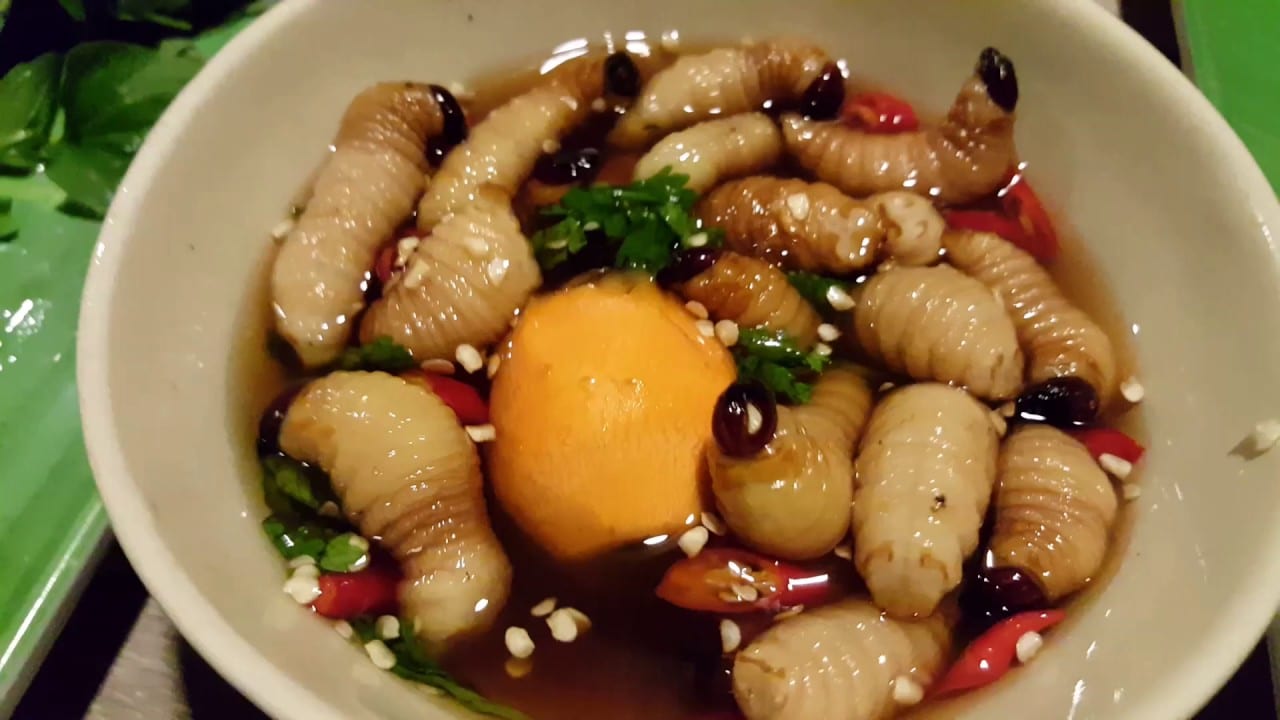
Coconut worms
Coconut worm, a form of beetle larvae, are a specialty of the Mekong Delta. There are at least 10 different ways of cooking them, but some people believe that coconut worms taste best when they are still alive.
It may be a little scary at first when the worms are still wiggling in your chopsticks, but don’t worry and just enjoy the explosive taste.
Want more flavor? Try it with a little fish sauce and don’t forget a glass of cold beer.
Blood pudding
As the name suggests, this dish is made from the blood of mostly pigs and ducks and seasoned with fish sauce.
It is served as an appetizer. However, the dish is not highly recommended since it may contain harmful bacteria that can lead to foodborne diseases.
Fermented shrimp paste
Shrimp paste is an indispensable part of Vietnamese cuisine. It’s smelly but tasty.
Sometimes compared to Australia vegemite, fermented shrimp paste is a popular dipping sauce served along with rice vermicelli dishes.
Thanks to the increased popularity of Vietnamese food, shrimp paste has won over many foreign fans.
Cobra heart wine
Do you have the courage to drink a glass of Vietnamese rice wine with a beating snake heart inside? It sounds scary but not to worry, just breathe and drink. And remember, do not chew the heart, just swallow it.
This kind of wine is believed to have many health benefits, including enhancing men’s sexual prowess.
“Kong” director Jordan Vogt-Roberts and chef Gordon Ramsey tried it. How about you?
The central bank has reported healthy liquidity in the foreign currency market and a stable exchange rate.
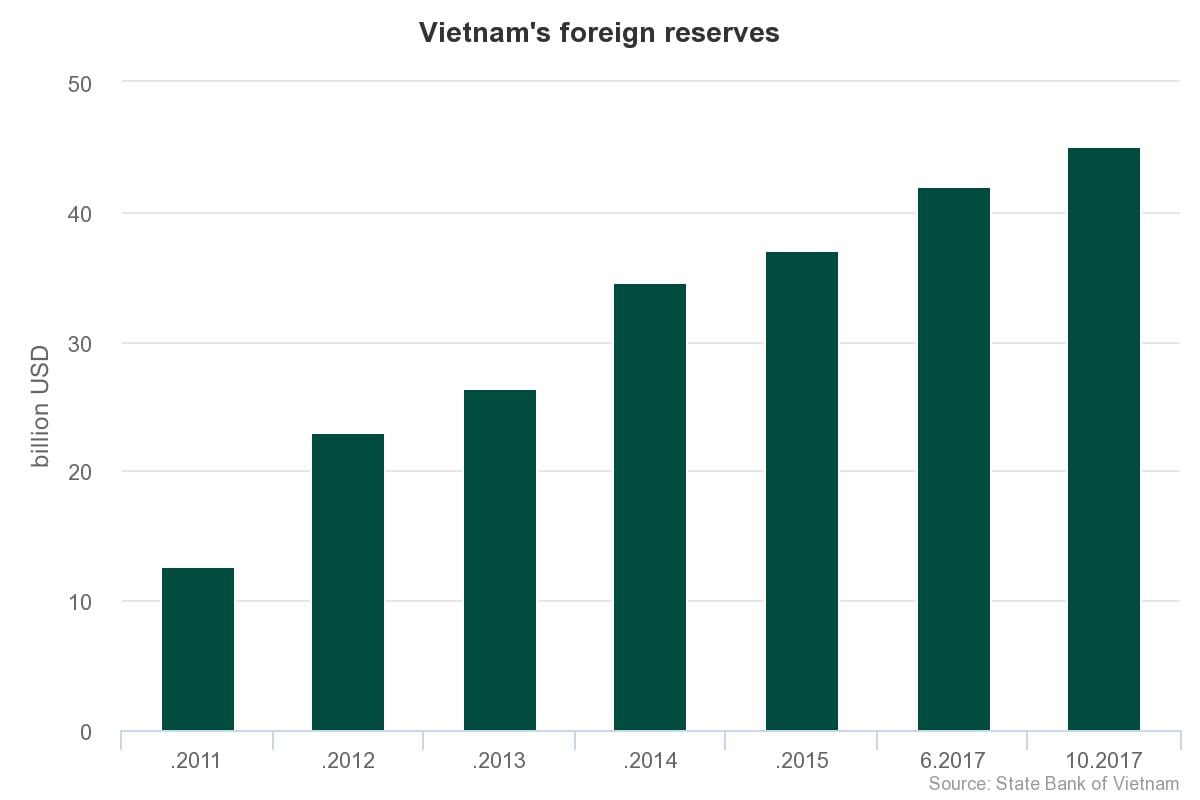
Vietnam’s foreign reserves have grown by more than 15 percent since the end of last year to reach their highest ever level, Party leader Nguyen Phu Trong said on Wednesday.
Trong was addressing a major Party meeting and reported that the country’s foreign reserves have reached $45 billion, which is around $6 billion higher than in late 2016.
The latest landmark surpasses the previous record of $42 billion announced in July, when the central bank reported a stable U.S. dollar exchange rate and healthy liquidity in the foreign currency market.
The dollar/dong rate in the banking system has been falling this week. The buying rate at major lender Vietcombank stood at VND22,685 on Thursday.
Vietnam’s foreign exchange reserves fell sharply to $27.9 billion at the end of 2015 during a campaign to curb dollar hoarding and stabilize the foreign exchange market.
Last year, the central bank decided to ease exchange rate rules, setting the official mid-point rate of the Vietnamese dong against the U.S. dollar on a daily basis.
Vietnam previously used a system that permitted the dong to trade around a fixed range that the central bank adjusted from time to time.
V.League 1 side Hoàng Anh Gia Lai (HAGL) will sign a two-year contract with South Korean coach Chung Hae-seong, the club has announced. Under the contract, Chung will be the team’s technical director.
The 59-year-old Chung was chief assistant coach of the South Korean national team at the Sydney Olympics in 2000. After that, Chung was assistant coach of Guus Hiddink’s South Korea national team competing in the 2002 South Korea-Japan World Cup.
Alongside coach Huh Jung-moo, he led the South Korean team to round 16 in the 2010 South Africa World Cup.
From 2003-07, he led Jeju United FC to second place in the 2004 FA cup, fourth place in the 2005 K-league and semi-final places in the 2007 FA cup. From 2010 to 2012, Chung trained Jeonnam Dragons FC.
HAGL will officially sign the contract with Chung on October 18 in HCM City. Chung’s first match with HAGL will be against Quảng Nam at the Vietnamese national premier league on October 21.
At present, HAGL rank 12 out of 14 teams in the league with 20 points after 20 rounds.
The duo of Vietnamese top tennis player Ly Hoang Nam and Japanese Ito Yuichi earned the chance to compete in the doubles final of the Thailand F8 Men’s Futures tennis tournament yesterday.
The pair beat No 1 seed N Vijay Sundar Prashanth and Karunuday Singh of India 6-2, 6-0 in the semi-final and will battle Pruchya Isaro of Thailand and Masato Shiga of Japan for the title.
Earlier, Nam lost to second seed Australian Max Purcell 1-6, 4-6 in the quarter-finals of singles event.
The Tay Ninh Province-born player Nam now ranks 520th in the world. In 2015, Nam and Sumit Nagal of India won the Wimbledon boys’ doubles.
Flooding and rain have become a matter of course, whether the city can handle it or not.
Motorbike drivers support each other as they push through strong-flowing water. Deadly incidents of people being swept down drain holes on rainy days are not uncommon in Vietnam.
A rough ride from school for this father and son.
A driver waits for help after his car breaks down thanks to a soaking ride.
Two women stand and watch as their house is flooded. “It happened so fast there’s nothing we could do,” one of them said.
The usual traffic outside Tan Son Nhat International Airport just gets worse after the rain.
Chaos on one of the roads connecting the airport with the city center.
Frustration escalates as a car suddenly breaks down in the middle of the road.
Flooding has become a year-round chronic problem in the modern megacity despite numerous expensive projects planned and launched to tackle the issue.
Now take a look back at another quite similar episode of motorbikes versus flooding in the city captured in May this year.
Vietnam needs to set up a set of standards on smart urban areas to shape sustainable development of cities, and set criteria for assessing the quality of life and services provided to the community, experts say.
To solve the problems arising from rapid urbanization such as traffic congestion, lack of parking space and administrative overload, modern technologies should be used to monitor and support management and bring better life to people.
A smart city is understood as an urban area with modern infrastructure and the application of IT that serves the management of the area.
In October 2015, the International Telecommunication Union (ITU) defined a smart city: “A smart sustainable city is an innovative city that uses information and communication technologies (ICTs) and other means to improve quality of life, efficiency of urban operation and services, and competitiveness, while ensuring that it meets the needs of present and future generations with respect to economic, social, environmental as well as cultural aspects.”
According to experts, smart cities are divided into four layers – sensor, network, platform and application layers. With the structure, core technologies are concentrated in the application layer, considered the most important central technology infrastructure. Information technology is considered a tool to connect technology infrastructure of smart cities.
Smart citites can also be understood as an organic connection between technology, people and institutional components.
In late 2015, the PM approved the national program on applying IT in the operations of state agencies with an aim to deploy smart cities in at least three localities in accordance with the criteria set by the Ministry of Information & Communication.
The Communist Party Congress’s Resolution also emphasized that Vietnam prioritizes the development of smart cities.
Many cities and provinces including Hue, Da Nang, Quang Ninh, HCMC, Phu Quoc Island, Lam Dong and Binh Duong have kicked off projects on smart city development.
A research work by Nguyen Van Khoi, Pham Le Cuong and Ha Minh Hiep from STAMEQ shows that there is a growing tendency of developing core technologies to serve as the fundamental for smart urban area’s infrastructure.
This means that every smart urban area focuses on developing certain groups of core technologies such as transport, environment, high technology and IT.
Intelligent traffic technology, for example, enhances the efficiency and quality of urban traffic through surveillance cameras, remote sensing and data analysis technologies to manage the traffic output and cargo circulation in real time.
Another trend in smart city deployment is the development of new IT services to increase government connections and the connections between government and people and businesses, and enhance accountability and government transparency.
Miss Vietnam 2016 Do My Linh was stuck in floods in Yen Bai Province while doing a charity project in the area on October 11.
My Linh and her crew went to Cu Vai Village for a charity project about using solar power to bring electricity to the mountainous areas. However, due to heavy rains, floods and landslides, Cu Vai Village was isolated.
Miss Vietnam 2016 Do My Linh walks on a muddy road in Cu Vai on October 11.
Linh’s co-workers said they lost contact with her the whole day on October 11. On October 12, Linh went on the social media and assured her fans about her safety and said that they were still trying to complete the project. She hoped for the rains to stop quickly to prevent more damage to the mountainous areas.
According to Linh, after living in a house without a door, there is no power and their meals only consist of bamboo shoots and rice, she was even more determined to complete the project.
In the morning of October 12, My Linh was still stuck in Cu Vai. However, she has to go to China in eight days to participate in Miss World 2017.
Miss Vietnam 2016 Do My Linh walks on a muddy road in Cu Vai on October 11.
Yen Bai provincial authorities are trying to restore phone signals and connection with the village. The only way to currently access the village is to walk a 6-km-long mud road and face possible landslides.
The city’s tourism department has been criticized for making proposals on such a ‘sensitive’ topic.
Top authorities in Saigon have turned down a proposal by the city’s tourism department to charge visitors an extra fee for overnight stays.
Tran Vinh Tuyen, the city’s vice chairman, asserted that the city has no intention of considering such fees. The tourism department’s director has also been criticized for “making proposals on sensitive topics that affect the tourism environment,” according to Tuoi Tre (Youth) newspaper.
The department filed the proposal last month, suggesting the city impose a tax of VND23,000 ($1) per night on all visitors using accommodation in the city. This money would then go to the city’s proposed tourism development fund, to be spent on promotional campaigns and staff training.
Tourism officials said the request follows the revised Tourism Law which will take force next January and includes a new national tourism development fund that will draw cash from the state budget, visa fees and entrance tickets.
Following the tourism department’s proposal, the city’s finance department was tasked with researching it. Vo Van Hoan, the city’s chief of staff, has however denied giving such instructions, claiming he had never heard of it.
Earlier this year, the tourism ministry proposed a similar fee to be imposed on foreign tourists staying in local hotels across the country. This proposal was rejected because many dismissed it as “discriminatory.”
Saigon is among the top tourist destinations in Vietnam, being home to many historical sites and the country’s most vibrant commercial center.
The southern megacity drew 5.2 million foreign visitors and 21.8 million Vietnamese last year, both up 10 percent from the year before. Its tourism sector raked in VND103 trillion ($4.5 billion) that same year, a 9 percent increase against 2015, according to the city’s figures.
Despite the failure of the national automobile industry development plan, Vietnamese companies have never given up the dream of making cars.
Bui Ngoc Huyen, general director of Vinaxuki, a Vietnamese auto manufacturer, said the biggest problem for Vietnamese manufacturers is the difficulty in accessing financial sources.
It is very difficult for businesses to borrow money for long time and at low interest rates. Vinaxuki, for example, has to have commercial loans with interest rates of up to 20 percent.
Huyen said that if manufacturers can arrange capital, making Vietnamese branded cars would not be too difficult.
With powerful financial capability, manufacturers can hire the world’s leading design centers to design car models and attract high-quality specialists.
When the designs are completed, it is necessary to make a prototype and then a chassis.
A chassis production line, run with high accuracy and productivity, can be imported for several hundreds of millions of dollars. Some Vietnamese enterprises are considering importing modern production lines which are completely automatic, with robots and dozens of workers.
Also according to Huyen, with the chassis, some car parts and assembling, painting and examining lines, the localization ratio may reach 50 percent.
If manufacturers want to have locally made content ratio of 60 percent and more, they need to manufacture engines. As the era of electric-run cars has arrived, it will be better to strive to develop electricity engines.
Nguyen Minh Dong, former designer of Volkswagen, commented that there are favorable conditions for purchasing automotive technology, from design to chassis, from software to motors. If manufacturers have powerful financial capability, they can buy advanced technologies and hire talented specialists.
The important thing is to have the design of the whole car. “Each car contains tens of thousands of car parts. You can’t just buy car parts and assemble them to make a fully worked out car. There must be standards and compatibility,” he explained. “Parts need to operate in harmony and fit together to obtain the desired performance.”
Therefore, he thinks that manufacturers need to cooperate with a strategic partner to receive technology transfer, support in design and help in selecting car part suppliers.
“After technology transfer, manufacturers need to develop products and new independent technologies in accordance with their directions and strategies,” he said.
An automobile engineer pointed out that Vietnam-made cars, when they come out, will have weak brands. Therefore, he suggested it would be better to choose well-known car part suppliers.
“The fame of the suppliers will help with the marketing for cars,” he said.