Around 70,000 workers are needed in HCM City for the remaining months of the year, mostly in garments and textiles, sales, services, logistics and IT, according to the HCM City Human Resources Forecast and Labour Market Information (Falmi) Centre.
Many workers, however, are reluctant to change jobs because of the bonus they receive at year end.
A report from the recruiting firm, the Navigos Group, which includes the online recruitment portal VietnamWork and executive search firm Navigos Search, said that several companies were willing to offer bonuses to new employees to compensate for the loss.
The labor market in the power sector is expected to thrive after a long quiet period as thermal power is forecast to continue to expand to meet electricity demand in Việt Nam.
Many solar energy projects from foreign investors are being proposed in localities throughout the country.
The cost of buying and installing solar panels has decreased significantly, while the government has policies to encourage investment in solar energy.
High demand for managers
According to Navigos Search, recruitment demand for mid- and senior-level positions by the firm’s clients rose in the last quarter, with 19 per cent compared to the same period last year.
The industries which had the highest recruitment demand in this managerial segment included banking and finance, consumer goods and retail, ICT, manufacturing and services.
In the banking and finance industry, the highest demand was from banks, insurance companies and consumer finance companies. In the service industry, the recruitment demand was mostly from companies in advertising and marketing.
The demand in ICT ranked third, with most of the jobs in IT services and system integration. The positions were primarily for managers and engineers experienced in different programming languages.
According to Navigos Search, some multinational companies in the consumer goods industry in the last quarter were struggling to recruit regional sales managers, especially in the northern mountainous area of the country.
Experienced candidates are not interested in taking jobs in this area, and less experienced candidates do not meet the requirements of the employers.
In addition, English is a weakness of mid-level sales managers in the northern area.
The emergence of international fashion brands in Việt Nam has opened up more employment opportunities for Vietnamese candidates at all levels.
In the retail industry, mergers and acquisitions (M&A) are still ongoing. Some leading Vietnamese brands have been acquired by corporations from Japan and Thailand. The M&A deals have created opportunities for Vietnamese staff to access international working styles and professional chain management.
As for salaries, the highest pay is for senior-level management positions in the consumer goods industry, with nearly VNĐ300 million (US$13,157) per month.
Salaries for mid- and senior-level managers in various industries, such as real estate, banking, ICT and manufacturing, range from VNĐ100 million to VNĐ220 million ($4.385-9.649) per month.
The Falmi Centre reported that recruitment demand for workers in the last quarter rose by nearly 24 per cent compared to the same period last year.
Suck it up and forget what’s on the plate in front of you for a lively taste of Vietnam.
Diverse in tastes and ingredients, Vietnamese cuisine has won the hearts of many foreigners for its elegance and novelty.
But if you only try the eye-catching, attractive looking dishes, you are definitely missing out on one of the best things about Vietnamese cuisine: adventure!
So, we dare you to try all these dishes.
Coconut worms
Coconut worm, a form of beetle larvae, are a specialty of the Mekong Delta. There are at least 10 different ways of cooking them, but some people believe that coconut worms taste best when they are still alive.
It may be a little scary at first when the worms are still wiggling in your chopsticks, but don’t worry and just enjoy the explosive taste.
Want more flavor? Try it with a little fish sauce and don’t forget a glass of cold beer.
Blood pudding
As the name suggests, this dish is made from the blood of mostly pigs and ducks and seasoned with fish sauce.
It is served as an appetizer. However, the dish is not highly recommended since it may contain harmful bacteria that can lead to foodborne diseases.
Fermented shrimp paste
Shrimp paste is an indispensable part of Vietnamese cuisine. It’s smelly but tasty.
Sometimes compared to Australia vegemite, fermented shrimp paste is a popular dipping sauce served along with rice vermicelli dishes.
Thanks to the increased popularity of Vietnamese food, shrimp paste has won over many foreign fans.
Cobra heart wine
Do you have the courage to drink a glass of Vietnamese rice wine with a beating snake heart inside? It sounds scary but not to worry, just breathe and drink. And remember, do not chew the heart, just swallow it.
This kind of wine is believed to have many health benefits, including enhancing men’s sexual prowess.
“Kong” director Jordan Vogt-Roberts and chef Gordon Ramsey tried it. How about you?
The central bank has reported healthy liquidity in the foreign currency market and a stable exchange rate.
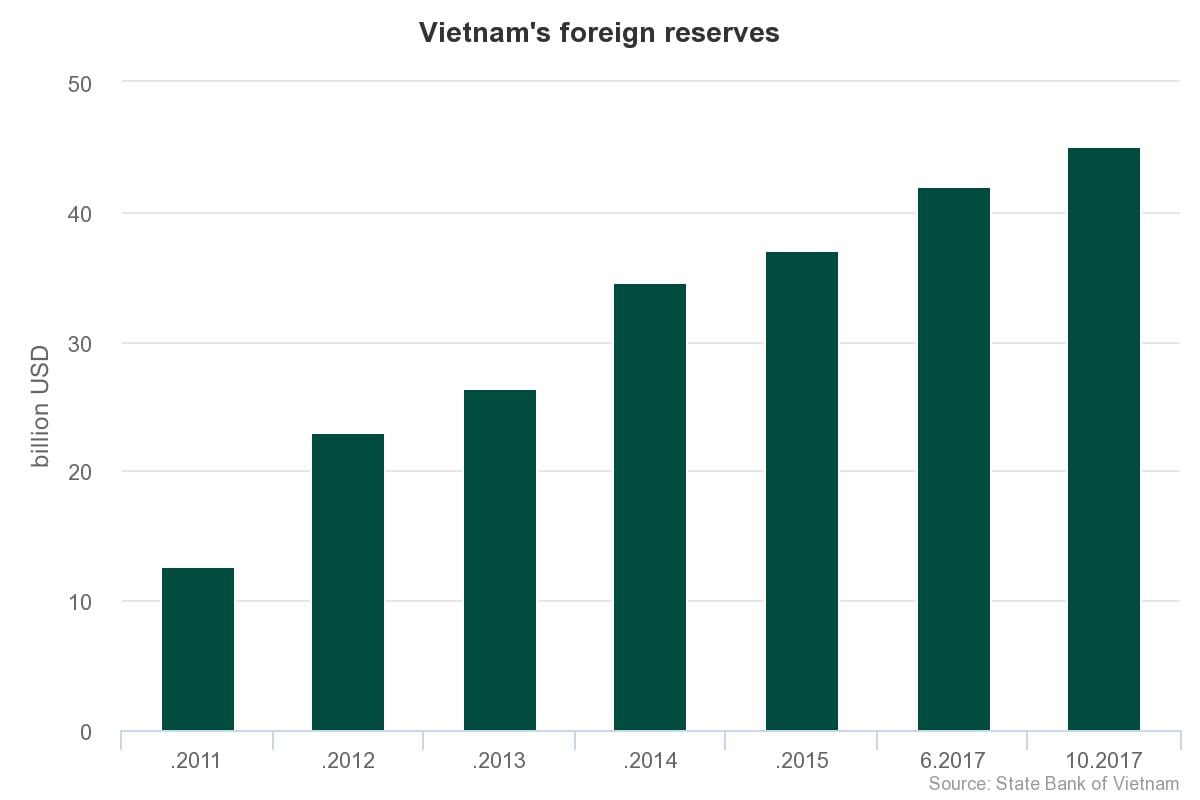
Vietnam’s foreign reserves have grown by more than 15 percent since the end of last year to reach their highest ever level, Party leader Nguyen Phu Trong said on Wednesday.
Trong was addressing a major Party meeting and reported that the country’s foreign reserves have reached $45 billion, which is around $6 billion higher than in late 2016.
The latest landmark surpasses the previous record of $42 billion announced in July, when the central bank reported a stable U.S. dollar exchange rate and healthy liquidity in the foreign currency market.
The dollar/dong rate in the banking system has been falling this week. The buying rate at major lender Vietcombank stood at VND22,685 on Thursday.
Vietnam’s foreign exchange reserves fell sharply to $27.9 billion at the end of 2015 during a campaign to curb dollar hoarding and stabilize the foreign exchange market.
Last year, the central bank decided to ease exchange rate rules, setting the official mid-point rate of the Vietnamese dong against the U.S. dollar on a daily basis.
Vietnam previously used a system that permitted the dong to trade around a fixed range that the central bank adjusted from time to time.
V.League 1 side Hoàng Anh Gia Lai (HAGL) will sign a two-year contract with South Korean coach Chung Hae-seong, the club has announced. Under the contract, Chung will be the team’s technical director.
The 59-year-old Chung was chief assistant coach of the South Korean national team at the Sydney Olympics in 2000. After that, Chung was assistant coach of Guus Hiddink’s South Korea national team competing in the 2002 South Korea-Japan World Cup.
Alongside coach Huh Jung-moo, he led the South Korean team to round 16 in the 2010 South Africa World Cup.
From 2003-07, he led Jeju United FC to second place in the 2004 FA cup, fourth place in the 2005 K-league and semi-final places in the 2007 FA cup. From 2010 to 2012, Chung trained Jeonnam Dragons FC.
HAGL will officially sign the contract with Chung on October 18 in HCM City. Chung’s first match with HAGL will be against Quảng Nam at the Vietnamese national premier league on October 21.
At present, HAGL rank 12 out of 14 teams in the league with 20 points after 20 rounds.
The duo of Vietnamese top tennis player Ly Hoang Nam and Japanese Ito Yuichi earned the chance to compete in the doubles final of the Thailand F8 Men’s Futures tennis tournament yesterday.
The pair beat No 1 seed N Vijay Sundar Prashanth and Karunuday Singh of India 6-2, 6-0 in the semi-final and will battle Pruchya Isaro of Thailand and Masato Shiga of Japan for the title.
Earlier, Nam lost to second seed Australian Max Purcell 1-6, 4-6 in the quarter-finals of singles event.
The Tay Ninh Province-born player Nam now ranks 520th in the world. In 2015, Nam and Sumit Nagal of India won the Wimbledon boys’ doubles.
Flooding and rain have become a matter of course, whether the city can handle it or not.
Motorbike drivers support each other as they push through strong-flowing water. Deadly incidents of people being swept down drain holes on rainy days are not uncommon in Vietnam.
A rough ride from school for this father and son.
A driver waits for help after his car breaks down thanks to a soaking ride.
Two women stand and watch as their house is flooded. “It happened so fast there’s nothing we could do,” one of them said.
The usual traffic outside Tan Son Nhat International Airport just gets worse after the rain.
Chaos on one of the roads connecting the airport with the city center.
Frustration escalates as a car suddenly breaks down in the middle of the road.
Flooding has become a year-round chronic problem in the modern megacity despite numerous expensive projects planned and launched to tackle the issue.
Now take a look back at another quite similar episode of motorbikes versus flooding in the city captured in May this year.
Vietnam needs to set up a set of standards on smart urban areas to shape sustainable development of cities, and set criteria for assessing the quality of life and services provided to the community, experts say.
To solve the problems arising from rapid urbanization such as traffic congestion, lack of parking space and administrative overload, modern technologies should be used to monitor and support management and bring better life to people.
A smart city is understood as an urban area with modern infrastructure and the application of IT that serves the management of the area.
In October 2015, the International Telecommunication Union (ITU) defined a smart city: “A smart sustainable city is an innovative city that uses information and communication technologies (ICTs) and other means to improve quality of life, efficiency of urban operation and services, and competitiveness, while ensuring that it meets the needs of present and future generations with respect to economic, social, environmental as well as cultural aspects.”
According to experts, smart cities are divided into four layers – sensor, network, platform and application layers. With the structure, core technologies are concentrated in the application layer, considered the most important central technology infrastructure. Information technology is considered a tool to connect technology infrastructure of smart cities.
Smart citites can also be understood as an organic connection between technology, people and institutional components.
In late 2015, the PM approved the national program on applying IT in the operations of state agencies with an aim to deploy smart cities in at least three localities in accordance with the criteria set by the Ministry of Information & Communication.
The Communist Party Congress’s Resolution also emphasized that Vietnam prioritizes the development of smart cities.
Many cities and provinces including Hue, Da Nang, Quang Ninh, HCMC, Phu Quoc Island, Lam Dong and Binh Duong have kicked off projects on smart city development.
A research work by Nguyen Van Khoi, Pham Le Cuong and Ha Minh Hiep from STAMEQ shows that there is a growing tendency of developing core technologies to serve as the fundamental for smart urban area’s infrastructure.
This means that every smart urban area focuses on developing certain groups of core technologies such as transport, environment, high technology and IT.
Intelligent traffic technology, for example, enhances the efficiency and quality of urban traffic through surveillance cameras, remote sensing and data analysis technologies to manage the traffic output and cargo circulation in real time.
Another trend in smart city deployment is the development of new IT services to increase government connections and the connections between government and people and businesses, and enhance accountability and government transparency.
Miss Vietnam 2016 Do My Linh was stuck in floods in Yen Bai Province while doing a charity project in the area on October 11.
My Linh and her crew went to Cu Vai Village for a charity project about using solar power to bring electricity to the mountainous areas. However, due to heavy rains, floods and landslides, Cu Vai Village was isolated.
Miss Vietnam 2016 Do My Linh walks on a muddy road in Cu Vai on October 11.
Linh’s co-workers said they lost contact with her the whole day on October 11. On October 12, Linh went on the social media and assured her fans about her safety and said that they were still trying to complete the project. She hoped for the rains to stop quickly to prevent more damage to the mountainous areas.
According to Linh, after living in a house without a door, there is no power and their meals only consist of bamboo shoots and rice, she was even more determined to complete the project.
In the morning of October 12, My Linh was still stuck in Cu Vai. However, she has to go to China in eight days to participate in Miss World 2017.
Miss Vietnam 2016 Do My Linh walks on a muddy road in Cu Vai on October 11.
Yen Bai provincial authorities are trying to restore phone signals and connection with the village. The only way to currently access the village is to walk a 6-km-long mud road and face possible landslides.
The city’s tourism department has been criticized for making proposals on such a ‘sensitive’ topic.
Top authorities in Saigon have turned down a proposal by the city’s tourism department to charge visitors an extra fee for overnight stays.
Tran Vinh Tuyen, the city’s vice chairman, asserted that the city has no intention of considering such fees. The tourism department’s director has also been criticized for “making proposals on sensitive topics that affect the tourism environment,” according to Tuoi Tre (Youth) newspaper.
The department filed the proposal last month, suggesting the city impose a tax of VND23,000 ($1) per night on all visitors using accommodation in the city. This money would then go to the city’s proposed tourism development fund, to be spent on promotional campaigns and staff training.
Tourism officials said the request follows the revised Tourism Law which will take force next January and includes a new national tourism development fund that will draw cash from the state budget, visa fees and entrance tickets.
Following the tourism department’s proposal, the city’s finance department was tasked with researching it. Vo Van Hoan, the city’s chief of staff, has however denied giving such instructions, claiming he had never heard of it.
Earlier this year, the tourism ministry proposed a similar fee to be imposed on foreign tourists staying in local hotels across the country. This proposal was rejected because many dismissed it as “discriminatory.”
Saigon is among the top tourist destinations in Vietnam, being home to many historical sites and the country’s most vibrant commercial center.
The southern megacity drew 5.2 million foreign visitors and 21.8 million Vietnamese last year, both up 10 percent from the year before. Its tourism sector raked in VND103 trillion ($4.5 billion) that same year, a 9 percent increase against 2015, according to the city’s figures.
Despite the failure of the national automobile industry development plan, Vietnamese companies have never given up the dream of making cars.
Bui Ngoc Huyen, general director of Vinaxuki, a Vietnamese auto manufacturer, said the biggest problem for Vietnamese manufacturers is the difficulty in accessing financial sources.
It is very difficult for businesses to borrow money for long time and at low interest rates. Vinaxuki, for example, has to have commercial loans with interest rates of up to 20 percent.
Huyen said that if manufacturers can arrange capital, making Vietnamese branded cars would not be too difficult.
With powerful financial capability, manufacturers can hire the world’s leading design centers to design car models and attract high-quality specialists.
When the designs are completed, it is necessary to make a prototype and then a chassis.
A chassis production line, run with high accuracy and productivity, can be imported for several hundreds of millions of dollars. Some Vietnamese enterprises are considering importing modern production lines which are completely automatic, with robots and dozens of workers.
Also according to Huyen, with the chassis, some car parts and assembling, painting and examining lines, the localization ratio may reach 50 percent.
If manufacturers want to have locally made content ratio of 60 percent and more, they need to manufacture engines. As the era of electric-run cars has arrived, it will be better to strive to develop electricity engines.
Nguyen Minh Dong, former designer of Volkswagen, commented that there are favorable conditions for purchasing automotive technology, from design to chassis, from software to motors. If manufacturers have powerful financial capability, they can buy advanced technologies and hire talented specialists.
The important thing is to have the design of the whole car. “Each car contains tens of thousands of car parts. You can’t just buy car parts and assemble them to make a fully worked out car. There must be standards and compatibility,” he explained. “Parts need to operate in harmony and fit together to obtain the desired performance.”
Therefore, he thinks that manufacturers need to cooperate with a strategic partner to receive technology transfer, support in design and help in selecting car part suppliers.
“After technology transfer, manufacturers need to develop products and new independent technologies in accordance with their directions and strategies,” he said.
An automobile engineer pointed out that Vietnam-made cars, when they come out, will have weak brands. Therefore, he suggested it would be better to choose well-known car part suppliers.
“The fame of the suppliers will help with the marketing for cars,” he said.
New statistics show a five-star hotel room in the capital now costs an average of $151 a night, compared to $118 in Saigon.
Five-star hotels in Hanoi have raised prices by 38 percent on average since last year and are charging significantly more than their peers in Saigon, with statistics showing a strong increase in the capital’s international arrivals in the first nine months.
A report from real estate consultancy firm Savills showed Hanoi’s luxury hotels charged an average of $151 per night in the third quarter, which was a slight drop compared to what spring holidaymakers had to pay, but a massive leap from a year ago.
Room rates at three and four-star hotels also went up slightly to $48 and $73 per night, leaving the city’s average hotel fee at $108, up 26 percent from last year.
The industry’s supply has expanded 8 percent from last year to 9,840 rooms, but tourism figures show that arrivals have been growing at a much faster rate. International arrivals to Hanoi in the first nine months increased 24 percent on-year to around 3.5 million, according to the city’s statistics office.
Also according to Savills, Hanoi’s luxury hotels are now much more expensive than in Saigon, where five-star hotels now charge an average of $118 per night, compared to $67 for a four-star room and $43 for three-star accommodation.
The southern megacity, which received 4.2 million foreign visitors in the first nine months, plans to add more than 3,600 hotel rooms in the next three years.
Hanoi and Saigon, the country’s largest and most expensive cities, are also the top tourist destinations in Vietnam thanks to a mixture of historical sites and modern vibrancy.
In April, budget tourism site Price of Travel named the cities among the cheapest tourist spots in Asia for 2017, with daily expenses for a backpacker estimated at $18.16 in Hanoi and $18.33 in Saigon.
Hanoi, a 1,000-year-old city, was also named the cheapest travel destination by TripAdvisor travelers between 2014 and 2016. The travel site’s report last year estimated that a three-night holiday for two in Hanoi costs only $494, which is nearly four times less than New York, the most expensive travel destination in the ranking.
Seemingly priced out of the game, drivers, passengers and experts discuss the fate of local cab firms.
A phone call and a five-to-ten minute wait. A few more phone calls and a cab arrives…if you’re lucky. If not, an apology from the call center and you’re late for the airport.
That was three years ago, but now for many Vietnamese, the idea of dialing a taxi call center is an alien concept. In the new era of technology, Grab and Uber are beating street taxis with just the click of a button.
And it is not just the passengers who have been won over. Easy registration and flexible working hours have drawn over 50,000 cab drivers to work for Uber and Grab in Vietnam, with many leaving traditional taxi firms in search of a better living.
Vinasun, Vietnam’s biggest taxi firm in 2014, lost 8,000 drivers this year, almost half of its employees, while rival Mai Linh Taxi also lost 6,000 drivers.
A doomsday scenario for traditional taxi firms is foreseeable.
“I honestly don’t care if traditional taxis disappear,” Nguyen Huyen Trang, a 26-year-old Hanoian working in Saigon told . “Even if they do survive, I don’t think I need them.”
“It’s not worth investing in a motorbike when you’re lazy and afraid of being stopped by the traffic police,” Trang elaborated. “I’m not familiar with Saigon’s streets so it’s best just to book cheap Uber or Grab rides.”
A professional ride-hailing app user, Trang has no difficulty booking rides even late at night or early in the morning. She also books her rides to the airport – a destination still dominated by taxi companies.
In her six months as a Grab and Uber regular, Trang has only hailed a street taxi once when it was stormy.
“I was in a hurry,” Trang said. “If I hadn’t been I wouldn’t have minded waiting 5 or 10 minutes for an Uber or Grab.”
Trang went on to extol the perks of ride-hailing apps: clean cars and rating-aware drivers, hence a better attitude and a feeling of safety. She also expressed her distaste for traditional taxis that she said are outdated and often overcharge.
The comments section on multiple posts on social media agree with Trang. To the public, traditional taxis have long been associated with reckless driving, dirty seats, an unwillingness to take short journeys and the risk of being overcharged.
A video captured in July showing a Vinasun driver fighting with a call center operator for booking short trips confirms the stigma.
Vain attempts
Ta Long Hy, chairman of Vinasun, did not reply to calls on Tuesday as the company was in the middle of a media crisis.
From October 7-9, thousands of Vinasun taxis poured onto Saigon’s streets displaying red and yellow bumper stickers saying: “Grab and Uber must abide by Vietnamese law” and “Stop pilot scheme for Grab and Uber.”
While Hy told local media that the “drivers had stuck the stickers on themselves”, a video recorded shows a driver recalling how he had been instructed to add the bumper stickers by the company’s technical team.
A Vinasun taxi seen on the street on October 8, 2017 with bumper sticker saying “Grab and Uber must abide by Vietnamese law” – Photo: Hong Nhut
“We don’t have the spare money to do this to a company car,” the driver said. “Before, I earned VND800,000 to VND1,000,000 ($35-$44) a day. Now there are days when I go home without earning anything,” the driver said.
Officials from the Ministry of Industry and Trade told that the slogans were derogatory and may have violated the Competition Law.
Uber and Grab operate legally in Vietnam as part of a pilot scheme that also allows for 10 or more app-based ride-hailing services, including the apps launched by Vinasun and Mai Linh.
The taxi firms also plan to launch their own motorbike ride-hailing apps, but that hasn’t stopped Vinasun from threatening to sue Grab and Uber for unfair competition on multiple occasions.
But with fares almost double their rivals, their way out is limited.
“Before, these taxi firms formed associations that created rules and barriers,” said Huynh The Du, a public policy expert at the Fulbright Economics Teaching Program in Saigon. “They have been enjoying limited competition for a very long time, but now Grab and Uber are breaking down the wall.”
“Even if taxi firms are able to cut costs by eliminating these barriers, and Grab and Uber stop their price war, there’s still a big price gap,” Du continued.
“The evolution of technology can’t be reversed, and that’s the brutal truth for traditional taxi firms.”
Photo: Tri Thuc Tre
In search of a lifeline
With the price and service war seemingly already lost, driver and customer numbers may be the only light at the end of the tunnel for these taxi firms.
Nguyen Thi Thu Thuy, 59, a retiree who doesn’t own a mobile phone and relies completely on traditional taxis, thinks local road knowledge trumps all – a reason London’s black cabs and New York’s yellow cabs are also clinging to in the fight against ride-hailing apps.
“I like to hop into a taxi as soon as I hail one in the street, and traditional taxis, they know the roads,” Thuy said. “My daughter has booked Grab for me a few times but it was time-consuming. They just drive around not knowing exactly where they are going.”
But Trang, the Grab and Uber regular, found the idea amusing.
“Honestly, a lot of traditional taxis don’t know their way around either. I’d rather pay a cheap price and help the driver out using GPS.”
Against all odds, Vietnamese pride is another lifeline that could be thrown to traditional taxi firms.
“I support traditional taxis because they are Vietnamese firms,” Thuy said. “I think it’s better to have both kinds of taxis. The more competition there is, the better service customers receive.”
Grab drivers in a Facebook group also told that if they were offered a better salary, they’d be happy to switch to support a local business.
Bui Quang Huy, a 35-year-old who bought a new car to work full time as a Grab driver, thinks the competition is healthy. “It gives drivers like us more options,” he said.
Every day he earns VND500,000 to VND700,000 ($22-$31) working 10-to-12 hours straight. Huy estimates he needs three years to break even.
But regarding concerns of a future monopoly or limited competition, Du, the public policy expert, dismissed the notion with a laugh.
“There’s no need to worry about oligopoly when the traditional form of taxi disappears,” Du said. “The market is open to any brand of ride-hailing services, not just Grab and Uber.”
“There will come a time when the market, the number of drivers and their salaries balance themselves out,” he said.
“Any protests or threats of legal action are just temporary delays. Traditional taxis will have to transform or they’ll disappear.”
Telecom operator Vietnam Posts and Telecommunications Group (VNPT) expects to hold its initial public offering (IPO) in 2019, according to the group’s chairman Tran Manh Hung.
“There is still a lot of work to be done for the group’s IPO, such as selecting advisors, valuating the firm and seeking a strategic partner,” Hung told Dau tu (Investment) newspaper.
“The selection of advisors alone is a complicated process, as each component of the IPO plan will require a specific advisor to work on it. The VNPT will look for cooperation from foreign, reputable IPO advisors.”
He added that “the company will try to finalise its IPO portfolio and complete all the required procedures in 2018, then do the IPO in 2019”, as there were still problems with the firm’s IPO plan that required the Government to make the final decisions.
The preparation of the IPO will be carried out after the restructuring plan, which has been submitted to the Ministry of Information (MIC) and Communications and the Prime Minister, is approved, he said.
To complete the restructuring plan, the VNPT has founded a board, which specialises in the firm’s equitisation process, and asked its member companies to compile corporate reports.
The VNPT has completely restructured its three corporations, which are telecommunication services provider VNPT VinaPhone, network operator VNPT Net and value-added services provider VNPT Media.
New corporation
The VNPT has also proposed that the MIC establish a new corporation that would focus on technology development and produce both software and hardware components. The establishment of the fourth corporation under the management of VNPT has got the green light from the MIC.
After two years of restructuring, the information-technology sector of VNPT says it has made rapid and strong development in different fields.
The business unit has been able to develop and provide software applications for the Government, its agencies and ministries; smart city applications for provinces and cities; and products for other sectors, such as healthcare and education.
As part of the restructuring plan, the VNPT also wanted to hold 20 per cent in MobiFone to make up for the reduction of its charter capital when the latter split away in August 2014.
Two years later, the VNPT proposed that the Government allow it to spend parts of the income from the equitisation of MobiFone on the firm’s business activities.
Responding to the company’s request, the Prime Minister has assigned the MIC to develop the equitisation plan for MobiFone and submit that plan to the Government for review.
Park Hang Seo from the Republic of Korea (RoK) has officially become the head coach of the men’s national, U23 and Olympic football teams of Vietnam.
Park’s contract with the Vietnam Football Federation (VFF) lasts from October 2017 until the end of 2019.
Park Hang Seo, born in 1959, used to be a player of the RoK national team before starting a professional coaching career. He was known as the No 1 assistant of Guus Hiddink, who led the RoK team to the semi-finals of the World Cup 2002 and the RoK’s U23 team to win the bronze medal at the Asian Games in the same year.
He and his teams obtained many achievements at different tournaments of the RoK. Notably, he set a record in 2013 when he led the Sangju Sangmu FC with all players being RoK citizens to win 11 consecutive victories at the K.League Challenge.
Before the VFF inked the contract with Park, the football teams of Vietnam were temporarily led by Mai Duc Chung, head coach of the women’s national team. Chung replaced coach Nguyen Huu Thang, who resigned after the national U22 team was defeated at the 29th Southeast Asian Games (SEA Games 29) in Malaysia in August.
The first challenge to Park is to lead the national team in a match against Afghanistan at My Dinh Stadium, Hanoi, on November 14, within the fifth qualification round of the 2019 AFC Asian Cup.
The new coach expressed his hope to receive support from football fans and the media. He also wants to bring new vitality to the national, U23 and Olympic teams so that they will gain the best results at upcoming international events.
Now in its third year, the forum is the country’s biggest e-payment event.
World famous billionaire and Alibaba chairman Jack Ma is expected to visit Hanoi next month to attend a forum on e-payment services.
Now in its third year, the annual Vietnam E-Payment Forum (VEPF), co-hosted by VnExpress and the National Payment Corporation of Vietnam, provides an opportunity for the government, experts and businesses to sit down together and discuss the latest trends in e-payment services and the best ways to apply them in Vietnam.
This year, mobile payment will be in the spotlight.
As a speaker at the event, Jack Ma, founder and executive chairman of Chinese e-commerce giant Alibaba, will talk about his experiences of developing e-commerce and mobile payment services in China.
E-payment has gradually replaced cash in Vietnam’s northern neighbor, and these days, most Chinese people pay for products and services using their smartphones.
According to iResearch, the leading provider of online audience measurement and consumer insights in China, the mobile payment market was valued at $5.5 trillion last year in China, nearly 50 times greater than that of the U.S., and Ant Financial Service, a subsidiary of Alibaba, contributed a lion’s share of 54 percent.