

Strongly Affirming National Rights and the Spirit of Independence and Freedom
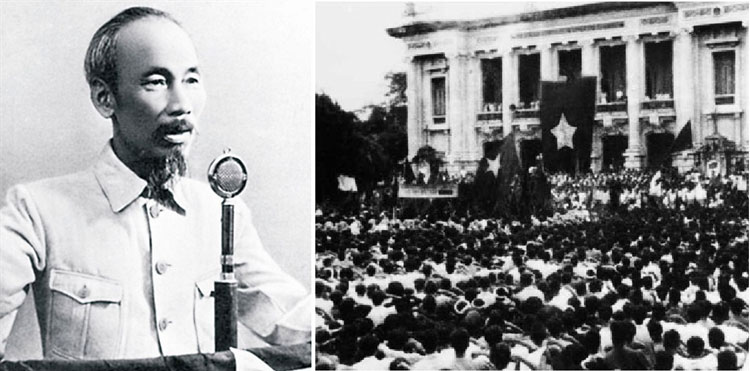
On September 2, 1945, at Ba Dinh Square (Hanoi), the first President of the Democratic Republic of the “new Vietnam” quoted the American Declaration of Independence: “All men are created equal, that they are endowed by their Creator with certain unalienable Rights, that among these are Life, Liberty and the pursuit of Happiness,” and the Declaration of the Rights of Man and of the Citizen of the French Revolution: “Men are born and remain free and equal in rights.”
From there, he broadened the scope to affirm: “All the nations on the earth are born equal; every nation has the right to live, to be happy and free.” From these “undeniable truths” regarding human rights, President Ho Chi Minh elevated them to the rights of nations upon giving birth to the Democratic Republic of Vietnam.

President Ho Chi Minh reading the Declaration of Independence at Ba Dinh Square on the afternoon of September 2, 1945. Photo: Archival material from the State Records and Archives Department
The independence and freedom of the nation are sacred and inviolable rights. They are inherent rights and universal values recognized by humanity. The Declaration of Independence declared to the world a reality that conforms with justice and that was taking place in Vietnam following the complete triumph of the August Revolution: “Vietnam has the right to be a free and independent country—and in fact is so already.”
When the independence and freedom of the nation are threatened, “The entire Vietnamese nation is determined to mobilize all their physical and mental strength, to sacrifice their lives and property in order to safeguard their independence and liberty.” Any foreign invading force will be struck back; any domestic saboteur will be punished. During the fierce years of the subsequent wars of resistance, that resolve was crystallized into the truth: “Nothing is more precious than independence and freedom.”
That spirit has accompanied the Vietnamese nation, creating illustrious exploits and glorious victories throughout the 20th century.
The August Revolution of 1945 affirmed human rights. It was a revolution of the people, carried out by the people and for the benefit of the people, bringing the rights of human beings to every citizen, aiming toward the goal of building a better society.
The people were both the driving force and the goal of liberation of the revolution. With the purpose of fighting for the fundamental rights of the nation and of humanity, striving for human happiness, this revolution embodied profound humanitarian significance. The Democratic Republic system—a universal achievement of human politics—was established for the first time in Vietnam, in alignment with the global democratic trend.

The Declaration of Independence displayed at the History Museum. Photo: Author’s archive
The Declaration of Independence of the Vietnamese people was also a warning bell signaling the collapse of the old-style colonial system—which had been formed through a process associated with aggression, the stripping of independence, and the enslavement of nations by colonial powers. The victory of the Vietnamese people’s revolution, followed immediately by the heroic resistance that successfully safeguarded independence, forged faith and served as a source of encouragement and support for oppressed nations to rise up and fight for their own independence.
Looking Toward a Developing Future
The nationwide uprising to “Rise up to restore our ancestral homeland” (Ho Chi Minh) opened a new revival for the Vietnamese nation. The victory of the struggle to regain independence also created the premise for building splendid achievements in the third revival in the nation’s history.
National independence and self-reliance are the fundamental bedrock and prerequisite conditions to promote geopolitical and geoeconomic potentials; to awaken, promote, and develop cultural heritage values, natural landscape resources, along with the cultural identity and people of Vietnam, striving for a prosperous and thriving Vietnam.
In the new context, national independence also encompasses equality and the right to self-determination in international relations, ensuring territorial integrity and national sovereignty; protecting and maintaining relations of friendship, cooperation, and mutual development on the basis of respect for each other’s interests among nations in economic connectivity, contributing to building common peace, friendship, prosperity, and progress.
The Declaration of Independence marked a historical turning point for the Vietnamese nation, ending the colonial and feudal regimes to usher in the Era of Independence and Freedom. After regaining and firmly safeguarding national independence, the Vietnamese people continue to build an increasingly developed and comprehensively progressive country: developing the economy and culture, elevating the material and spiritual lives of the people, and driving social development—all aimed at the goal of human happiness.
Quotations from the Declaration of Independence – Ho Chi Minh (2011): Complete Works, Volume 4 – National Political Publishing House, Hanoi, pp. 1–3.
Discover more from Vietnam Insider
Subscribe to get the latest posts sent to your email.