

For decades, international textile trade fairs have functioned as mirrors of industrial geography. Events in Shanghai, Frankfurt, or Guangzhou did not merely showcase products; they signaled where production capacity, innovation, and sourcing gravity were concentrated. Buyers attended not only to place orders, but to read the direction of the market.
In periods of structural stability, these fairs reinforced existing hierarchies. When disruption strikes, however, trade platforms begin to reveal shifts before official statistics fully capture them. The profile of exhibitors changes. The origin of buyers diversifies. Machinery suppliers follow new clusters. What appears to be a commercial exhibition often reflects a deeper reconfiguration of global production networks.
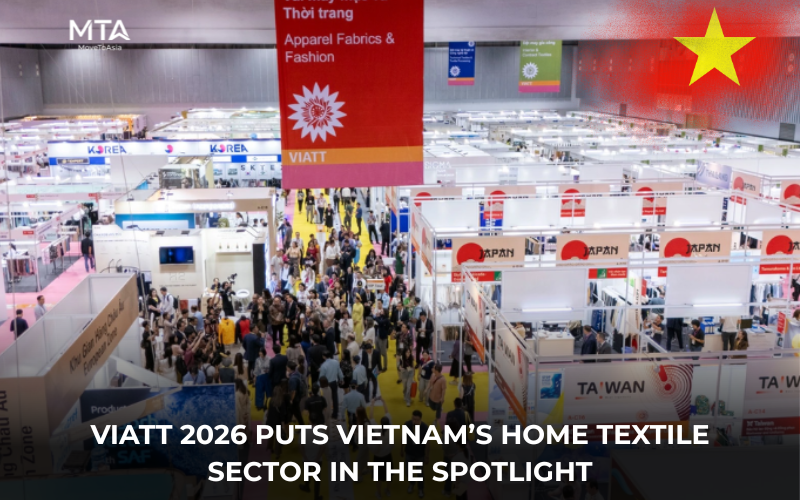
VIATT 2026, held in Ho Chi Minh City and organized by Messe Frankfurt, should be understood in this context. The event does not create Vietnam’s home textile industry. Rather, it provides a consolidated view of a sector that is gaining visibility within global sourcing strategies.
Yet greater visibility does not automatically imply industrial dominance. The prominence of Vietnam’s home textile manufacturers at an international fair must be interpreted as part of a broader diversification movement, not as a simple narrative of substitution.
From China-Centric Sourcing to ASEAN Diversification
The backdrop to VIATT 2026 is the gradual unwinding of a China-centric sourcing model that defined the home textile industry for more than twenty years. China’s scale, vertical integration, and logistical efficiency positioned it as the primary supplier of bedding, curtains, upholstery fabrics, and finished textile goods to Western markets.
That concentration, once seen as rational and efficient, became a structural vulnerability during the pandemic. Factory shutdowns, port congestion, and container shortages exposed the risks embedded in highly centralized production systems. At the same time, trade tensions between major economies introduced tariff volatility and political uncertainty into sourcing decisions.
In response, international brands accelerated China+1 strategies. The objective was not to abandon China entirely, but to distribute risk across multiple geographies. Southeast Asia, with its growing manufacturing base and trade agreement networks, emerged as a natural candidate.
Vietnam has been one of the primary beneficiaries of this reallocation. Over the past five years, incremental investment has flowed into spinning, weaving, cut-and-sew, and finishing operations. For home textiles, where product variety and compliance requirements are increasingly demanding, this capacity expansion is particularly significant.
VIATT 2026 should therefore be interpreted as a visible expression of this structural shift. The fair brings together Vietnamese producers, regional suppliers, and international buyers at a moment when sourcing diversification is no longer optional but embedded in procurement policy.

Vietnam’s Home Textile Industry Within the Broader Textile Economy
Vietnam’s textile and garment sector remains one of the country’s largest export industries. In 2025, textile and apparel exports exceeded USD 40 billion, placing Vietnam among the world’s top exporters in the category. While garments account for the majority of shipments, home textiles represent a growing sub-segment driven by bedding, cushions, and decorative fabric demand in Europe and North America.
The broader macroeconomic environment reinforces this trend. Vietnam’s GDP growth in 2025 approached 8 percent, supported by manufacturing expansion and export resilience. Total trade turnover neared USD 930 billion, underscoring the country’s integration into global supply chains. Manufacturing continues to absorb the largest share of foreign direct investment, with annual disbursed FDI in the processing and manufacturing sectors exceeding USD 27 billion.
Within textiles specifically, investment has gradually shifted upstream. Historically, Vietnam relied heavily on imported yarn and fabric. In recent years, additional weaving and dyeing projects have been approved in northern and southern industrial zones, partially strengthening domestic value chains.
For home textiles, this evolution matters. Products such as duvets, quilts, and curtains require not only sewing capacity but consistent fabric supply, quality finishing, and compliance with chemical regulations. The ability to consolidate these functions domestically improves lead-time control and tariff positioning under agreements such as the EVFTA and CPTPP.
Against this macro backdrop, VIATT 2026 reflects an industry that is expanding not only in volume but in capability.
VIATT as a Barometer of Sector Maturity
Trade fairs often reveal more through their composition than through promotional messaging. At VIATT 2026, the mix of finished home textile manufacturers, fabric suppliers, and machinery providers points to a progressively deepening ecosystem rather than a simple assembly base.
The presence of equipment and technology firms suggests ongoing investment in automation and process standardization, essential for scaling large retail programs where consistency is critical. International buyer participation further reflects a strategic shift, as sourcing teams increasingly map alternative production bases in Southeast Asia.
Yet visibility does not imply uniform maturity. Vietnam’s home textile sector remains uneven, with advanced, audit-ready factories operating alongside others still strengthening process discipline. In this sense, VIATT 2026 serves as a diagnostic snapshot of an industry expanding, but still consolidating.

More global buyers are turning to Vietnam as part of their China Plus One sourcing strategy.
Competitive positioning beyond labor cost
Vietnam’s competitiveness in home textiles is often reduced to labor cost comparisons (250 – 400 USD). While wage differentials with parts of coastal China remain relevant for labor-intensive operations (500 – 800 USD), cost arbitrage alone does not sustain long-term buyer engagement.
Increasingly, differentiation depends on process discipline, compliance integration, and production planning capability. Large retail programs require stability and transparency, making managerial depth as important as wage levels.
Regional dynamics also matter. Southern clusters around Ho Chi Minh City serve established export markets, while northern areas benefit from proximity to Chinese raw material supply chains. Vietnam’s positioning is therefore multidimensional, cost-competitive and increasingly capable, but not yet fully comparable to China’s integrated scale.
Industry Perspective
“Vietnam’s home textile sector has moved beyond pilot diversification. It is now part of structured sourcing portfolios, but execution standards remain decisive,” observes a regional supply chain analyst specializing in Southeast Asian manufacturing.
Caption: Regional textile supply chain analyst commenting on ASEAN diversification trends.
This assessment underscores a central theme: opportunity exists, yet disciplined engagement remains essential.
Upstream Sourcing Realities
Despite clear progress, upstream integration remains one of Vietnam’s structural challenges in home textiles. A substantial share of yarns and specialty fabrics is still imported from China, South Korea, or Taiwan, particularly for higher-specification products.
This reliance directly affects rules of origin under trade agreements such as the EVFTA, where fabric sourcing criteria determine tariff eligibility. It also influences lead times: imported inputs increase exposure to external disruption, while deeper domestic integration shortens production cycles and improves forecasting stability.
Supplier qualification adds further complexity. Fabric consistency, dye stability, and chemical compliance require systematic validation. Diversification without structured onboarding can introduce new operational risks. VIATT 2026 reflects this dual reality: expanding capability alongside transitional dependencies.
Compliance and Governance in Home Textiles
Compliance expectations in global textile markets continue to tighten. Environmental standards, chemical management, and social audits are now baseline requirements rather than competitive advantages.
Vietnamese export-oriented factories have improved audit readiness over time, but performance remains uneven. For large-scale home textile programs, scaling discipline production planning, documentation rigor, and management stability is as critical as certification.
Compliance should therefore be viewed as continuous governance, not a one-time qualification step. Buyers integrating Vietnam into sourcing portfolios increasingly apply ongoing monitoring frameworks.
Why Global Buyers Continue to Expand in Vietnam
Operational friction has not slowed order allocation to Vietnam. Instead, brands continue to rebalance regional exposure in favor of diversified production networks.
Political stability, expanding manufacturing capacity, and participation in major trade agreements reinforce Vietnam’s positioning. Infrastructure upgrades further support export logistics.

Understanding Vietnam’s business culture and working practices often requires support from trade fairs to sourcing partners on the ground.
Platforms such as VIATT reduce information asymmetry by consolidating suppliers and buyers in a single venue, facilitating structured evaluation. For global players, Vietnam is not a substitute but a complementary pillar within a diversified sourcing architecture.
VIATT 2026 as a Structural Signal
VIATT 2026 should be read less as a promotional showcase and more as an indicator of industrial consolidation. Trade fairs often reveal where production ecosystems are deepening.
Vietnam’s home textile sector is not displacing established manufacturing centers outright. It is integrating into a multi-country framework designed to absorb disruption and distribute risk.
In this sense, the fair represents a milestone within a broader supply chain redesign : one shaped by resilience, governance, and strategic diversification rather than opportunistic relocation.
Discover more from Vietnam Insider
Subscribe to get the latest posts sent to your email.