

Some signals show that Vietnam is a land with great potential to attract the world’s major chip manufacturers.
The big guys expand their investment
At the end of August, Nikkei Asia newspaper reported that Synopsys Company (USA) announced that it would train electrical engineers in Vietnam and support Ho Chi Minh City Hi-Tech Park (SHTP) to establish a chip design center through software sponsorship program.
It is one of the few American companies that dominate the global market for electronic design automation (EDA) or chip design software. Synopsys has 2 offices in Ho Chi Minh City and two in Da Nang with more than 400 employees. The company plans to hire about 300-400 more people.
According to Nikkei Asia, Synopsys’s latest move is a welcome one for Vietnam. Manufacturers like Apple and Panasonic are expanding in Vietnam, but growth in the chip industry was still relatively slow until Intel and Samsung started recoiling their investment two years ago.
The Nikkei Asia newspaper quoted Robert Li, Vice President of Sales for Synopsys in Taiwan and South Asia, as saying that through partnerships with foreign companies, Vietnam can start designing integrated circuits (ICs), such as ICs for refrigerators and air conditioners, and then up the industry value chain.
Earlier in early August, at a meeting with Prime Minister Pham Minh Chinh, Mr. Roh Tae-moon, General Director of Samsung Group (Korea), said that in the first 6 months of this year, the total export turnover of Samsung Vietnam Nam reached 34.3 billion USD, up about 18% over the same period last year. In 2022, Samsung sets an export turnover target of USD 69 billion, invests an additional USD 3.3 billion and will continue to expand investment in Vietnam.
In particular, this group is preparing conditions for trial production of grid chip semiconductor products and will mass production from July 2023 at Samsung Electro-Mechanics factory in Thai Nguyen. At the same time, Samsung plans to inaugurate a Research and Development Center (R&D) in Hanoi in late 2022 and early 2023. This is also Samsung Group’s R&D center not only for Vietnam but also for the whole region. Southeast Asia, currently about 85% complete.
Before Samsung, Vietnam had Intel Products Vietnam (IPV), which is the largest assembly and testing plant in the Intel Corporation network. During the global chip crisis, IPV not only maintained stable operations but also made a number of innovative contributions to help it fill the shortage in semiconductors.
According to experts, the investment by Intel and now Samsung (these are two of the three largest chip manufacturers in the world today) to invest in the production of semiconductor devices and components in Vietnam is considered an unprecedented step forward in attracting FDI enterprises to expand investment in high-tech fields in the coming time.
Vietnam also has a number of FDI enterprises involved in the production of semiconductor devices and components set foot in Vietnam. For example, earlier this year, Amkor Technology Company (Korea) signed an agreement to develop a plant project for manufacturing, assembling and testing semiconductor materials at Yen Phong 2C industrial park (Bac Ninh) with a total capital investment by 2035 is 1.6 billion USD.
The company manufactures, assembles and tests semiconductor materials, supplying strategic partners with leading electronics companies such as Qualcomm, Samsung, NVIDIA, Foxconn, Broadcom, LG, SK Hynix. The project is expected to be operational by the end of 2023.
Or Renesas Vietnam Design Company under Renesas Electronics Group (Japan) has been present for many years, specializing in the field of design, research and development of LSI chips and embedded software for mobile phones and vehicles. steam, photographic and video cameras serving the global market. This is one of the most important design centers of Renesas Electronics Group…

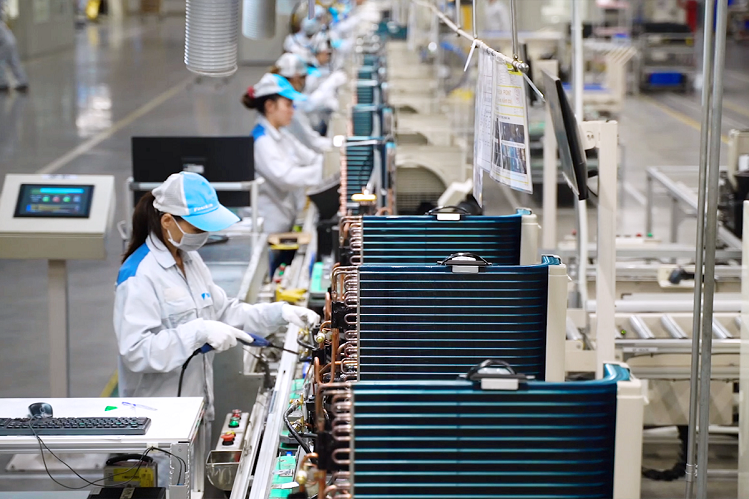
Many large chip investment groups in the world are paying attention to Vietnam. Photo: NG.NG
Not worry about lack of market
Mr. Do Khoa Tan, Deputy General Secretary of the Vietnam Electronic Business Association, said that the chip and semiconductor manufacturing corporations as well as the R&D centers of the world’s manufacturing corporations entering Vietnam are a bright spot for the high-tech industry. Simply put, any electronic device needs semiconductor components, especially household products. The demand for chips has started to increase.
For example, an electric car almost entirely uses chips to control. Since the COVID-19 pandemic, the supply of chips has been disrupted, especially for products used for cars, which has caused many countries to start boosting investment to produce this commodity. Although many companies have participated, the majority of the supply chain is still focused on 3 major manufacturers, TSMC (Taiwan), Samsung and Intel.
In particular, each corporation will have its own expertise in chips for computers, memory chips or chips for mobile devices… He added that in Vietnam when implementing electronic citizenship, it is necessary to chip to remember all the information of the people. This is the simplest type of chip, but currently, Vietnam cannot produce because the price is too expensive when the quantity is not large enough. Because in order to produce all kinds of chips, it is necessary to master technology. Next comes the huge investment and then the level of labor.
Mr. Do Khoa Tan emphasized: Vietnam has established microchip centers and has a microchip training department at universities, but almost only in the field of design. And the big investment to mass production will be very difficult.
Vietnam can hurry to attract corporations to expand investment in this high-tech industry. To do that, focus on training human resources. But if only independent training, with this industry graduates, will not be able to find jobs because the number of manufacturing factories is not much.
Universities and training centers need to have close links with corporations to provide customized training on content suitable to business goals and projects. Currently, high-quality human resources in the field of microchips in Vietnam are also highly appreciated, but are still lacking compared to the needs of many corporations when planning to expand production.
According to Prof. Dr. Dang Luong Mo, a scientist on microchips in Japan, the human resources for designing and making chips in Vietnam are already very crowded, very active with about 40-50 businesses, and thousands of good engineers. However, the most important for this industry is manufacturing, which requires huge investment capital from billions to tens of billions of dollars.
@ Cafef
Discover more from Vietnam Insider
Subscribe to get the latest posts sent to your email.