

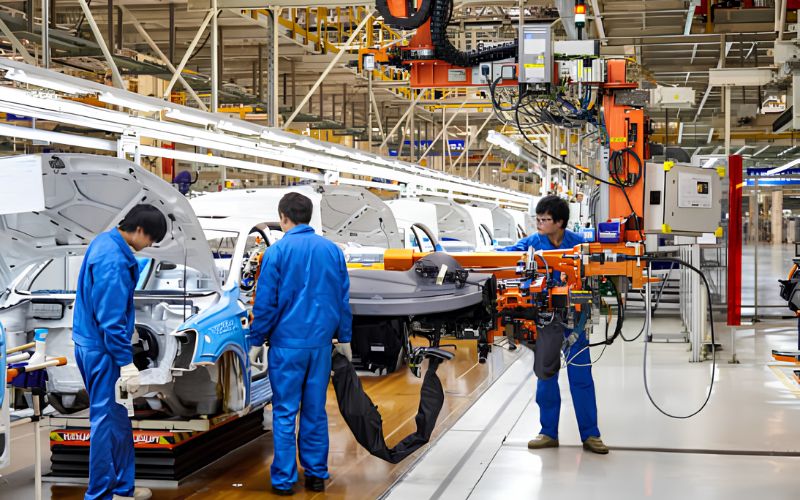
Vietnam’s automotive industry is gradually moving beyond vehicle assembly toward a broader manufacturing and supplier ecosystem. As vehicle production and investment develop, opportunities are emerging for Vietnamese suppliers of automotive components, precision parts, tooling, and manufacturing services. However, the extent of these opportunities depends on how well local suppliers can meet automotive quality, technical, and production requirements.
The change is still developing rather than complete. Vietnam has built competitive capabilities in several manufacturing areas, but many high-value and technology-intensive components remain dependent on imports. For automotive buyers, this makes Vietnam an increasingly relevant sourcing location, although the opportunities vary significantly by component and supplier capability.
What Is Driving the Growth of Vietnam’s Automotive Supply Chain?
Three developments are shaping Vietnam’s automotive supply chain.
- Growing production and investment are creating stronger demand for local suppliers. As vehicle manufacturers expand their operations, they need a wider network of companies capable of supplying components and production inputs consistently. Foreign investment also brings new technical requirements and opportunities for domestic suppliers to participate in international supply chains.
- Localization and supply-chain diversification are reinforcing this trend. Manufacturers are looking for ways to source closer to production and reduce excessive dependence on a single market. Vietnam’s established manufacturing base and position within Southeast Asia make it a natural candidate for this diversification.
- The expansion of electric vehicle production is also creating opportunities in electrical systems, electronics, battery-related components, and precision manufacturing. However, the extent to which Vietnamese suppliers can participate will depend on their technical capabilities, investment, and ability to meet customer qualification requirements.
These developments create a favorable environment for supplier development, but they do not guarantee that every automotive component can be sourced competitively in Vietnam. For a broader perspective on Vietnam’s business environment and investment opportunities, watch the video below.
How Vietnam’s Automotive Supplier Base Is Developing
The most important change is not simply the number of automotive companies operating in Vietnam. It is the gradual expansion of the activities they can support.
Vietnam already has suppliers working across areas such as metal processing, plastics, rubber products, wiring, tyres, seats, and other components. These capabilities build on the country’s wider manufacturing base and provide a foundation for deeper automotive localization.
The supplier structure is also becoming more layered. Alongside vehicle manufacturers and major Tier 1 suppliers, Tier 2 and Tier 3 companies are increasingly important for providing specialized components, materials, and processing services.
However, development remains uneven. Local suppliers are generally better positioned in components that rely on established manufacturing processes than in highly sophisticated systems requiring advanced engineering and technology. Key areas such as advanced electronics, semiconductors, and some high-value drivetrain components continue to depend heavily on overseas suppliers.
For buyers, this distinction is important: a growing supplier base does not automatically translate into a deeply localized automotive supply chain. The availability of local manufacturers must be assessed alongside their technical capabilities, quality systems, and readiness to meet specific automotive requirements.
Where Is Vietnam Competitive in Automotive Manufacturing?
Vietnam has several advantages that support further growth.
Manufacturing costs remain competitive, while the country has developed a broad industrial workforce and supporting industries in areas such as metalworking, plastics, machinery, and electronics. Its integration into Asian manufacturing networks also makes Vietnam relevant for companies looking to diversify regional production.
The bigger challenge is moving beyond cost and basic manufacturing capability.
Automotive customers require consistent quality, traceability, reliable delivery, engineering support, and the ability to maintain production at scale. Meeting these requirements can be difficult for smaller suppliers that have limited investment in technology, tooling, testing, or product development.
Localization is another gap. Vietnam still relies on imported components for many higher-value products, which limits how much of the automotive value chain can currently be supplied domestically.
For local manufacturers to move into more demanding automotive programs, investment must extend beyond production capacity to include engineering, quality management, process control, and scalable manufacturing. These capabilities are particularly important when suppliers move from initial sampling to sustained, high-volume production.

>> Related article: Vietnam’s Changing Business Landscape in 2026: What to expect in 2027?
What Does This Mean for Automotive Buyers?
For international buyers, Vietnam is becoming a more credible sourcing option, but it should not be approached as a one-size-fits-all manufacturing destination.
The strongest opportunities are likely to be found in component categories that match Vietnam’s existing capabilities, particularly metal, plastic, rubber, fabricated, and other process-intensive products. Buyers can also explore Vietnamese suppliers as part of a broader regional sourcing strategy rather than expecting the country to supply every component locally.
Before selecting a supplier, buyers should assess three areas beyond price:
- Technical fit: Does the supplier have the necessary capabilities in materials, machining, tooling, and process control to manufacture the required component to specification?
- Quality readiness: Can the supplier demonstrate consistent inspection procedures, quality management, documentation, and traceability that meet the buyer’s requirements?
- Production scalability: Can the supplier maintain quality, delivery performance, and production capacity as order volumes increase?
Supplier qualification should also reflect the specific requirements of the automotive program. Relevant certifications, including IATF 16949 where applicable, may be important, but buyers should verify the standards and approval requirements set by their customers and target markets.
For highly technical components, working with suppliers elsewhere in the region may still be necessary. A hybrid sourcing model—combining Vietnamese suppliers for suitable components with established regional suppliers for more specialized systems—can offer a more practical route than pursuing full localization from the outset.
The Outlook for Vietnam’s Automotive Supply Chain
Vietnam’s automotive supply chain is likely to continue expanding as production, investment, localization, and electrification develop.
The next stage of growth will depend less on adding suppliers alone and more on developing the capabilities needed to serve increasingly demanding automotive programs. This means strengthening engineering, quality management, technology, and production scalability while improving the ability of local suppliers to meet international customer requirements.
If these gaps narrow, Vietnam will be better positioned to move beyond an assembly-oriented role and participate more deeply in regional automotive supply chains. The pace of progress, however, will vary by component category and the level of technical capability required.
Conclusion
Vietnam’s automotive industry presents a developing opportunity for international buyers, particularly in manufacturing categories that align with the country’s existing industrial capabilities. Growing production, foreign investment, supply-chain diversification, and EV development are creating new possibilities, although many high-value and technology-intensive components remain dependent on imports.
For global buyers, the key is to identify where Vietnamese suppliers can already meet technical, quality, and volume requirements—and where further qualification or regional sourcing is needed. Vietnam does not need to localize every automotive component to become a valuable sourcing base. Its long-term competitiveness will depend on building a deeper supplier ecosystem capable of delivering consistent quality, technical performance, and production reliability.
Discover more from Vietnam Insider
Subscribe to get the latest posts sent to your email.