

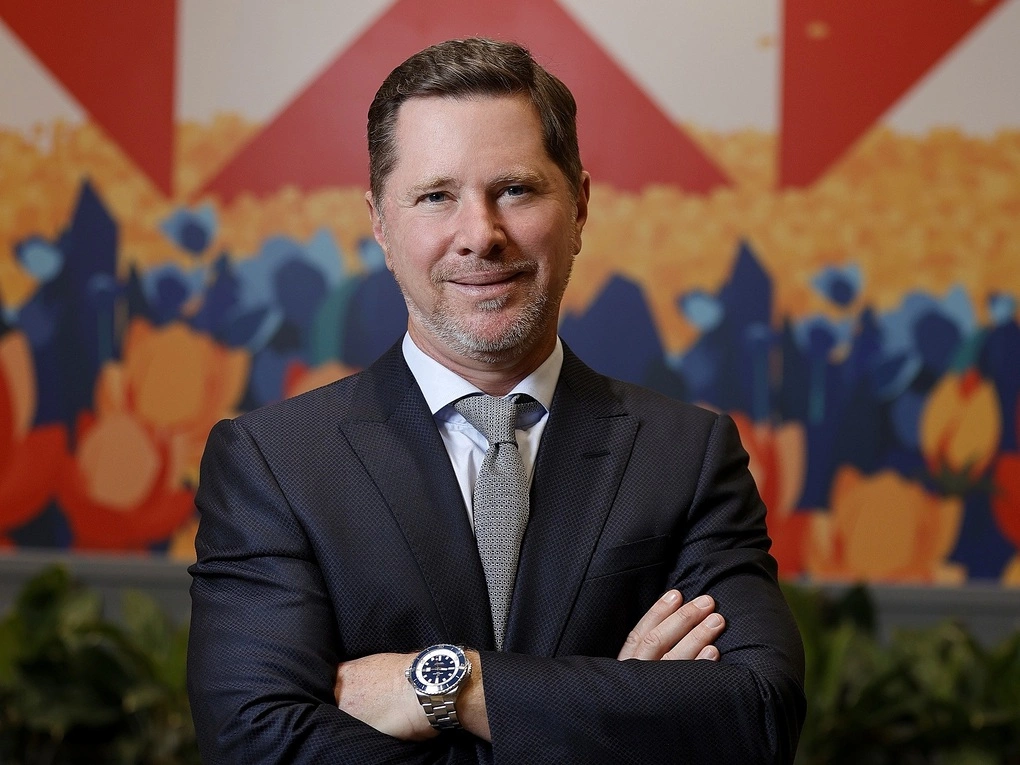
In a newly released analysis, HSBC Vietnam CEO Tim Evans stated that “Vietnam has moved faster and further than any other economy” in trading artificial intelligence goods, including semiconductors, components, and mission-critical server hardware.
According to research from HSBC Global Investment Research, Vietnam’s share of global trade in AI-related hardware climbed from 1.2% in 2015 to 12.4% in 2025. This leap represents the highest gain recorded by any individual economy during this timeframe.
Earlier in 2026, South Korean exports to Vietnam grew faster than to any other Southeast Asian market. This surge underscores deep manufacturing ties and Vietnam’s expanding footprint in hardware assembly, particularly AI server equipment, Evans noted.
Meanwhile, Taiwan ran its first-ever quarterly trade deficit with Vietnam in the first quarter. Over the three-month period through May, Taiwan’s imports from Vietnam surged 173% year-on-year, driven primarily by electrical machinery, appliances, and electronic components.
Evans highlighted this shift as a “major transition.” Vietnam has outgrown its historical role as a low-cost, final-stage assembly outpost. Instead, the country now serves as a key node in a multilateral network, importing high-value components from Taiwan and South Korea, adding sophisticated domestic value, and re-exporting advanced systems across Asia and global markets.
“These two-way trade flows continue to deepen, reinforcing Vietnam’s position within international production networks,” Evans observed.
HSBC data shows intra-Asia trade in AI-related goods reached nearly $2 trillion last year, doubling pre-pandemic levels. AI-related hardware accounted for 35% of total Asian exports, up sharply from 19% a decade earlier.
Policy initiatives and geographical advantages have propelled Vietnam’s swift ascent. The government instituted a national semiconductor development strategy while designating science, technology, and digital innovation as core economic drivers.
Global manufacturers responded with massive capital commitments in advanced packaging, testing, and electronics assembly. Simultaneously, Vietnam collaborates with top global tech corporations to absorb research and chip design capabilities.
In the first half of the year, manufacturing and processing attracted $17.91 billion in foreign direct investment (FDI), representing 63% of total registered new and expanded capital, according to the General Statistics Office. Multiple provinces secured flagship semiconductor and electronics projects.
Thai Nguyen led nationwide FDI attraction with over $8 billion in the first six months, directing most capital into high-tech complexes, semiconductor facilities, and electronic component plants. Hai Phong drew $1.83 billion after streamlining administrative procedures for semiconductor and electronics support ventures like LG Innotek.
At the same time, domestic AI adoption is picking up speed. With a young, digital-native population and an agile business landscape, Vietnam stands ready to develop into a high-value consumer market for AI-driven services, Evans noted.
In April, Ho Chi Minh City granted investment certificates to four strategic high-tech projects worth over $1.23 billion. These initiatives feature the $508 million Evolution DC VN HCMC data center by a Singaporean consortium and a $480 million hyperscale data center complex developed by STARMASON.
Riding the AI trade wave introduces distinct macroeconomic risks. Evans warned that deeper specialization exposes Vietnam to sector-wide shocks, including cooling corporate AI capital expenditures, tighter export controls, and semiconductor price volatility. Additionally, rising chip and component prices could stoke broader regional inflationary pressures.
Nevertheless, underlying structural tailwinds remain resilient. Supply chains continue diversifying across Asia, while multilateral agreements like RCEP and the CPTPP lower tariff barriers. Vietnam has also demonstrated a proven capacity to absorb large-scale capital deployments.
“As Asia evolves from an export springboard into a self-sustaining hub of AI demand, Vietnam stands squarely at the center of this transformation, both economically and geographically,” Evans affirmed.
If Vietnam successfully converts this manufacturing momentum into an integrated AI ecosystem—fusing hardware scale with workforce skills, infrastructure, and enterprise adoption—the payoffs will extend far beyond trade balances, elevating factory floor productivity, service industries, and everyday business operations nationwide.
Discover more from Vietnam Insider
Subscribe to get the latest posts sent to your email.