

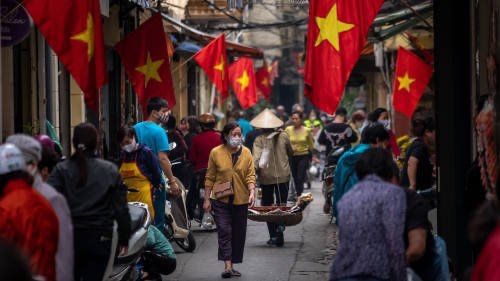
Hanoi praised for efforts to contain the spread by focusing on isolating infected people.
When most of Vietnam’s 96m citizens were celebrating the Tet lunar new year holiday, Prime Minister Nguyen Xuan Phuc was at a government meeting declaring war on coronavirus.
The disease was raging over the border in China and Mr Phuc warned it would soon reach Vietnam. “Fighting the epidemic is fighting the enemy,” he said at the end of January.
Since then Vietnam has proved a model in containing the disease in a country with limited resources but determined leadership.
Rather than embark on mass testing, which has been the crux of wealthier South Korea’s response to the outbreak, Vietnam has focused on isolating infected people and tracking down their second- and third-hand contacts.
“Mass testing is good, but it depends on the resources of each country,” said Tran Dac Phu, a senior health official advising Vietnam’s Emergency Operation Centre, which is equivalent to the US Centers for Disease Control.
“The important thing is, you need to know the number of people who might have come in contact with the disease, or returned from pandemic areas, then perform tests on these people.”
Apart from aggressive tracing of infected people’s contacts, the communist leadership’s measures have also included forced quarantines and the conscriptionof medical students, retired doctors and nurses to join the fight.
“Vietnam is a mobilisation society,” said Carl Thayer, professor emeritus at the University of New South Wales Canberra. “It is a one-party state; it has large public security forces, the military and the party itself; and it’s a top-down government that’s good at responding to natural disasters.”
Over the weekend, Hanoi introduced mandatory 14-day quarantines for all people arriving in the country and the cancellation of all foreign flights.
“We have to mobilise all society to the best of our capability to fight the outbreak together, and it’s important to find the cases early and isolate them,” said Mr Phu.
Vietnam has reported 121 coronavirus cases and no deaths. Most recent cases were part of a “second wave” of infections traced back to people arriving from abroad. As of March 20, Vietnam had tested 15,637 people — a fraction of the 338,000 tested in South Korea.
As elsewhere in south-east Asia with limited testing, the true number of cases is probably much higher than reported. But Vietnam’s response has still been impressive. It halted all flights to and from China on February 1 and schools in Vietnam’s two biggest cities, Hanoi and Ho Chi Minh City, and most other provinces were told to remain closed after Tet.
On February 13, Vietnam became the first country after China to seal off a large residential area. It imposed a 21-day quarantine in a part of Vinh Phuc province, north of Hanoi, where more than 10,000 people live, after cases were traced back to workers returning from Wuhan.
At a time when its neighbour Thailand is being criticised for its haphazard response to coronavirus, and Myanmar — which reported its first two coronavirus cases late on Monday after previously denying it had any cases at all — Vietnam’s response has been praised by health officials. Kidong Park, the World Health Organization’s representative in Hanoi, lauded Vietnam for its “proactiveness and consistency throughout the response”.
However, Vietnam’s success in containing Covid-19 depends in part on the mobilisation of medical and military personnel, surveillance and intrusion, and on the state’s network of informants — measures that might prove difficult for the US or European countries to countenance.
By John Reed in Bangkok and Pham Hai Chung in Hanoi @ Financial Times
Discover more from Vietnam Insider
Subscribe to get the latest posts sent to your email.