

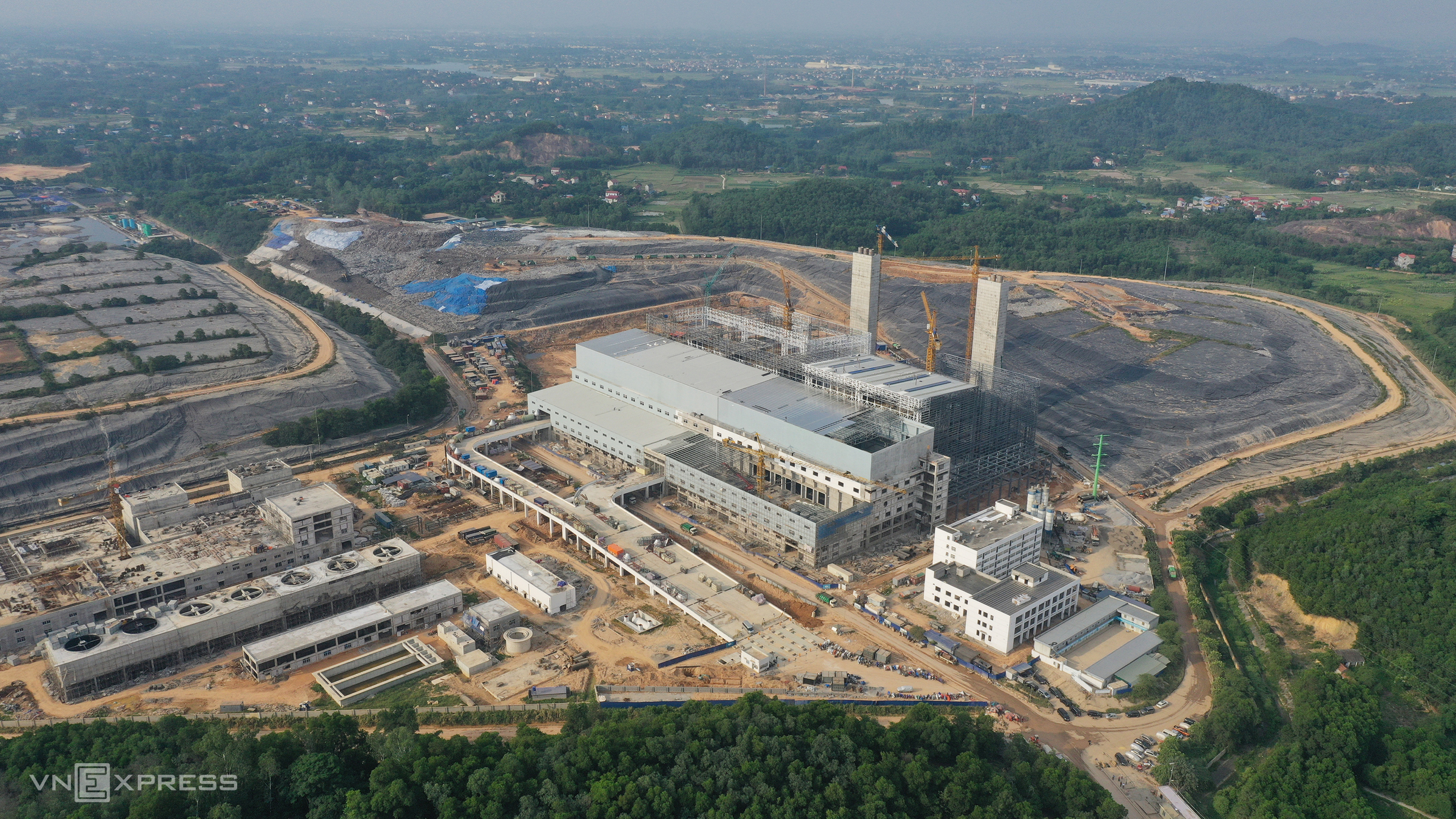
Applying thermal biochemical technology, scientists have developed a waste treatment system that does not emit air, waste ash, waste water, or odors, operating at the Bac Giang waste treatment plant.
On December 15, this technology was applied by Asian Green Energy Joint Stock Company at the factory converting domestic and industrial solid waste into energy in Yen Dung district, Bac Giang. The factory has a capacity of 150 tons of waste/day, with an estimated operating cost of about 150,000-250,000 VND/ton of waste.
Professor Huynh Van Hoa, Chairman of Live Again Group, project manager, said that the waste treatment technology using thermal biochemical technology without emissions was developed by him and his colleagues after nearly 30 years of research. This technology processes waste in a multi-part heating chamber, creating synthetic gas and biochar. The special feature of the technology is that it does not emit emissions, does not generate ash and slag, and does not discharge wastewater into the environment.
The waste treatment process of Professor Hoa and his colleagues has been patented in the US since 2020.

The authors at the plant converting domestic and industrial solid waste into energy in Yen Dung district, Bac Giang. Photo: Hong Ha
Professor Hoa said that the first phase of the project is designed to process 150 tons of solid waste and convert 70 tons of fuel into DME gas, electronic fuel, and Methanol solvent. The second part of the first phase will generate electricity with a capacity of 2 MW/h, convert carbon into activated carbon, and recover hydrogen gas from waste.
“With this technology, there is no need to classify waste at the source and it can receive most types of waste such as: household waste, industrial waste, medical waste, livestock waste, human waste, biomass into clean energy and biochar”, said Professor Hoa. He added that the output of the technology has by-products including DME (colorless gas, used as fuel), methanol, efuel, biochar. The inorganic substances removed: recyclable metals, bricks, glass concrete… are finely ground to produce refractory bricks.

The output product of the waste treatment process is activated carbon. Photo: Hong Ha
According to experts, zero-emission thermal biochemical technology opens up the prospect of waste treatment in rural and small urban areas, thanks to the ability to separate the plant modules to clean waste, grind it, press it into pellets and then transport it to the main plant to convert it into fuel and biochar, which is not limited by geography and scale of treatment. It is possible to thoroughly treat local waste sources without requiring investment in large-capacity plants.
In addition, the plant’s technology is not limited to applications in the solid waste and liquid waste treatment industry. The investment cost is 30% lower than the current waste-to-energy incineration technology, but the advantages are: no smoke emissions (the plant has no chimney), no ash, no wastewater, and the payback period is halved compared to waste-to-energy incineration technology.
The research team said that depending on the actual needs of local waste sources, the processing capacity can be optimized to 360 tons/day and night.
Source: vnexpress.net
Discover more from Vietnam Insider
Subscribe to get the latest posts sent to your email.