

As global manufacturers continue to diversify supply chains beyond China, Southeast Asia has emerged as a central pillar of industrial relocation. Within the region, Vietnam and Malaysia are often compared as alternative manufacturing destinations. However, such comparisons can be misleading. While both countries are deeply integrated into global trade, they represent two structurally different manufacturing models, each optimized for distinct production requirements.
By 2025, Vietnam and Malaysia play complementary, rather than competing, roles in regional supply chains. Understanding these differences is increasingly important for industrial buyers and sourcing professionals designing long-term, resilient manufacturing strategies.
Trade Scale: Volume versus Density
Vietnam’s manufacturing model is anchored in scale. In 2025, the country’s total import–export turnover surpassed USD 900 billion for the first time, with full-year projections approaching USD 920 billion, according to Vietnam Customs under the Ministry of Finance. This milestone places Vietnam among the world’s top 25 economies by trade value, reflecting nearly two decades of export-led industrial growth since joining the World Trade Organization in 2007.
Malaysia operates at a smaller absolute scale but with higher trade density relative to its population. On a year-to-date basis in 2025, Malaysia’s total trade reached approximately RM2.77 trillion, equivalent to USD 590–600 billion, according to Malaysia’s Ministry of Investment, Trade and Industry (MITI) and the Department of Statistics Malaysia.
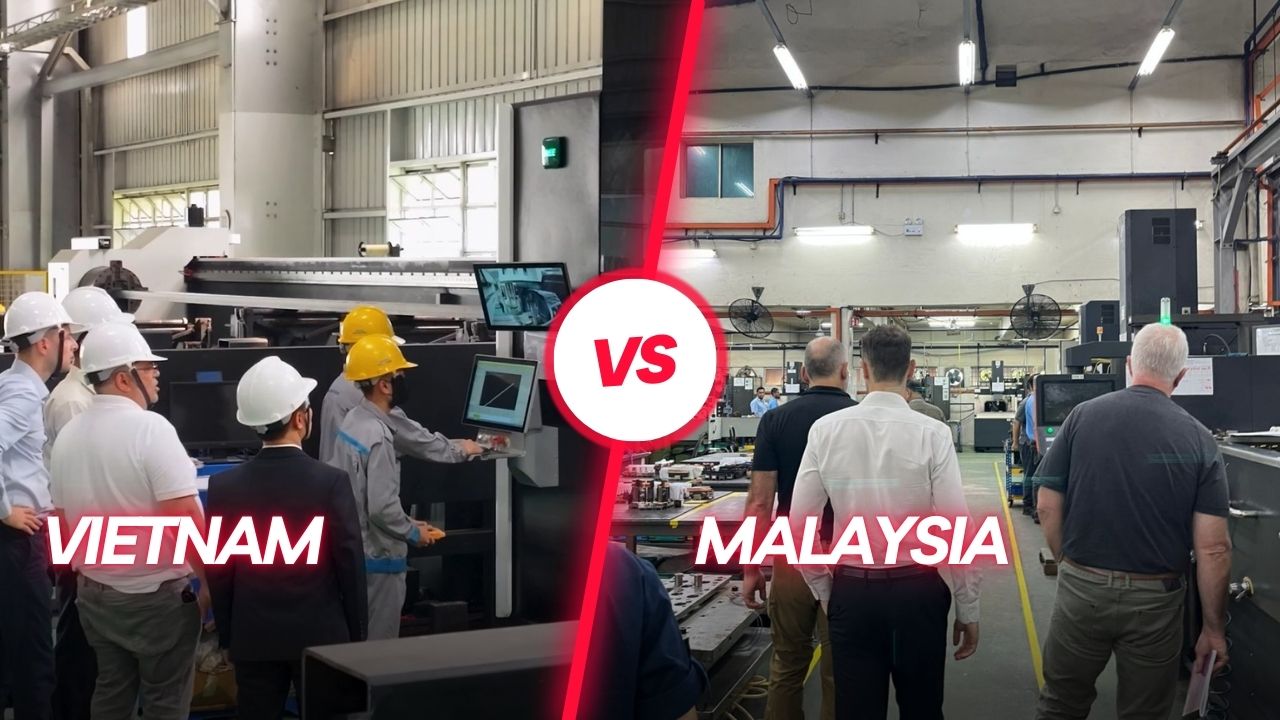
To ground these trade figures in operational reality, the accompanying factory tour video offers a visual reference of how Malaysia’s capital-intensive manufacturing model translates onto the shop floor, particularly in precision-driven and technology-led production environments.
Measured purely by headline trade volume, Vietnam is now significantly larger. However, Malaysia’s trade profile is more concentrated in capital-intensive and technology-driven manufacturing.
Manufacturing Structure: Labor-Led vs. Capital-Intensive
Manufacturing contributes roughly 25 percent of Vietnam’s GDP, supported by sustained foreign direct investment and rapid industrial park expansion across northern, southern, and central regions (World Bank). Manufactured goods account for over 85 percent of Vietnam’s exports, led by electronics, furniture, textiles, footwear, machinery, and consumer products (General Statistics Office of Vietnam; UN Comtrade).
Vietnam’s competitive advantages lie in labor availability, cost efficiency, and production scalability. These factors enable high-volume manufacturing with relatively flexible minimum order quantities, making the country particularly attractive for export-oriented production serving the U.S. and European markets.
Malaysia’s manufacturing sector contributes approximately 23 percent of GDP, a share that has remained stable over the past decade (World Bank). More than 85 percent of Malaysia’s exports are manufactured goods, with electrical and electronics (E&E) products accounting for around 40 percent of export value (UN Comtrade; Malaysian Investment Development Authority – MIDA).
Rather than expanding through labor growth, Malaysia’s manufacturing base has evolved through automation, engineering capability, and process optimization, particularly in semiconductor, medical device, and automotive supply chains concentrated in Penang, Selangor, and Johor.
Factory Capability: Scale Efficiency vs. Process Discipline

>> Related article: Outsourcing Manufacturing in Asia for Efficient Scaling of Contract Manufacturing in 2026
At the factory level, the structural differences become more pronounced.
Vietnamese manufacturing excels in high-volume production, particularly for labor-intensive and mid-complexity products. Over the past decade, quality systems and export compliance have improved significantly, driven by multinational investment and exposure to global buyers. However, advanced engineering capabilities and capital intensity remain uneven across sectors.
In contrast, Malaysian factories are typically more automated, engineering-led, and compliance-oriented. Stronger in-house capabilities in CNC machining, injection molding, mold design, and regulated manufacturing support production for industries where defect tolerance is low and audit readiness is critical.
As a result, Vietnam is optimized for throughput and cost efficiency, while Malaysia is better positioned for low-to-mid volume, high-value manufacturing where technical complexity and consistency outweigh unit cost considerations.
To ground these differences beyond macroeconomic data, factory walkthroughs in Malaysia reveal controlled production environments, process discipline, and technical depth that illustrate how industrial maturity translates into operational reality on the factory floor.
Cost Structure and Workforce Dynamics
Vietnam continues to offer lower average labor costs than Malaysia, supported by a larger and younger workforce. This labor availability underpins Vietnam’s ability to scale production rapidly across multiple industries, even amid rising wages.
Malaysia’s labor costs are higher, and its manufacturing sector relies more heavily on foreign labor, particularly in industrial and precision roles. However, higher wages are partially offset by higher productivity, automation, and lower rework rates, especially in technically demanding sectors.
For buyers, Vietnam offers cost efficiency through scale, while Malaysia offers cost predictability through process stability.
Vietnam vs. Malaysia: Manufacturing Recap 2025
By 2025, Vietnam operates at a substantially larger trade and production scale than Malaysia. At the same time, Malaysia maintains a higher concentration of capital-intensive and technology-driven manufacturing relative to its economic size.
This distinction explains why the two countries are increasingly deployed together rather than positioned as direct substitutes. Multinational manufacturers commonly assign high-volume, cost-sensitive production to Vietnam, while retaining technically complex, compliance-intensive, or precision-driven manufacturing in Malaysia.
Rather than converging, the two manufacturing systems are evolving into complementary roles within Southeast Asia’s industrial landscape.

>> Related article: Supply Chain 2026 Redesigning Procurement Manufacturing and Risk Management
Key Takeaways for Industrial Buyers Entering 2026
For industrial buyers evaluating Vietnam and Malaysia in 2026, the decision is less about choosing a location and more about aligning with the right manufacturing structure.
Vietnam is best suited for scale-driven production where volume, cost efficiency, and speed are decisive. Malaysia offers advantages in precision manufacturing, technical depth, and regulatory compliance, making it more appropriate for complex or high-spec products.
Increasingly, leading manufacturers are adopting dual-country sourcing strategies, leveraging Vietnam for scale while assigning high-value or technically demanding components to Malaysia. This approach reflects a broader shift toward supply chain resilience based on structural diversification rather than cost minimization alone.
Discover more from Vietnam Insider
Subscribe to get the latest posts sent to your email.