

Vietnamese students are increasingly looking beyond the US for university, with rising costs, tighter visa rules and uncertain post graduation work prospects making Singapore and Hong Kong more attractive alternatives.
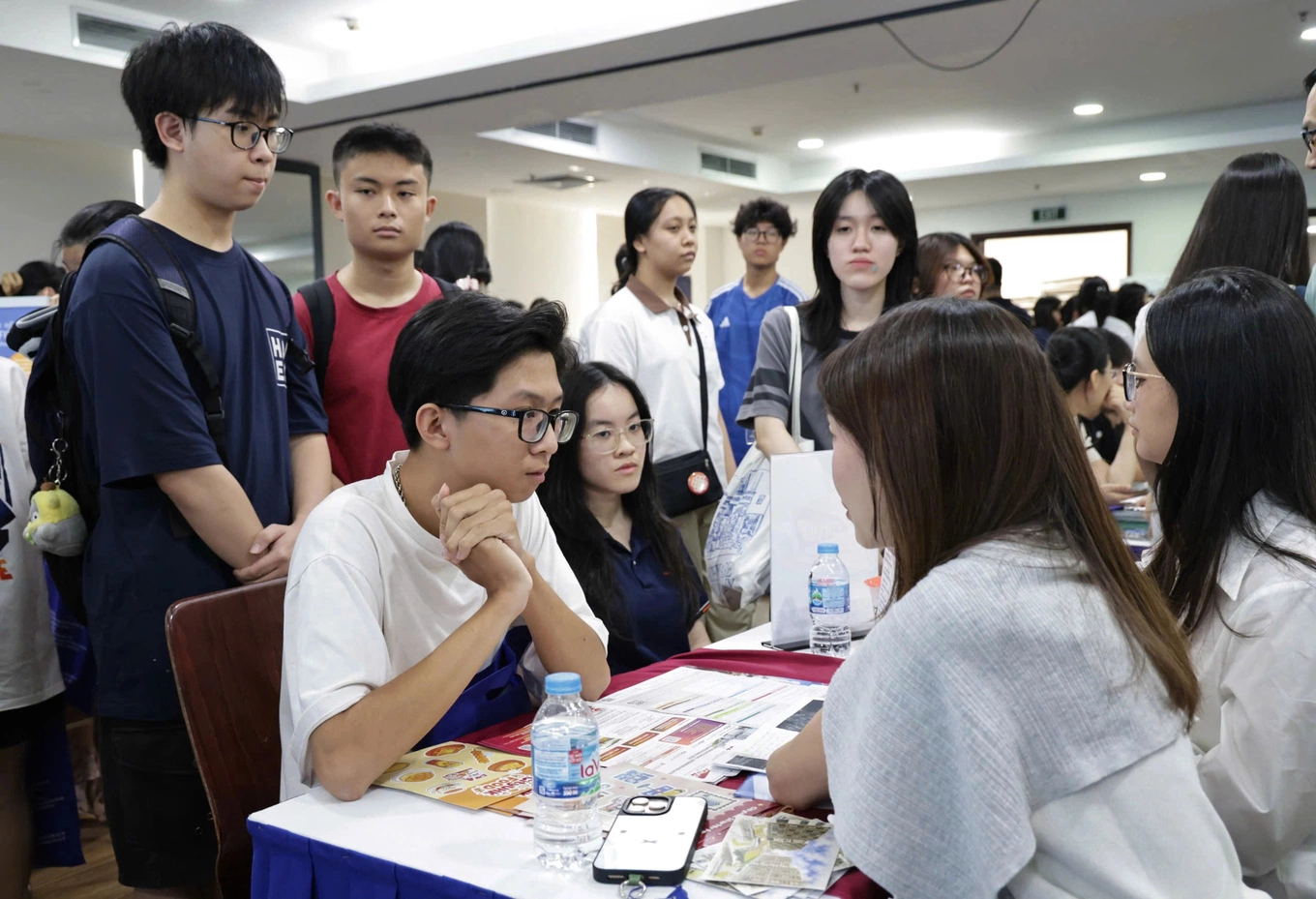
At a study abroad seminar in Hanoi on Oct. 3, counselors said 30% to 40% of their students are now considering Asian universities alongside or instead of US schools. Hong Kong University has seen an especially sharp rise in Vietnamese applications, from just one in 2022 to 300 this year.
For students such as 10th grader Nghiem Tan Cuong, the decision is increasingly about value as much as prestige.
Cuong, a math student at Hanoi Amsterdam High School for the Gifted, had once considered studying in the US. His family changed plans after weighing the cost. His parents can afford around VND300 million to VND400 million ($11,500 to $15,400) a year, making many US universities difficult to justify.
For the 2026 to 27 academic year, tuition and fees average $26,034 for out of state students at ranked public US colleges and $46,973 at private universities, before accommodation and other living expenses, according to U.S. News & World Report.
Singapore and Hong Kong offer another advantage for Vietnamese families: globally ranked universities in major international cities that are only a few hours from home.
Asia gains ground as US costs rise
The shift is becoming increasingly visible among Vietnamese families.
Le Dieu Linh, deputy director of education consultancy Summit Education, said most families previously focused almost entirely on American universities. Over the past one to two years, however, 30% to 40% of the company’s students have considered Asian universities and applied to schools in the region alongside US institutions.
Hong Kong University has recorded an even more dramatic increase.
According to its Vietnam admissions representative Vu Hai Truong, the number of Vietnamese applicants rose from one in 2022 to three in 2023 and 30 in 2024.
This year, applications jumped tenfold to 300. Of those applicants, 192 were admitted.
Cost is one of the biggest reasons behind the change.
Data from 395 US institutions compiled by U.S. News & World Report shows tuition and fees at ranked national universities have increased about 102% at private schools since 2007 to 08. The increase was 99% for in state students at public universities and 89% for out of state students.
Even after adjusting for inflation, tuition has risen by about 18% to 26%.
For families already facing high living costs, the total price of a US degree can therefore become difficult to justify, particularly when students can find highly ranked alternatives closer to Vietnam.
Visa rules add another layer of uncertainty
Cost is not the only concern.
Students and parents are also watching changes to US immigration and employment rules, particularly because many international students view post graduation work opportunities as part of the value of studying in America.
New guidance issued in August by the US Student and Exchange Visitor Program limits curricular practical training, a form of work authorization commonly used for internships, to programs where the training is required for every student.
The H 1B work visa system has also changed from a purely random lottery to a wage weighted selection system. Applicants associated with the highest wage level receive four entries, while entry level applicants receive one.
A $100,000 fee on new H 1B petitions for workers abroad, introduced in September 2025 and extended for another year in September, has added to concerns about whether US employers will be willing to hire foreign graduates. A federal court blocked collection of the fee in June.
For Vietnamese students planning years ahead, such policy uncertainty can make the US a harder investment to assess.
Why Singapore and Hong Kong look attractive
Singapore and Hong Kong offer a combination that is increasingly appealing to Vietnamese families: strong universities, English language education, international business environments and geographic proximity.
In the QS World University Rankings 2027, the National University of Singapore ranks 10th globally, Hong Kong University 11th and Nanyang Technological University 12th. Peking University ranks 13th and Tsinghua University 14th.
For families, Hong Kong also offers a middle ground between Asian proximity and Western style education.
Truong described Hong Kong as “just Western enough”, giving students an international environment while allowing parents to keep them relatively close to home.
Hong Kong University’s tuition for non local undergraduates in most programs will be HK$250,000 to HK$280,000 ($31,900 to $35,700) a year in 2027 to 28.
The university also reports that its 2025 bachelor’s graduates earned an average monthly salary of HK$33,338 ($4,250).
International graduates have another potential advantage: they can remain in Hong Kong for two years after graduation without first securing a job.
Singapore is similarly attractive for students who want an English speaking environment without moving to North America or Europe.
Simpler admissions appeal to Vietnamese students
Admissions requirements are another factor.
Nguyen Thuy Linh, an admissions representative of the Singapore Institute of Management, said many Singapore universities place greater emphasis on academic results and English proficiency than on the extensive essays, extracurricular records and achievement portfolios often expected by US universities.
Some institutions mainly require a GPA of at least 7.0 out of 10 and an IELTS score of 6.0. Essays may be required mainly for scholarship applications.
Hong Kong University has also lowered its minimum GPA requirement for Vietnamese applicants from 8.0 to 7.0, according to Truong.
The university has established principal nominated scholarships with eight Vietnamese high schools, including Hanoi Amsterdam, Chu Van An and Nguyen Sieu in Hanoi, and Le Hong Phong and Tran Dai Nghia in Ho Chi Minh City.
That compares with four partner schools in Thailand and none in Laos or Cambodia.
The growing competition for Vietnamese students suggests Asian universities are becoming more deliberate about recruiting talent from the country.
Rankings are no longer the whole story
For Vietnamese students, the changing choices do not necessarily mean the US is losing its appeal altogether.
Instead, families appear to be weighing prestige against cost, distance, admissions complexity, immigration policy and career prospects.
Le Dieu Linh advised students to research their chosen field and potential career path before deciding where to apply rather than simply following university rankings.
Nguyen Thuy Linh also urged students to strengthen both spoken and written English, regardless of where they study, so they can adapt to international academic and professional environments.
For a new generation of Vietnamese students, the question may therefore be less about whether to pursue an “American dream” and more about which international education offers the strongest return on the family’s investment.
Discover more from Vietnam Insider
Subscribe to get the latest posts sent to your email.