

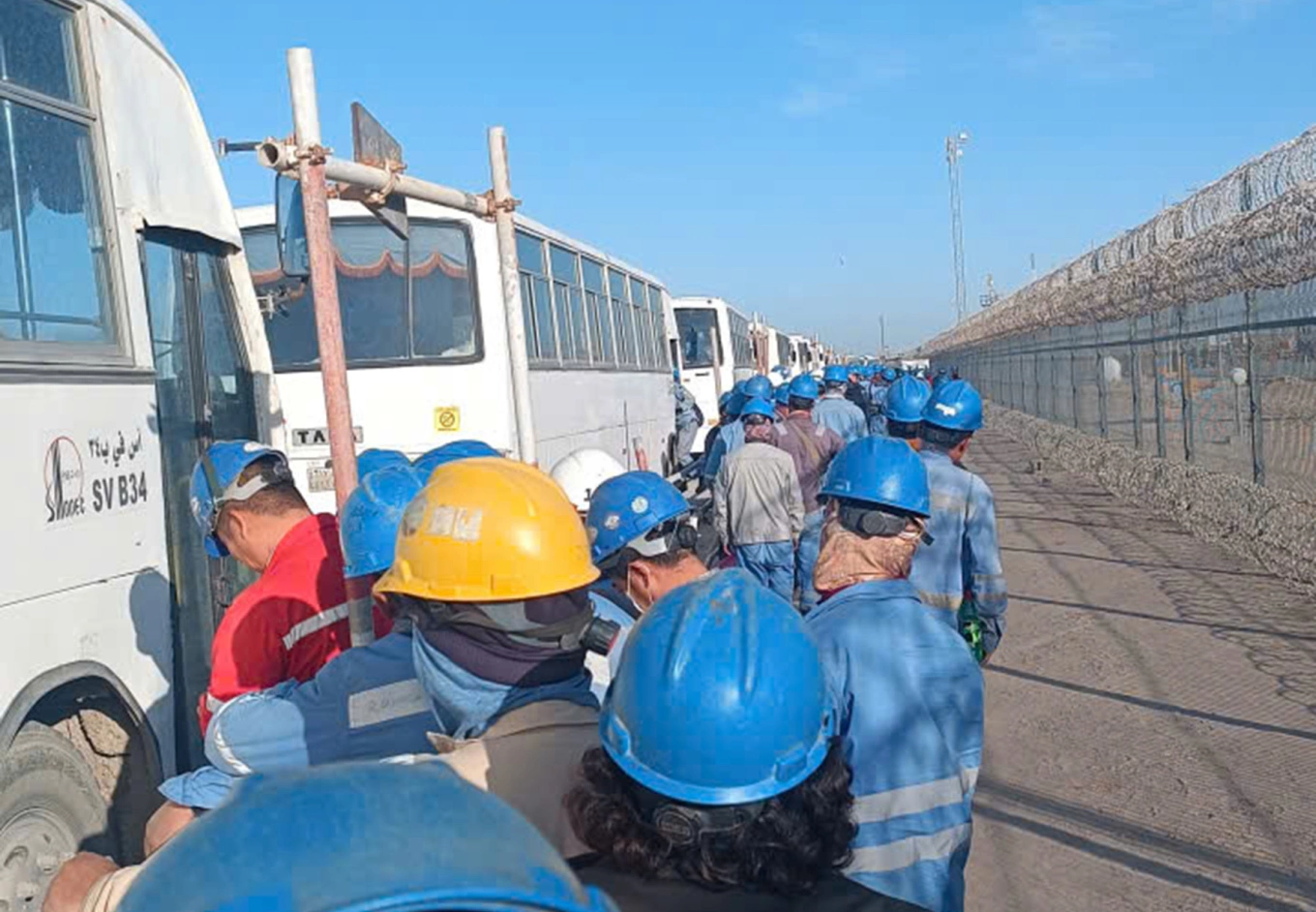
For thousands of Vietnamese laborers working across the Middle East, daily life has become a tense balancing act between continuing their jobs and watching a regional conflict unfold nearby.
Although many worksites remain outside active strike zones, workers say they are living with constant uncertainty—hearing military aircraft overhead, following safety advisories, and preparing for the possibility of sudden evacuation.
Around 10,000 Vietnamese workers are currently employed across the region, including in Saudi Arabia, the UAE, Qatar, and Bahrain, according to labor agencies.
Waiting for the Day to Go Home
One of them is Pham Trong, a 31-year-old worker from Nghe An Province who has spent the past two years at a petrochemical refinery on the Persian Gulf coast of Saudi Arabia.
His contract ends on March 23, and he has been counting down the days until he returns home.
Trong had already planned gifts for his family: saffron for his wife, dates for his children, and local specialties for relatives.
But those plans suddenly became uncertain when the latest escalation of tensions in the Middle East began at the end of February.
Missile strikes and military retaliation across the region have forced workers like Trong to closely monitor the situation while continuing to work.
Working Near Potential Targets
The refinery where Trong works lies outside the immediate strike zones but is only a few hours from military installations, which could become potential targets.
From the worksite, he says there are no explosions or visible missile trails.
Still, the uncertainty weighs heavily.
“Missiles move fast. You never know what could happen,” he said.
For safety, employers have tightened security and advised workers to avoid city centers and military facilities—areas more likely to be targeted.
Weekend trips to nearby towns, once a rare chance for workers to relax and shop, have been completely suspended.
Life Reduced to Two Locations
Another Vietnamese worker, Dang Huy Diep, a construction supervisor at a petrochemical project in the industrial city of Jubail, says life has become extremely restricted.
Workers now move between only two places:
-
the construction site
-
the company dormitory
Military aircraft have been flying overhead more frequently in recent days, which Diep believes may be patrol flights.
“Life still continues, but the atmosphere feels very different,” he said.
Despite the tension, most workers have chosen to remain.
“Everyone is still working normally. No one is thinking about leaving yet,” he added.
Thousands of Workers Affected
Labor export companies estimate nearly 6,000 Vietnamese workers are currently employed in Saudi Arabia alone, many in oil and petrochemical facilities along the Persian Gulf.
These jobs typically offer salaries of 50–60 million VND per month ($2,000–$2,400) for skilled engineers and technicians under two-year contracts.
However, the escalation has already disrupted recruitment.
Vietnam has temporarily suspended sending workers to the Middle East since March 1 until the security situation stabilizes.
Hundreds of workers who were preparing to depart have had to cancel flights or postpone travel.
Emergency Plans in Place
Labor agencies say they are closely monitoring the safety of workers through daily communication channels and internal reporting systems.
Employers in the region have also pledged to assist with evacuation if the conflict spreads.
For now, many workers remain in place—continuing their jobs while watching events unfold.
“War hasn’t reached us yet,” Diep said.
“If it does, we’ll deal with it then.”
Until then, thousands of Vietnamese laborers across the Gulf are living and working just beyond the edge of the conflict.
Discover more from Vietnam Insider
Subscribe to get the latest posts sent to your email.