

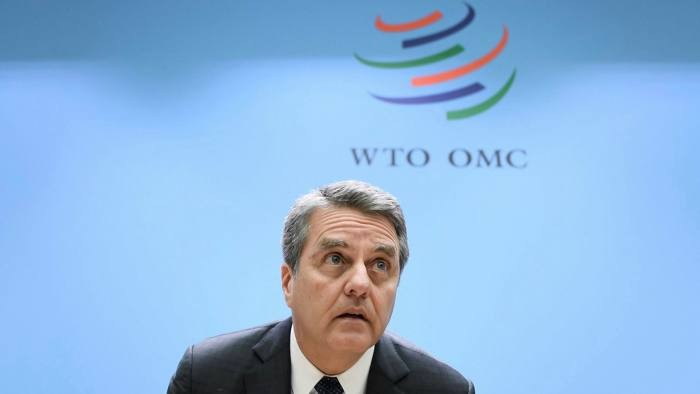
Move comes after tussles with Trump administration and as global trade faces pandemic turmoil
The head of the World Trade Organization is stepping down early from his post, opening a vacancy at an institution that is grappling with global trade tensions and a collapse in commerce during the Covid-19 pandemic.
Roberto Azevêdo, a former Brazilian diplomat who has held the director-general post since 2013, told WTO ambassadors in a statement on Thursday that he would end his term of office in September, a year before it expires.
Mr Azevêdo said his early departure would allow governments to focus next year’s planned meeting of trade ministers on reform of the organisation rather than have it consumed with the process of appointing his successor. The ministerial meeting, which is due to take place in Kazakhstan, has been postponed from this June to next year because of the Covid-19 pandemic.
He urged the WTO’s member countries to move swiftly to have someone in place as soon as possible.
“The selection process would be a distraction from — or worse, a disruption to — our desired outcomes,” he said. “Instead of focusing all efforts on the search for compromise . . . we would be spending valuable time on a politically charged process that has proved divisive in the past.”
His departure was originally reported by Bloomberg.
Simon Evenett, professor of international trade at the University of St Gallen in Switzerland, described Mr Azevêdo’s resignation as “extremely unfortunately timed”, as it leaves the WTO without its top leadership at a time when it is struggling to define its future. The institution has largely been forced to the sidelines during the increase in trade tensions since Donald Trump’s election as US president and the subsequent tariff war between the US and China.
The WTO has consistently been attacked by Mr Trump’s administration, which has strongly criticised its over-reach and blamed it for allowing China to practise unfair trade.
The appellate body, the highest authority in the organisation’s dispute settlement process, ceased to function late last year after the US blocked the appointment of new judges to replace two who retired.
Under Mr Azevêdo, the organisation has deliberately kept a low profile during the coronavirus pandemic, staying largely silent over the global rash of export restrictions on medical equipment. Citing its lack of authority in the area, the organisation has declined to intervene publicly. The blocks on exports have set off a global procurement scramble and further increased trade tensions.
Despite this, there has been growing disgruntlement on Capitol Hill in recent weeks, with two separate pieces of legislation calling for the US to withdraw from the WTO. Both Democrat and Republican lawmakers have argued that coronavirus has exposed the need to protect US sovereignty, which they see as being damaged by the loss of US manufacturing capability to China.
Democrats Peter DeFazio and Frank Pallone, chairman of the House of Representatives committee on energy and commerce, introduced a bill in the lower chamber of Congress arguing that the WTO had allowed China to develop “unfair” trade practices. Republican senator Josh Hawley introduced a similar resolution to the Senate last week following an opinion piece in The New York Times in which he called for the total abolition of the organisation.
Clete Willems, a former Trump administration trade official now working at the law firm Akin Gump, said it would be a mistake for the US to leave the WTO.
“I agree with the administration and folks on the Hill who think the WTO has failed to constrain some of the worst behaviour of China,” Mr Willems said. “But the last thing we should do to counter China is to withdraw from the WTO. It is what they want, and it would be a grave mistake to walk away.”
The process of appointing Mr Azevêdo’s replacement could stretch into next year if the WTO appoints an acting director-general from one of its existing senior staff, but the timing of the resignation will hand the Trump administration a considerable amount of power over the nomination.
US trade representative Robert Lighthizer thanked Mr Azevêdo for his “exemplary service”.
“Despite the many shortcomings of the WTO, Roberto has led the institution with grace and a steady hand. He will be difficult to replace,” said Mr Lighthizer. He added that the US would “look forward” to taking part in the process of selecting a new director-general.
Mr Lighthizer has continued to press allies on reforming the WTO. The US trade representative’s office confirmed that Mr Lighthizer spoke with Japan’s minister for foreign affairs, Toshimitsu Motegi, on Tuesday on the need to reform the WTO’s dispute settlement system.
Prof Evenett said Mr Azevêdo’s departure showed the limitations of a low-key technocratic approach to trying to revive the WTO, which has not concluded a major global trade agreement since its creation in 1995.
“The resignation marks the end of the ambassadorial small-fix approach to getting the WTO negotiating function back on track,” he said. “[Mr] Azevêdo has improved the atmosphere in Geneva with a series of small trust-building exercises but has not really engaged the big players.”
Unlike his predecessors in the job, Mr Azevêdo had been a WTO ambassador rather than a minister, and Prof Evenett said he lacked the political clout to raise the organisation’s profile.
“We need a DG who has a more flexible approach and is listened to in the halls of power,” he said.
Reporting by Alan Beattie in Brussels and Aime Williams @ FT
Discover more from Vietnam Insider
Subscribe to get the latest posts sent to your email.