

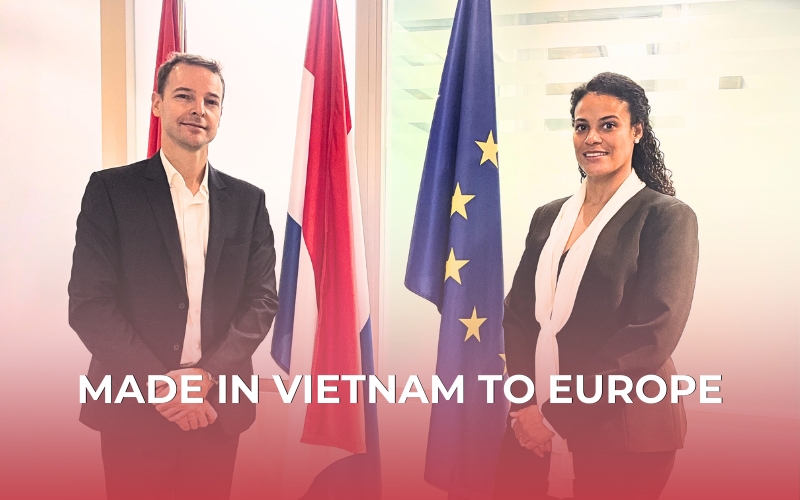
Vietnam’s economic relationship with Europe is entering a new phase. Long seen as a manufacturing base and export platform, Vietnam is increasingly becoming a strategic market in its own right — for European companies looking to expand in Southeast Asia, and for Vietnamese companies preparing to enter or scale across European markets.
This was one of the key themes discussed in a recent interview with Raïssa Marteaux, Consul General of the Kingdom of the Netherlands in Ho Chi Minh City. The conversation explored how companies can approach market entry between Europe and Vietnam more effectively, at a time when trade, investment, industrial upgrading and regulatory expectations are all moving quickly.
The full video discussion looks at the practical side of international expansion: how companies can prepare for a new market, identify the right partners, understand local business environments and build long-term commercial relationships between Vietnam, the Netherlands and Europe.
This video series is being released as part of the ongoing collaboration established through the MOU signed between FVSource and representatives of the Ready2Export program to help strengthen the capabilities of Vietnamese SMEs.
Vietnam’s Growth Is Creating New Market-Entry Opportunities
Vietnam remains one of Southeast Asia’s most dynamic economies. According to Vietnam’s National Statistics Office, GDP growth reached an estimated 8.02 percent in 2025. In the fourth quarter alone, GDP expanded by 8.46 percent year-on-year, the highest fourth-quarter growth rate recorded in the 2011–2025 period. Industry and construction grew by 9.73 percent in the same quarter, while services increased by 8.82 percent.
These figures matter for European businesses. They show that Vietnam is no longer only a production destination for export-oriented industries. It is also a growing domestic market, supported by industrial development, urbanisation, infrastructure investment and a rising demand for higher-quality products, technologies and services.
For companies from Europe, this creates opportunities in several areas: industrial equipment, logistics, agri-food technologies, water management, energy efficiency, healthcare, education, professional services, automation, high-tech manufacturing and sustainable solutions.
However, market potential does not automatically translate into market success. Vietnam is a competitive, relationship-driven and fast-changing business environment. European companies entering the market need to understand demand, pricing, distribution, technical standards, after-sales service, regulatory requirements and the role of local partners.
A strong product or technology in Europe may not be enough. Companies often need to adapt their offer, clarify their value proposition and build a local presence or partnership model that fits the Vietnamese market.
The Netherlands as a Strategic Gateway
The Netherlands holds a particular position in the Europe–Vietnam relationship. In 2025, it remained Vietnam’s largest trading partner within the European Union for the second consecutive year. Bilateral trade reached 14.3 billion US dollars, up 3.8 percent from 2024. Vietnamese exports to the Netherlands accounted for 13.5 billion US dollars, while imports from the Netherlands reached 825 million US dollars.
This trade structure makes the Netherlands one of Vietnam’s most important gateways into Europe. The country’s logistics infrastructure, including the port of Rotterdam, its distribution networks and its long-standing role as a European trade hub, make it a natural entry point for Vietnamese goods moving into the wider EU market.

Guillaume Rondan and Raïssa Marteaux, Consul General of the Kingdom of the Netherlands
The investment relationship is also significant. By the end of October 2025, Dutch investors had 466 active projects in Vietnam, with registered capital of around 14.93 billion US dollars. This made the Netherlands the largest EU investor in Vietnam and the ninth-largest investor among all countries and territories investing in the country.
These numbers reflect a broader trend. The relationship between Vietnam and the Netherlands is no longer limited to trade volumes. It increasingly includes investment, technology transfer, logistics, industrial cooperation, sustainability, agriculture, water management and innovation.
From Exporting Products to Building Market Strategies
For both Vietnamese and European companies, one of the main challenges is moving from opportunity to execution.
For European firms, Vietnam can be approached in different ways. It may be a market for selling products and services, a sourcing and manufacturing base, a regional platform for ASEAN, or a partner in a broader supply-chain diversification strategy. Each option requires a different market-entry model.
A company selling industrial machinery, for example, may need local technical partners for installation, training and maintenance. A food technology company may need to understand local processing standards, cold-chain limitations and distribution channels. A professional service provider may need to build trust through local references and long-term presence. A manufacturer looking for suppliers must qualify factories, assess capacity, verify quality systems and understand how production is actually managed on the ground.
This is why market entry must start before the first business trip. It requires market mapping, competitor analysis, partner identification, regulatory review, pricing assessment and a clear understanding of how decisions are made locally. Local agencies can help support the initial qualification of stakeholders, as well as on-the-ground visits, bringing value to both Vietnamese and European delegations :
Vietnam’s business environment also varies significantly by region. Ho Chi Minh City, Hanoi, Binh Duong, Dong Nai, Hai Phong and Da Nang each play different roles depending on the sector. Industrial clusters, distributors, government contacts, suppliers and end customers are not always located in the same places. A national strategy often needs to be translated into a regional execution plan.
Vietnamese Companies Also Need to Prepare Differently for Europe
The same logic applies in the other direction. Vietnamese companies looking to expand into Europe face opportunities, but also higher expectations.
Since the EU–Vietnam Free Trade Agreement entered into force in 2020, trade between the two sides has expanded significantly. In 2025, European Commissioner for Trade Maroš Šefčovič stated that Vietnamese exports to the EU had increased by around 60 percent since the agreement took effect, while EU exports to Vietnam had grown by around 10 percent.
This growth has helped Vietnamese exporters gain visibility in Europe. But it also highlights the need for stronger preparation. European buyers are increasingly focused on traceability, documentation, compliance, social responsibility, environmental standards and supply-chain transparency.
For Vietnamese small and medium-sized enterprises, entering Europe is therefore not only about finding buyers. It is about proving reliability.
Companies need to show that they can meet technical requirements, provide proper documentation, maintain consistent quality, communicate professionally, understand European regulations and respond to buyer expectations. In many sectors, certifications, testing reports, sustainability policies and traceability systems are no longer optional. They are part of the commercial conversation.
The European market is also not uniform. The Netherlands, Germany, France, the Nordic countries and Southern Europe may have different buyer expectations, pricing levels, business cultures and distribution structures. A successful European strategy requires prioritisation. Companies need to decide where to enter first, which partners to work with and how to position their products.
Sectors Where Cooperation Is Becoming More Concrete
The trade data between Vietnam and the Netherlands show how diversified the relationship has become.
In 2025, Vietnamese exports of computers, electronic products and components to the Netherlands reached around 3.4 billion US dollars, accounting for more than a quarter of Vietnam’s exports to the Dutch market. Machinery, equipment, tools and spare parts represented more than 2.2 billion US dollars.
Agri-food exports also remained important. Coffee exports to the Netherlands reached 373 million US dollars in 2025, up 57.9 percent. Cashew nut exports reached 495 million US dollars, while fruits and vegetables reached 158 million US dollars. Seafood exports stood at 215 million US dollars, and wood and wood products reached 104.7 million US dollars.
These figures show that cooperation is expanding beyond traditional categories. Electronics, components, machinery, industrial goods, agri-food, wood products, logistics and technical services are all part of the broader Europe–Vietnam trade picture.
For the Netherlands, this creates opportunities to support Vietnam’s industrial and agricultural upgrading. Dutch expertise in logistics, water management, high-tech agriculture, cold-chain systems, port development, circular economy and sustainable production aligns closely with several of Vietnam’s development priorities.
For Vietnam, cooperation with Dutch and European partners can help local companies move toward higher-value exports, better compliance, stronger branding and more resilient supply chains.
A More Strategic Europe–Vietnam Relationship
The broader political context is also changing. In January 2026, the European Union and Vietnam announced the upgrading of their relationship to a Comprehensive Strategic Partnership. The agreement reflects 35 years of diplomatic relations and aims to deepen cooperation in trade, investment, green transition, digital transformation, security, research and people-to-people ties.
For companies, this upgrade is not just symbolic. It signals that Europe and Vietnam see each other as long-term partners in a more complex global trade environment.
European companies are looking for diversification, supply-chain resilience and growth opportunities in Asia. Vietnam is looking to move up the value chain, attract higher-quality investment and reduce dependence on a limited number of markets. These priorities increasingly overlap.
At the same time, trade is becoming more demanding. Access to the European market increasingly depends on transparency, sustainability, documentation and compliance. Access to the Vietnamese market increasingly requires local understanding, adaptation and trusted execution partners.
This makes market-entry strategy more important than ever.
From Opportunity to Long-Term Execution
Vietnam’s growth, the Netherlands’ role as a European gateway and the EU–Vietnam strategic partnership all point in the same direction: the corridor between Vietnam and Europe is becoming more important. Yet the companies that benefit most will not necessarily be those that move fastest. They will be those that prepare carefully, understand both sides of the market and build partnerships that can last.
For European companies, Vietnam offers a combination of domestic demand, industrial capability, regional positioning and supply-chain diversification. For Vietnamese companies, Europe offers access to high-value markets, demanding buyers and opportunities for long-term upgrading.
But in both cases, international expansion requires more than ambition. It requires market knowledge, operational discipline, regulatory awareness and trust.
Discover more from Vietnam Insider
Subscribe to get the latest posts sent to your email.