

Vietnam has become one of the world’s leading manufacturing destinations, supplying products to both domestic consumers and international markets. As more foreign companies source from Vietnam, a common question often arises: why can two products manufactured in the same factory follow very different requirements?
The answer lies not in where the products are made, but in where they are sold. Products intended for Vietnam’s domestic market and those manufactured for export are often developed around different regulations, customer expectations, production systems, and supply chain requirements.
For international buyers, understanding these differences is essential. It provides a clearer picture of how Vietnamese manufacturers operate and helps buyers evaluate suppliers beyond price, production capacity, or lead time.
Vietnam’s Manufacturing Sector Serves Different Markets
Not every factory in Vietnam serves the same type of customer.
Some manufacturers focus primarily on the domestic market, while others have built their businesses around supplying international brands, distributors, or OEM customers across Europe, North America, Japan, Australia, and other regions.
Although products manufactured for local and export markets may appear nearly identical, the production systems behind them are often very different. Export-oriented manufacturers typically invest more heavily in engineering support, process control, traceability, documentation, and quality management because they must satisfy not only regulatory requirements but also the expectations of international customers.
These differences become even more apparent in industries where precision, consistency, and traceability are critical. Electronics manufacturing provides one of the clearest examples.
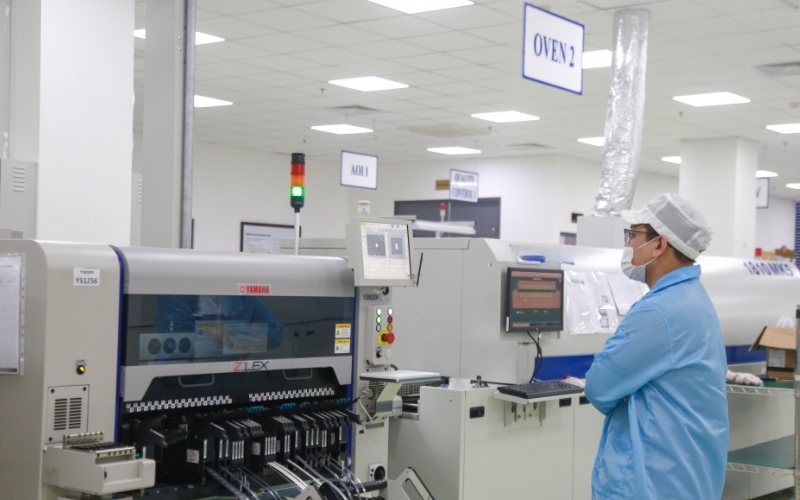
A factory producing printed circuit board assemblies (PCBAs) for overseas customers does far more than assemble electronic components. Export production often integrates engineering validation, automated surface-mount technology (SMT) assembly, automated optical inspection (AOI), functional testing, component traceability, and detailed production documentation before products leave the factory.
The following factory interview provides a practical look inside a Vietnam-based PCBA manufacturer, illustrating how engineering, automation, and quality systems support export-oriented production for global customers.
While electronics offers one of the most visible examples, the same principle applies across many manufacturing sectors in Vietnam. Furniture, garments, machinery, consumer products, and industrial equipment destined for overseas markets are often produced under different processes than products intended solely for domestic distribution.
Why Export Products Often Follow Different Requirements
Many buyers assume that the differences between domestic and export products are primarily about quality. In reality, quality is only one part of the equation.
Export products are designed to satisfy a much broader set of requirements. Depending on the destination market and customer, manufacturers may need to adapt product specifications, materials, testing procedures, documentation, packaging, labeling, or production controls.
As a result, manufacturers frequently produce multiple versions of what appears to be the same product. While the overall design may remain unchanged, internal components, packaging, user documentation, or quality inspection procedures may differ according to customer or market requirements.
Export Markets Define the Rules
One of the most important principles in international sourcing is that product requirements are determined by the destination market—not by where the product is manufactured.
A Vietnamese manufacturer producing electrical equipment for domestic retailers may only need to comply with Vietnam’s applicable technical regulations. However, if the same product is exported to Germany, France, or other European Union countries, additional requirements may apply, including CE marking, technical documentation, electromagnetic compatibility (EMC) testing, restrictions on hazardous substances, and multilingual product information.
Similarly, products destined for the United States may require compliance with FCC regulations, different electrical specifications, or market-specific labeling.
For manufacturers serving multiple markets, adapting products to these different regulatory frameworks has become a normal part of production planning rather than an exception.
Documentation and Traceability Are Part of the Product
For many international buyers, the product itself is only part of the purchase.
Equally important is the documentation that accompanies it.
Export shipments often require technical files, declarations of conformity, test reports, bills of materials, product manuals, supplier declarations, traceability records, and supporting documentation for critical components.
These documents help demonstrate that the exported product corresponds to the version that has been tested, approved, and manufactured under controlled conditions.
As global supply chains become increasingly regulated, documentation has evolved from an administrative requirement into an important element of product quality and risk management.
Packaging Must Support Global Logistics

Export Packaging in Vietnam
Domestic distribution within Vietnam generally involves relatively short transportation distances.
Export logistics present a very different challenge.
Products manufactured in Vietnam may spend four to eight weeks travelling by sea before reaching customers in Europe or North America. During that journey they may be exposed to humidity, vibration, stacking pressure, repeated handling, and extended storage.
For this reason, export packaging is designed not only to protect the product but also to support international logistics. Stronger cartons, moisture protection, palletization, shipping labels, barcodes, recycling symbols, importer information, and country-of-origin markings all become important parts of the export process.
For certain products, such as electronics containing lithium batteries, transportation itself also introduces additional regulatory requirements.
Why Export Experience Matters
When evaluating suppliers in Vietnam, buyers often compare production capacity, pricing, lead times, and manufacturing capability.
However, export experience can be equally important.
Manufacturers that have supplied overseas customers over many years typically develop systems that extend well beyond production. These may include engineering change management, documentation control, traceability, customer audits, export packaging, and structured quality management processes.
By contrast, a factory serving mainly the domestic market may produce reliable products but have less experience managing the documentation, certification, or customer-specific requirements commonly associated with international trade.
Rather than indicating differences in manufacturing capability, this reflects the different operational demands of domestic and export markets.
Looking Beyond Price When Sourcing from Vietnam
As Vietnam continues to strengthen its position in global manufacturing, international buyers are increasingly looking beyond quotations alone when selecting suppliers.
Understanding a manufacturer’s export experience, production systems, documentation practices, quality management, and familiarity with destination-market requirements often provides a more complete picture of its ability to support long-term international business.
For buyers, asking how a factory manages exports can be just as valuable as asking what it manufactures.
Conclusion
Products manufactured for Vietnam’s domestic market and those produced for export may look remarkably similar, yet they often follow different technical, commercial, and operational pathways before reaching customers.
These differences are shaped not only by regulations but also by customer expectations, production systems, documentation, logistics, and quality management practices.
As Vietnam continues to expand its role in global supply chains, understanding how manufacturers adapt products for different markets enables international buyers to make better-informed sourcing decisions and build stronger partnerships with export-oriented suppliers.
Discover more from Vietnam Insider
Subscribe to get the latest posts sent to your email.