

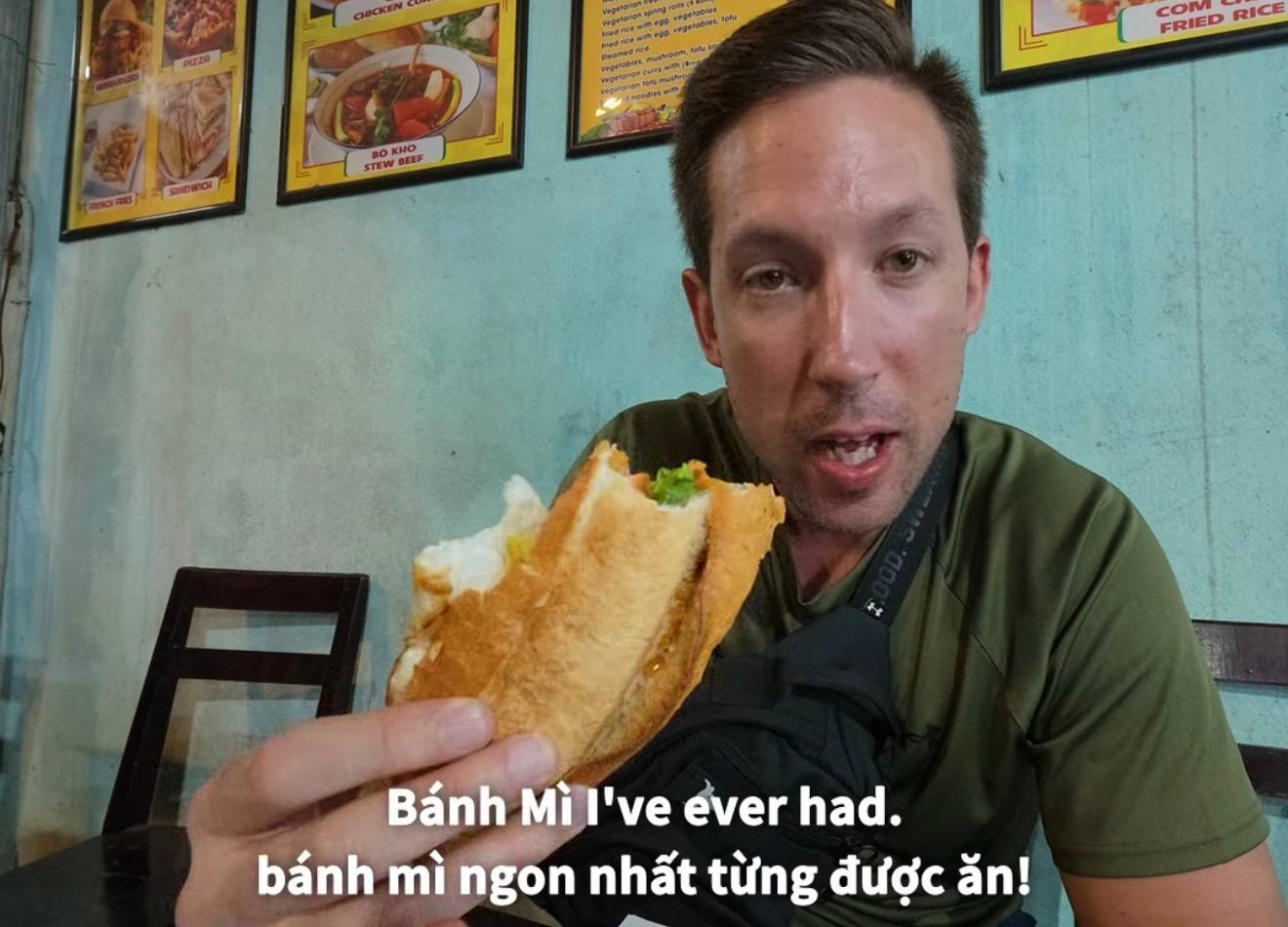
In a video shared on his social channels, Jozzie explained that Hoi An’s enchanting atmosphere was the sole reason he chose to extend his stay in Vietnam. The eatery appeared on his digital map as just another unassuming spot among countless choices scattered across the ancient town. Yet the experience far exceeded his expectations. Ordering a bowl of cao lau and a crusty banh mi, he lavished praise on the woman behind the stove, affectionately calling her an exceptionally warm, motherly host.


A Homestyle Kitchen in Cam Chau
Mama’s Authentic Vietnamese Kitchen sits on Cua Dai Street, a major thoroughfare linking the lantern-lit Old Town to the sea, lined with spots catering to both neighborhood residents and globe-trotters. In stark contrast to tourist-oriented establishments, this space feels like a family kitchen where every dish is prepared directly by the woman at the counter.
The stall operates almost around the clock—from 7:30 in the morning until 4:00 the following dawn—offering late-night comfort to travelers heading back from evening strolls through the ancient streets. Its unhurried pace and unpretentious setting create an immediate sense of ease rare to find in such a bustling tourist hub.
One detail caught Jozzie completely off guard: every patron who stepped inside, even first-time foreign visitors, addressed the woman running the kitchen simply as “Mama.” To an outsider, the practice seemed startling at first, yet it explained the comforting intimacy that lingered throughout his meal—living up to the moniker “Mama’s” chosen to welcome international guests.
Cao Lau and Banh Mi: Twin Pillars of Hoi An Cuisine
Of the two dishes Jozzie ordered, cao lau represents Hoi An’s culinary identity—a specialty nearly impossible to replicate elsewhere. Authentic cao lau noodles are crafted from rice soaked in ash lye gathered from Cham Island firewood, then mixed with mineral-rich water drawn exclusively from the ancient Ba Le Well, believed to date back to the Champa era. This centuries-old technique gives the noodles a chewy bite, a muted yellow tint, and a profile distinct from regular pho or rice noodles.
A traditional bowl features thinly sliced xa xiu (char siu pork), crisp golden pork cracklings, aromatic herbs from Tra Que village, and a small ladle of concentrated braising gravy rather than a full broth, requiring diners to toss all elements together before eating. This dry-tossed style often catches foreign guests by surprise, defying the Western assumption that Asian noodles are always served swimming in soup.


Hoi An’s banh mi, on the other hand, tells a different culinary tale—the marriage of French baguette baking and Vietnamese seasoning. The local crust is famously thin, airy, and crackling crisp, packed with rich pâté, cold cuts, savory pork roast, fresh herbs, pickled vegetables, and each vendor’s signature secret gravy.
The balance between the shattering crunch of the loaf, the savoriness of the meat fillings, and the acidity of pickled carrots and daikon is what elevates a great banh mi, explaining why global food critics continue to celebrate it. While Jozzie’s declaration that this was the best banh mi he had ever tasted was personal, it spoke volumes about the consistency this small kitchen maintains amid Hoi An’s crowded sandwich scene.


Jozzie’s experience reflects a growing shift among international travelers in Vietnam: bypassing overhyped tourist traps in favor of authentic, word-of-mouth discoveries. For an understated stall like Mama’s, gaining sudden viral attention proves that traditional homestyle cooking endures not through flashiness, but through genuine care in every bowl and crusty loaf.
Eatery Information
-
Name: Mama’s Authentic Vietnamese Kitchen
-
Address: 399 Cua Dai, Cam Chau, Hoi An, Quang Nam
-
Opening Hours: 7:30 a.m. to 4:00 a.m. the following morning
Delivery Inquiries: 0707 517 144 (English) | 0869 535 905 (Vietnamese)
(Source: kenh14.vn)
Discover more from Vietnam Insider
Subscribe to get the latest posts sent to your email.