

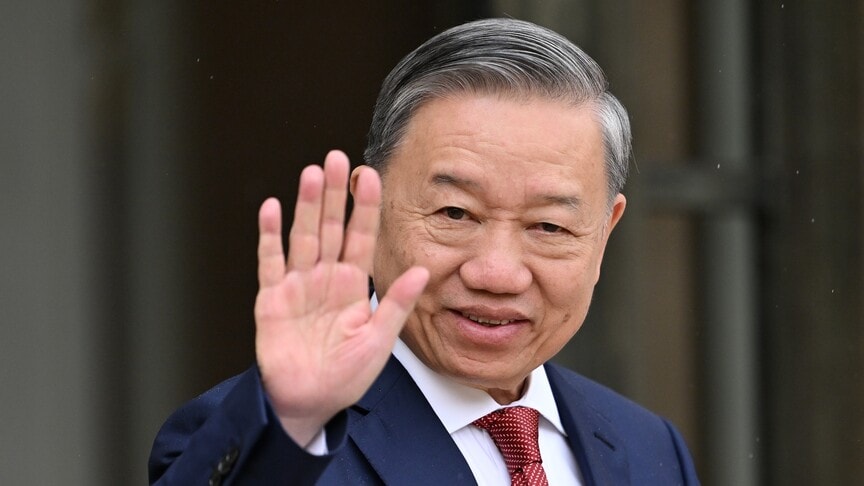
General Secretary and President To Lam visited Thailand, Singapore, and the Philippines between May 27 and June 1. This marked the conclusion of a major diplomatic tour across Southeast Asia. Counting earlier trips to Laos, Cambodia, Malaysia, and Indonesia, Vietnam’s top leader has visited seven ASEAN member states since August 2024.
The diplomatic journal The Diplomat recently analyzed these trips. The publication noted that regional contacts demonstrate ASEAN’s special position in Vietnam’s foreign policy. These engagements also highlight how Vietnam actively adjusts its approach toward neighboring regions.
ASEAN Holds an Increasingly Central Role
ASEAN has remained a top priority in Vietnam’s foreign policy for decades. Vietnam joined the Association in 1995. Since then, the country has integrated deeply into regional cooperation mechanisms and expanded international trade.
Historically, researchers noted that Vietnam’s “neighboring diplomacy” focused mainly on immediate land neighbors. These nations included China, Laos, and Cambodia. Vietnam categorized other ASEAN nations under a broader regional partner umbrella.
Recent diplomatic activities reveal a distinct strategic evolution. Experts emphasize that Vietnam no longer views Southeast Asia solely as an economic partner. Instead, the region forms a critical strategic space for national security amid growing global uncertainty.
This strategic pivot shines through recent diplomatic initiatives. Under General Secretary and President To Lam’s leadership, Vietnam has systematically upgraded bilateral ties with multiple ASEAN members.
Accelerating Bilateral Upgrades with ASEAN Partners
Between late 2024 and mid-2025, Vietnam elevated ties across Southeast Asia.
Vietnam established Comprehensive Strategic Partnerships with Malaysia, Indonesia, Singapore, and Thailand. This framework represents the highest tier in Vietnam’s diplomatic hierarchy. General Secretary and President To Lam finalized upgrades with Malaysia in November 2024, followed by Indonesia and Singapore in March 2025. Meanwhile, Thai Prime Minister Paetongtarn Shinawatra visited Hanoi in May 2025 to elevate ties.

Vietnam and the Philippines upgraded their ties to an Enhanced Strategic Partnership during the official visit of General Secretary and President To Lam from May 31 to June 1. Photo: Inquirer
During General Secretary and President To Lam’s visit to Manila, Vietnam and the Philippines elevated ties to an Enhanced Strategic Partnership. This move lays a strong foundation for deeper future cooperation. Additionally, Vietnam maintains a Comprehensive Partnership with Brunei and Comprehensive Cooperation with Myanmar.
Analysts observe that upgrading ties with all five ASEAN founding members—Indonesia, Malaysia, the Philippines, Singapore, and Thailand—reflects Hanoi’s rising regional stature.
Vietnam now actively shapes regional security discussions. The country has expanded its focus far beyond traditional economic goals.
Strategic Diplomatic Vision in the Regional Landscape
General Secretary and President To Lam delivered a keynote address at the Shangri-La Dialogue in Singapore. This event stands as Asia-Pacific’s premier security forum. The invitation marked the first time a Vietnamese General Secretary and President addressed the summit.

The invitation extended to General Secretary and President To Lam to deliver a keynote address at the 23rd Shangri-La Dialogue reflects Vietnam’s rising global stature and prestige. Photo: IISS
In his speech, the Vietnamese leader emphasized that national interests link directly to regional peace. This message reaffirms Hanoi’s core belief that development requires a peaceful environment. It also highlights ASEAN’s expanding role within Vietnam’s strategic planning.
Diplomatic experts note that Vietnam has broadened its definition of “neighbors.” The term now includes maritime partners like Indonesia and the Philippines alongside land border nations.
This modern framework supports intra-ASEAN unity. It helps member states navigate major-power competition, geopolitical tensions, supply chain changes, and trade barriers.
Moving Toward a More Cohesive ASEAN
General Secretary and President To Lam’s diplomatic efforts expanded bilateral cooperation significantly. Recent agreements cover trade, investment, defense, security, education, and cultural exchanges.
ASEAN remains one of Vietnam’s vital economic partners. Two-way trade reached approximately $91 billion in 2025, up from $84 billion in 2024. Thailand, Singapore, and the Philippines continue to lead as top regional trading partners.
Deeper ties with ASEAN offer vital strategic advantages alongside economic growth. A united ASEAN speaking with one voice protects member interests during global shifts.
Hanoi’s recent diplomatic campaign shows a clear trajectory: ASEAN occupies center stage in Vietnamese foreign policy. Strengthening these ties raises Vietnam’s international profile and drives regional integration forward.
Discover more from Vietnam Insider
Subscribe to get the latest posts sent to your email.