

A Journey of Deep Meaning
Some searches begin with a worn military map. Other searches start with a story that has faded with age. Meanwhile, some searches begin with a tiny DNA sample—just a few cells surviving after more than half a century underground.

A plastic comb and a small plastic bag buried for decades under the earth served a sacred mission. They restored the true identity of martyr Doan Van Kien. | Source: Dan Tri Newspaper
According to Decision 27/QD-BCDQG issued on March 22, 2026, Vietnam officially launched the 500-Day Campaign to complete the collection of DNA samples from relatives of unidentified fallen soldiers. Within less than two years, the campaign aims to search for and recover approximately 7,000 sets of remains. Furthermore, specialists will analyze 18,000 biological samples from remains and collect nearly 300,000 biological samples from relatives. This massive effort will build a national genetic database for matching.


The final letters from a fallen father to his wife and children before his sacrifice: “Are you proud? You have a husband who fought continuously for nearly 25 years without rest…” | Source: Nhan Dan Newspaper
More than 50 years after the war ended, tens of thousands of fallen soldiers remain unidentified. Countless gravestones bear only the brief inscription “Unknown Martyr.” For decades, families have lived without knowing where their loved ones rest. Similarly, aging children and siblings have never had the opportunity to burn incense at the exact resting place of their kin. Therefore, the 500-Day Campaign was born to bridge these painful gaps and create meaningful reunions for the living.
Why 500 Days?
Time is running out for the living generation. Direct genetic relatives, such as parents or siblings of the fallen soldiers, are now mostly over 70 or even 90 years old. Consequently, passing years mean many original DNA sources risk disappearing forever.
At the same time, time does not stand still for those who rest beneath the soil. After more than half a century in harsh tropical climate conditions, DNA in human remains degrades continuously. As a result, extraction grows more difficult, costs increase, and the success rate drops every year.

A photograph found inside the grave of a fallen soldier in Duc Hoa, Tay Ninh, who sacrificed his life in 1968. | Source: Tuoi Tre Newspaper
Therefore, the campaign is not merely preparing for the upcoming 80th anniversary of War Invalids and Martyrs Day. Instead, it is a urgent race to seize the final opportunity before both biological data sources vanish forever. It represents a human race against a clock ticking backwards.
How Many People Does It Take to Identify One Fallen Soldier?
Returning a name to an unnamed soldier involves far more than a simple DNA test or excavation. Behind every successful identification stands the coordinated effort of 32 search and collection teams. These units comprise over 1,500 officers and soldiers operating across Vietnam, Laos, and Cambodia. Furthermore, thousands of professionals across various sectors—including the military, police, healthcare, forensic science, and social affairs—contribute to the mission.
The operational strategy relies on four primary forces working seamlessly together.
Defense Forces: The Dangerous Frontline
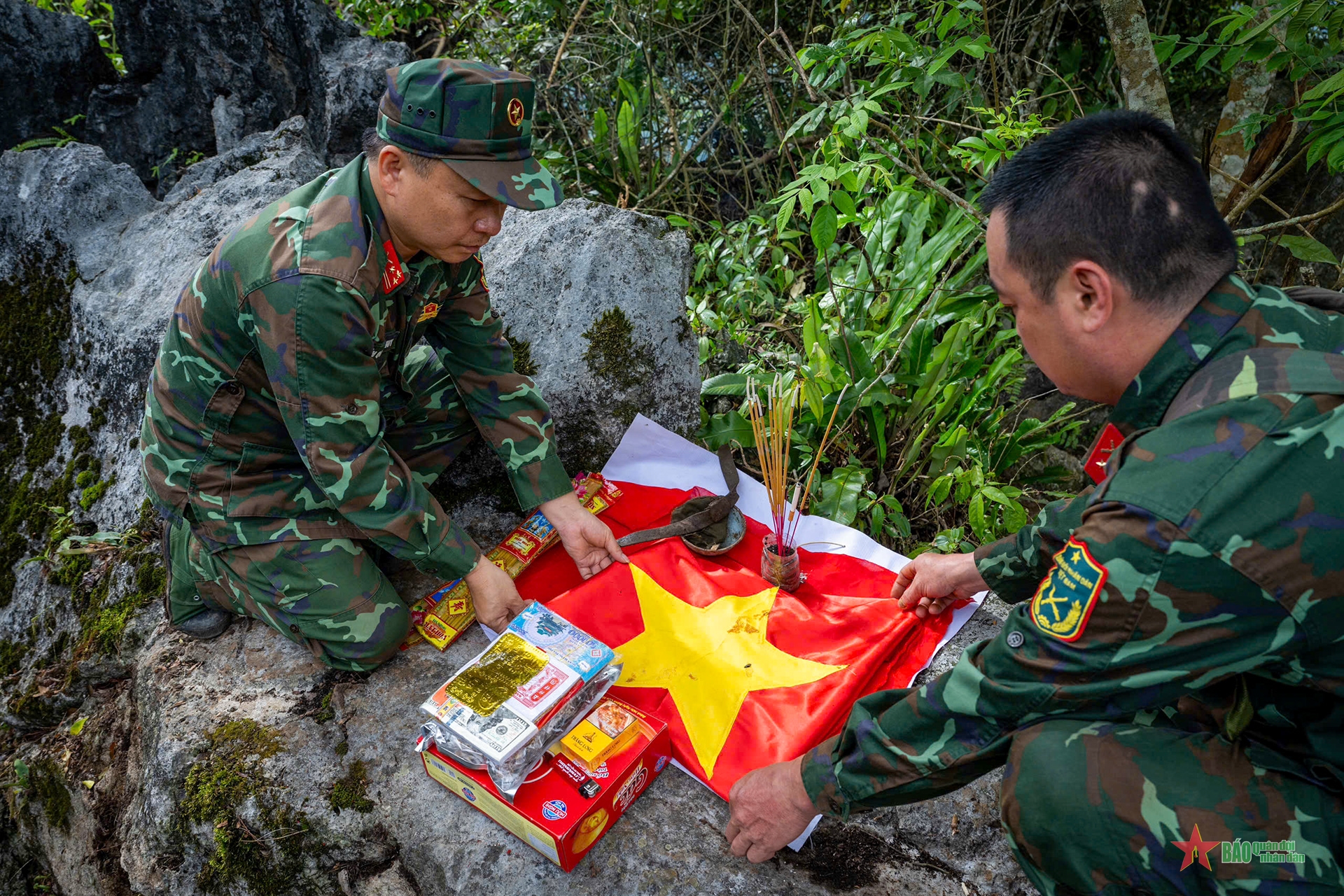
This group forms the first and most dangerous line of action. Their workspace covers old battlefield coordinates where dense jungles and time have erased nearly all physical traces.
Veterans serve as a vital source of information. Drawing on remaining memories, they provide historical details and cross-check terrain features to help functional forces narrow down search zones accurately.

A witness who lost the ability to speak uses expressive gestures to reveal a new mass grave location at Le Thi Rieng Park containing 190 fallen soldiers. | Source: Dan Viet Newspaper
Engineers take charge of clearing landmines and unexploded ordnance left behind at suspected locations. Thus, they secure an absolute safety perimeter for excavation teams.
Search and Recovery Teams rely on burial maps and eyewitness accounts to locate, excavate, and collect remains across domestic and international battlefields. This delicate work demands extreme patience to preserve every bone fragment and personal artifact buried for over half a century.

Officers working tirelessly to fulfill their sacred mission. | Source: Tuoi Tre Newspaper
Public Security Forces: Modern Tracing and Local Outreach
Unlike the defense sector, public security forces focus primarily on cross-checking population data, verifying family ties, and collecting samples. Their main challenge lies in the fact that families of fallen soldiers have migrated and changed residences over the past decades.
Administrative Police leverage the power of the National Population Database to search, locate, and verify demographic details of relatives nationwide. Thanks to modern technology, this tracing process moves at remarkable speed.
Local Police officers join forces with local medical staff to visit every household directly once data pinpoints a location. They assist relatives with identity verification and support sample collection on the spot.
Medical and Forensic Teams: Unlocking Genetic Clues
Within laboratories, science seeks to trace the passage of time and restore identities using the smallest biological clues.
Local Healthcare Workers collect blood or oral mucosa samples from living relatives. Furthermore, they ensure strict medical compliance during sample preservation and transport to testing centers.
Forensics Doctors examine and assess the condition of remains immediately after excavation. Using professional expertise, they select and preserve bone or tooth fragments that offer the highest chance of successful DNA extraction.
Biotechnology and Genetic Experts work at specialized DNA testing centers, such as the Military Forensic Institute and Criminal Science Institute. They tackle extreme medical challenges by using advanced technology to extract cells and amplify heavily degraded genes, ultimately building genetic profiles for identification.


Researchers at the DNA Identification Center under the Institute of Biology (Vietnam Academy of Science and Technology) conduct specialized research to identify remains. | Source: Nhan Dan Newspaper
Labor, Invalids, and Social Affairs: The Final Verification
Even when computers match two DNA samples, the result still requires formal validation before legally restoring a soldier’s name.
Labor, Invalids, and Social Affairs Officers manage a massive volume of original military records. They pull death notices and oversee cemetery maps for cross-verification. Ultimately, they act as the final checkpoint, ensuring legal certainty and absolute accuracy before official records and tombstones are updated.

A emotional reunion with the family of fallen soldier Tran Van Mai after 42 long years. | Source: Tuoi Tre Newspaper
Tears of Reunion
According to a VTV report broadcast on July 20, the 500-Day Campaign has successfully recovered more than 1,400 sets of remains. Additionally, task forces discovered five mass graves in Tuyen Quang and another mass grave at Le Thi Rieng Park. They also collected tens of thousands of biological samples from relatives, opening new opportunities to identify long-lost soldiers.

The wife of martyr Huynh Van Quen, Mrs. Nguyen Thi Le, recalls his promise before marching into the 1968 Tet Offensive: “I will return to marry you after we win this battle.” | Source: Znews Newspaper

The touching words of Mrs. Le, “From now on, I am truly his wife again…”, close a long journey of waiting that lasted 58 years. | Source: VTC News
These figures represent far more than operational progress; they embody a deeply humane mission. Every collected sample and every recovered set of remains offers a precious chance to return a name to someone who rested beneath the ancestral soil for decades. Ultimately, the campaign not only brings these soldiers home, but it also heals the enduring pain of countless families by providing a named grave and bringing their loved ones back to their homeland.
Discover more from Vietnam Insider
Subscribe to get the latest posts sent to your email.