

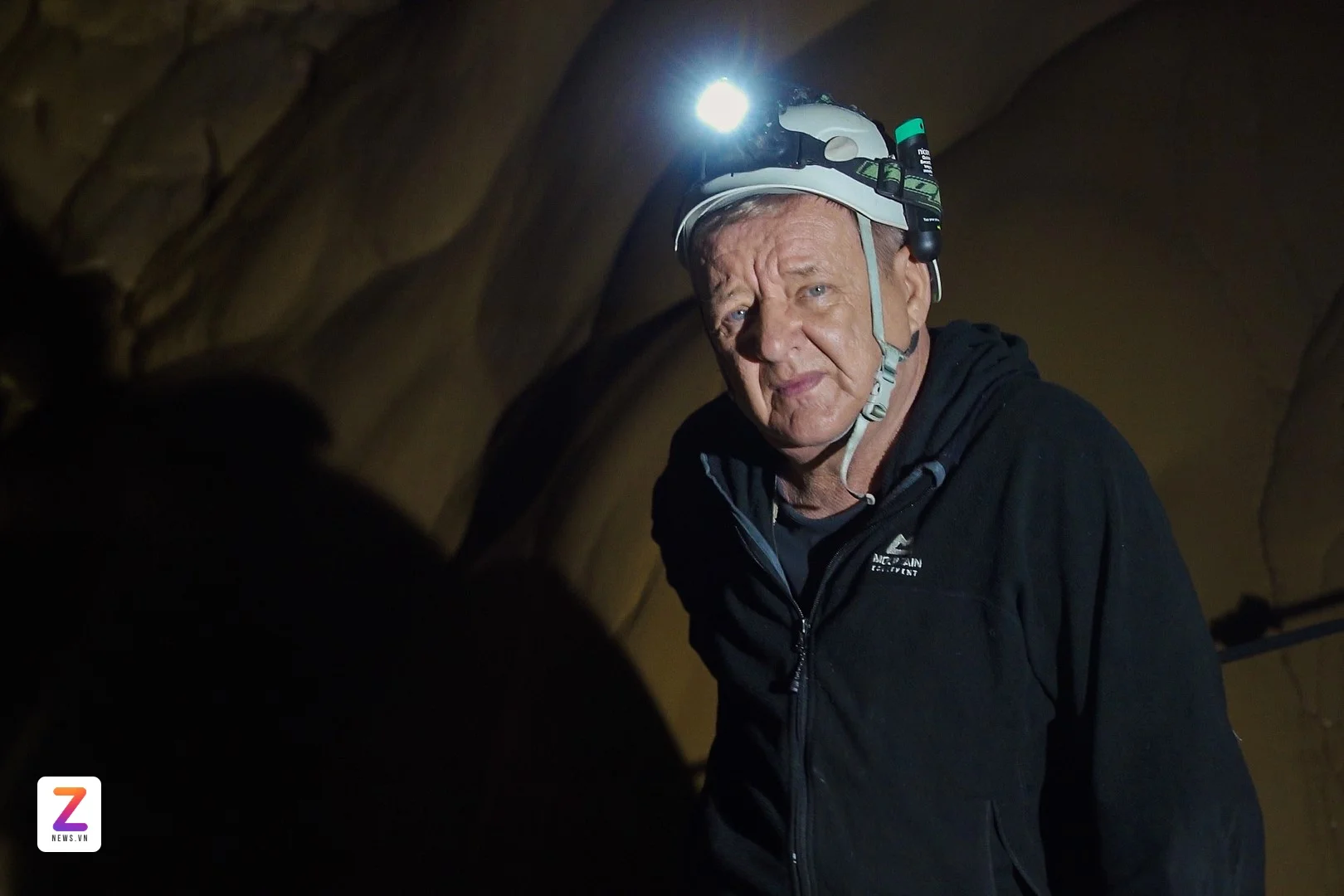
Villagers in Phong Nha once gathered to pray together upon hearing that a cave expedition team had met with an accident. The team brought together British experts, Vietnamese associates, and local residents. In 1997, a fierce flash flood trapped two expedition members inside a cave for 57 hours.
Team members worked tirelessly, exhausting their physical limits to lower water levels and bring their two teammates back safely. When they emerged, a feast prepared by the villagers stood waiting to welcome the people who were helping transform their lives by uncovering caves hidden deep inside the mountains.
That was the exact moment Howard Limbert, now 69, realized he had become part of this native community’s extended family.
“I never expected to stay connected with Vietnam for so long. We came for the caves, but we stayed for the people,” he shared.
35 Years Searching for 800 Caves in Vietnam
Howard Limbert and his wife Deb Limbert, alongside ten members of the British Cave Research Association (BCRA), formed the first caving expedition to set foot in Vietnam. Their arrival opened a new turning point for the Phong Nha region, leading eventually to Son Doong’s recognition as the largest cave on Earth.
After 35 years, Howard still chooses central Vietnam as his home. Over the decades, he has brought friends from around the world to Vietnam, pursuing a vocation few understood: exploring the cave systems of Phong Nha – Ke Bang.

Howard (in yellow) and Deb (in stripes) during their meeting with General Vo Nguyen Giap in 1992. (Photo: Howard Limbert)
Back in Britain, Howard began caving at the age of 16. He became completely captivated by European caves, going on to lead expeditions to Austria, Spain, Mexico, and New Zealand. This passion pulled him away from a medical career, anchoring his life to subterranean discovery worldwide.
In 1990, an inquiry was sent from Britain to three Southeast Asian nations requesting permission to conduct cave surveys. Only Vietnam responded. The expedition team he assembled set off immediately.
Back then, entering the country proved difficult, information was scarce, and navigating the rough road network from Hanoi took five full days. When Howard arrived, the small village of Phong Nha sat isolated along the Son River, quiet and rarely visited.
Accompanying him were academic partners from Hanoi University of Science (now VNU University of Science). They organized a six-week expedition, guiding the British team to areas showing immense speleological potential.
Howard and his team stepped into the limestone karst in the truest sense of exploration: no maps, no GPS, and no inkling of what lay underground. Everything rested on courage and raw passion. Yet Phong Nha Cave took him by surprise with nearly 8 kilometers of dry passages, water caves, underground rivers, and branch tunnels.
“The scale of this cave was overwhelming, unlike anything seen globally. Phong Nha was the very first cave I explored in Vietnam, and it was the finest and longest cave in Asia at the time,” he recalled.

Howard during a subterranean survey expedition. (Photo: Oxalis Adventure)
Phong Nha gradually wiped blank spots off the global geological map as its subterranean chambers stepped into the light one after another. In 1992, the team mapped Paradise Cave (Dong Thien Duong), measuring 18.5 kilometers in length, followed by Hang En—the world’s third-largest cave—in 1994. By 1999, surveys unveiled Khe Ry Cave, the world’s longest river cave, proving the immense geological scale of the Ke Bang massif.
From hydrological clues where the waters of Khe Ry and Hang En converged and disappeared beneath the jungle floor, Howard and his wife envisioned the existence of an even larger cavern. Yet for years, its entrance remained hidden.
A stroke of fortune arrived in 2007 when he met local woodsman Ho Khanh, who described a massive cavern entrance he had stumbled upon back in 1990. In 2009, the Limberts, Ho Khanh, and the survey team finally located Son Doong, exploring its depths and announcing it as the largest natural cave in the world.
The discovery immediately captured international media headlines, elevating Vietnam’s global profile and turning the Phong Nha – Ke Bang buffer zone into the world’s “cave kingdom.” Howard had not merely found a cave; he had unlocked a new chapter for an entire region.
To date, the team has surveyed more than 800 caves across central and northern provinces like Ninh Binh and Quang Ninh. According to Howard, many more subterranean systems remain undiscovered, primarily across northern Vietnam.
Transforming Local Livelihoods
Alongside surveying and mapping caves, Howard focused on improving local standards of living. When Phong Nha Cave was first explored, nearby communities derived few direct benefits. Only after Son Doong was unveiled did residents begin earning sustainable income.
“The local people play a critical role in every operation. Without them, our expeditions could never have succeeded. Life in the deep jungle is arduous, and their involvement made cave exploration far smoother,” he said.


A tour guide leads an expedition through Son Doong Cave in 2024. (Photo: Linh Huynh)
In 2011, the British speleologist took on the role of Technical Director for expedition operator Oxalis Adventure. From this position, he quietly introduced European safety standards to the jungle while changing local mindsets in Phong Nha.
The enterprise has always prioritized local hiring, currently employing nearly 600 staff. Few realize that many current guides and porters were once illegal loggers and poachers. Yet Howard recognized their innate understanding of the ancient forest and its caves. He adopted a core conviction: no one can protect natural heritage better than the local community itself.
The tourism value of these caves fundamentally reshaped local awareness of their ecological importance.
Today, many other residents participate in hospitality, running homestays, restaurants, and transport services. The cave tourism model allows them to live and work in their native hometown.
For Howard, his most rewarding achievement is witnessing this community and livelihood turnaround. People who once left litter behind and hunted wildlife now sweep the forest clean and stand guard over the caves.
High-performing local staff earn opportunities to advance into well-paid leadership positions, eliminating the need to take lengthy jungle treks away from their families. Several have received full company sponsorships to pursue university degrees and qualify as professional international guides.
“Phong Nha today looks completely different from when I first arrived. People’s lives have improved tremendously. Serving the Son Doong route alone provides stable livelihoods for about 130 local workers,” he remarked.
‘Vietnam’s Caves Are the Most Magnificent in the World’
To build a comprehensive understanding of Vietnam’s subterranean systems, Howard, his wife, and their colleagues worked closely with scientists on specialized research.
He noted that high-grade limestone formations coupled with heavy rainfall have carved out exceptional cave systems. Several caves also yield unique endemic species and archeological evidence of prehistoric human habitation.
Knowing where surface water drains into a sinkhole and where it re-emerges at an outlet stream allows surveyors to map out entirely new underground voids.
In central Vietnam, distinct tectonic conditions created colossal chambers. The caves of Phong Nha – Ke Bang are dynamic conduits, intricately linked through hydrological networks that funnel water from one chamber into another, continuously carving through the limestone bedrock.
However, the British expert maintains that tourism development must go hand in hand with environmental conservation. This principle remains uncompromised. Caves are fragile ecosystems that require millions of years to form, yet human carelessness can destroy them permanently in minutes.
In Phong Nha – Ke Bang, Howard and his team opened caves for both mass sightseeing and low-impact adventure tours. Mass tourism requires strict visitor controls to prevent tourists from touching and eroding fragile formations, alongside directional LED lighting to avoid irreversible heat and algae damage.
Adventure expeditions represent the right path forward, keeping visitor numbers strictly capped and led by knowledgeable, thoroughly trained teams.
“Around 30% of our trekking guests are Vietnamese nationals. I am delighted to see them appreciate the extraordinary caves their country possesses,” he observed.


 The buffer zone of Phong Nha – Ke Bang and the main chamber of Hang En. (Photo: Hoai Bao, Quynh Danh, Phan Nhat)
In April, Howard and his partners unveiled the Cave Exploration and Information Center in Phong Nha. The facility allows visitors to explore the complete history of regional caving free of charge. He hopes this gift to Vietnam will inspire younger generations to cherish caves and natural heritage.
Earlier, in 2015, the Vietnamese state conferred the Third-Class Labor Order on Howard and his wife in formal recognition of their contributions.
“Vietnam changed the course of our lives as well. We hope cave tourism will continue to flourish sustainably, bringing lasting opportunities to local people,” he concluded.
(Source: Tri Thuc Magazine – News.vn)
Discover more from Vietnam Insider
Subscribe to get the latest posts sent to your email.