

For decades, China has been at the centre of global manufacturing. Its scale, extensive supplier networks and established industrial infrastructure have made it a natural destination for companies looking to outsource production.
But for European manufacturers, the outsourcing landscape across Asia now offers a wider range of options.
Vietnam, Thailand, Malaysia and other Asian markets have developed specialised manufacturing capabilities, established subcontractor networks and increasingly mature industrial ecosystems. For companies looking to diversify their supply chains, reduce dependency on a single manufacturing base or explore new production opportunities, these markets deserve closer consideration.
The challenge, however, is not simply identifying an alternative manufacturing destination. It is understanding which market, supplier and industrial ecosystem actually fit the requirements of a specific project.
Looking Beyond a Single Manufacturing Hub
Choosing an outsourcing destination involves much more than comparing production costs. Manufacturers need to look at supplier capabilities, production capacity, technical requirements, quality standards, subcontractor availability, logistics, lead times and the maturity of the surrounding industrial ecosystem.
These factors can vary significantly from one market and even from one supplier to another.
A country may have strong capabilities in a particular manufacturing sector, but that does not necessarily mean every supplier within that market is suitable for an international project. The same applies to production costs: a lower quotation does not automatically translate into a lower total cost once quality, tooling, logistics, management and production follow-up are taken into account.
This is why a market that works well for one product or industry may not necessarily be the right fit for another.
For European manufacturers, diversification therefore does not always mean moving production from one country to another. It can also mean building a more flexible regional supply chain, identifying complementary manufacturing capabilities and selecting suppliers based on the specific requirements of each project.
Understanding the Manufacturing Ecosystem
A supplier should not be assessed in isolation. For many manufacturing projects, the surrounding ecosystem can have a direct impact on the feasibility and scalability of production. Access to qualified subcontractors, component suppliers, tooling, finishing, testing, logistics and other supporting services can influence both cost and lead time.
This is particularly relevant when entering a new market. A factory may have the required machinery and production capacity, but manufacturers also need to understand how the facility operates, what types of customers it serves, how quality is controlled, what processes are handled internally and which are outsourced.
For companies managing projects remotely from Europe, these questions can be difficult to assess through supplier profiles, online meetings or quotations alone.
Local knowledge and on-the-ground assessment can therefore play an important role in validating whether a supplier is genuinely suitable for the project.
From Country Selection to Project Fit
The decision to outsource should ultimately start with the requirements of the project. What level of technical capability is required? What production volume is expected? Which processes need to be managed internally? What quality and certification requirements apply? How important are lead times and supply-chain flexibility?
Once these requirements are clear, manufacturers can assess which markets and supplier ecosystems are capable of meeting them. This approach can lead to a more practical view of diversification.
Rather than asking whether Vietnam, Thailand, Malaysia or another Asian market is “better”, manufacturers can ask a more useful question:
Which manufacturing environment is the right fit for this project and how can we validate it?

Guillaume Rondan and Pietro Karjalainen during a factory assessment
That assessment may involve identifying potential suppliers, comparing their capabilities, visiting factories, evaluating production processes and understanding the wider subcontractor network before making a sourcing decision.
A Closer Look at Asia’s Manufacturing Ecosystems
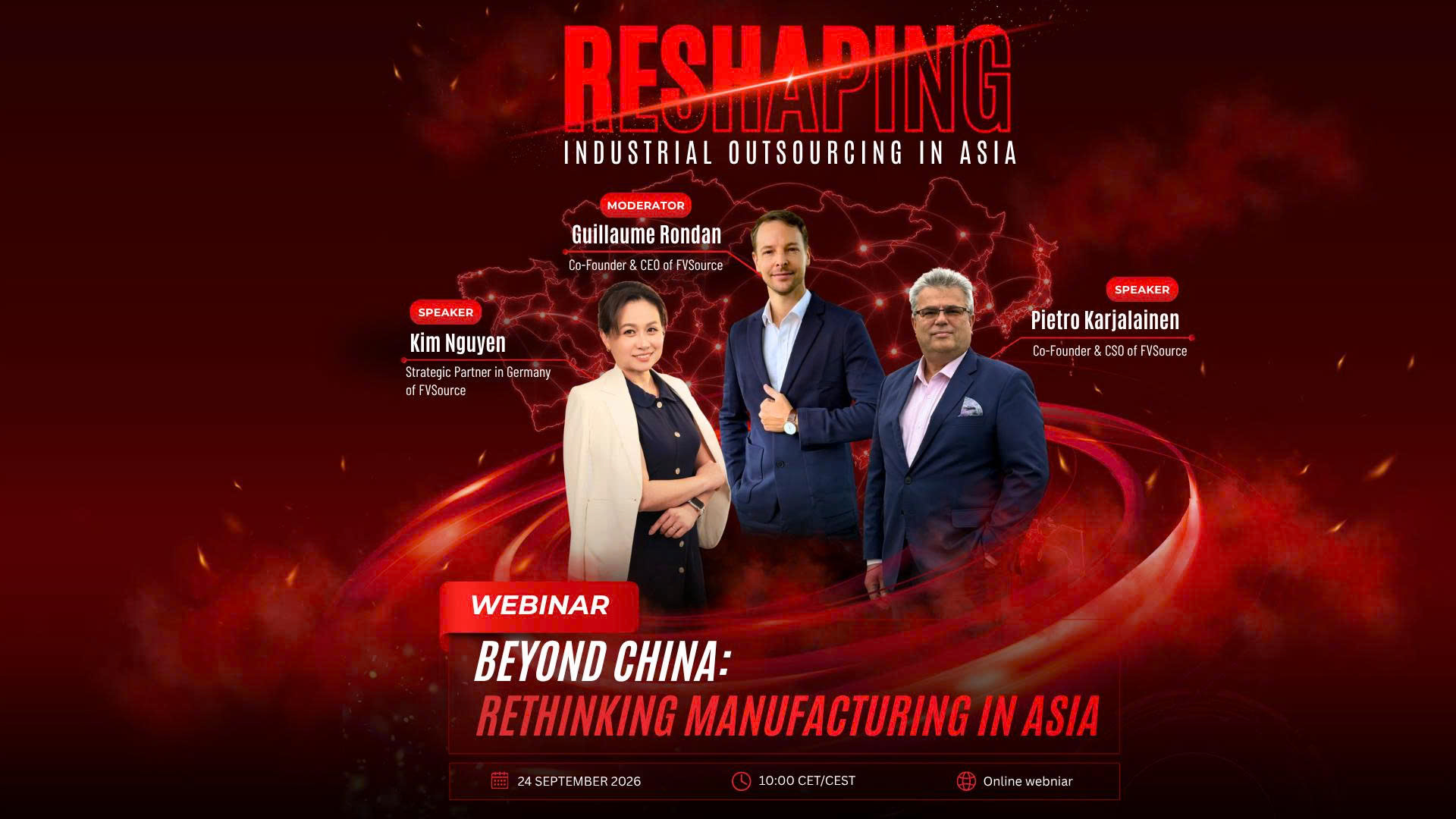
These questions are at the heart of FVSource’s upcoming webinar, “Where Should Your Next Outsourcing Project Go?”
The discussion will explore how European manufacturers can evaluate manufacturing opportunities across Asia and build a more flexible outsourcing strategy with a particular focus on the practical factors that influence supplier and market selection.
The session will feature perspectives from both Europe and Southeast Asia.
Kim Nguyen, Strategic Partner in Germany at FVSource, will discuss European manufacturing strategies and the growing relevance of diversification across Asia.
Pietro Karjalainen, CSO & Co-Founder of FVSource, will share insights into Asia’s manufacturing capabilities, supplier networks and industrial ecosystems.
The discussion will be moderated by Guillaume Rondan, CEO & Co-Founder of FVSource.
Rather than focusing on one destination, the webinar will look at how manufacturers can evaluate different markets, identify the right supplier ecosystem and approach outsourcing decisions on a project-by-project basis.
Event Details
- Thursday, 24 September 2026
- 10:00 AM France | 3:00 PM Vietnam
- Online | English
👉 Join the webinar: Register for the webinar
The meeting link will be accessible once the webinar begins.
About FVSource
FVSource is a Vietnam-based supply chain and market entry partner supporting international companies with sourcing, supplier identification, factory assessment, factory visits, production management and quality control across Vietnam and Southeast Asia.
With teams and partners across Vietnam, Estonia, Finland, Italy and Germany, FVSource combines international supply-chain experience with on-the-ground manufacturing capabilities to help companies evaluate suppliers, manage production and execute sourcing projects in Asia.
Discover more from Vietnam Insider
Subscribe to get the latest posts sent to your email.