

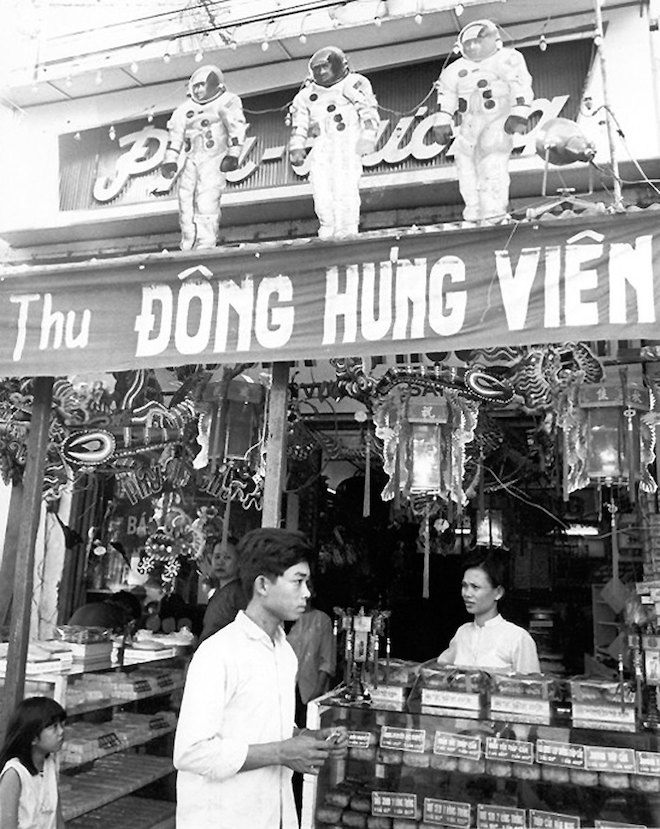
To this day, historians continue to explore whether the Mid-Autumn Festival originated within the ancient wet-rice farming culture of Vietnam or arrived through early exchanges with neighboring traditions. What remains certain is its deep antiquity—dating back at least two thousand years—and its enduring place as an autumn celebration eagerly awaited by children and families for months in advance.

Back in 1928, the Mid-Autumn Festival was already the most eagerly anticipated occasion of the year for children.
During the early decades of the twentieth century, the festive spirit arrived in Hanoi at the start of the eighth lunar month. Parents took their children by the hand and walked to Hang Gai and Hang Mã streets. These two historic guild streets in the heart of Hanoi served as the largest and most vibrant open-air marketplaces for handcrafted toys and festive papercrafts.

Mid-Autumn Festival street atmosphere nearly a century ago. The original French caption notes that residents were celebrating the festival following a bumper harvest in a small town.

According to historical records, this photograph was also taken in Hanoi in 1928, showing children parading together with oversized star lanterns to celebrate the Mid-Autumn Festival.

Taken between 1925 and 1935, this photograph captures the vibrant spirit of the lion dance, which has always been central to Mid-Autumn celebrations alongside lanterns and harvest cakes—a heritage proudly kept alive today.
Handcrafted Paper, Bamboo Splints, and Candlelight
The undisputed symbol of a traditional Vietnamese Mid-Autumn was the handcrafted five-pointed star lantern. Long before battery-powered plastic novelties existed, these lanterns relied on the patient touch of local artisans.
Craftsmen split and curved flexible bamboo strips into lightweight frames, stretching dyed red and green cellophane across shapes inspired by swimming carp and gentle rabbits. Children also carried pleated accordion lanterns made from colorful paper. The most mesmerizing creation was the revolving shadow lantern (đèn kéo quân). Powered entirely by convection currents rising from a small candle flame, an internal paper wheel turned steadily on a central axis, casting silhouettes of marching folk heroes, court dancers, and animals onto translucent outer panels.
Mechanical tinplate toys also captured children’s imaginations, becoming prized gifts that youngsters begged their parents to take home. Away from the crowded market streets, local neighborhood dry-goods vendors set up small curbside displays. They offered miniature lion heads, star lanterns, and hand-painted papier-mâché masks of Chu Teu—the jovial, round-faced folk character—alongside festive firecrackers and everyday household wares.

A toy and lantern boutique on Hanoi’s Hang Gai Street in 1915, captured in early autochrome color photography by French photographer Léon Busy for the Albert Kahn Collection

A 1915 storefront on Hang Gai Street filled with accordion lanterns, star frames, rabbit shapes, paper flowers, and miniature lion dance heads. Photo: Léon Busy

Handmade animal lanterns shaped from bamboo frames and translucent cellophane, with carp and rabbits dominating market displays. Photo: Léon Busy

Vibrant lanterns glowing with soft hues, transforming early colonial streetscapes into colorful festive lanes. Photo: Léon Busy

Families escorting children along Hang Gai and Hang Mã streets at the start of the eighth lunar month. Photo: Léon Busy

Hang Gai Street bustling with open-air toy stalls ahead of the full moon festival in September 1926. Photo: Vietnam Academy of Social Sciences

The bright, spontaneous smile of a young boy tending an open-air lantern stall in Hanoi, 1928


The lively community warmth and anticipation filling Hanoi’s lanes in the days leading up to the harvest moon

An early 20th-century carp lantern woven from bamboo slats and oiled paper in Hanoi, preserved at the Musée du Quai Branly in Paris, France

Two young children proudly posing beside their bamboo carp lantern. Photo: Léon Busy

Four young friends gathering around a delicate butterfly lantern. Photo: Léon Busy

Star lanterns, rabbit-shaped rolling lanterns, and swimming carp hanging outside a traditional street shop on Hang Gai Street. Photo: Léon Busy

The simple, quiet delight of a young girl with her wheeled rabbit lantern in September 1926, Hanoi

Two sisters smiling beside their treasured rabbit lantern in September 1926, Hanoi

A traditional bamboo star lantern crafted for the Mid-Autumn celebrations during the lunar Year of the Ox, 1937

A dual monk-head lantern crafted for the harvest moon in the lunar Year of the Ox, 1937. Photo: French School of the Far East – EFEO
A Timeless Glow Beneath the Harvest Moon
A century later, these vintage photographs remind us that the heart of Vietnam’s Mid-Autumn has never been about extravagance or technology. It has always been about community warmth: the rustle of delicate paper, the soft golden flicker of a candle carried through a shadowed courtyard, and the shared excitement of a family gathered together under the night sky.
If you have never set foot in Vietnam, picture stepping into an ancient brick alley on a crisp autumn evening. The air carries the gentle scent of beeswax and sweet baked pastry, and children run past with glowing paper stars dancing in their hands. As the full moon rises above your own hometown tonight, take a quiet moment to look up. Across oceans and across centuries, that same gentle moonlight continues to connect us all.
(Source: nguoihanoi.vn & eva.vn)
Discover more from Vietnam Insider
Subscribe to get the latest posts sent to your email.