

In late September, 25-year-old “Anh Ngoc” in Ho Chi Minh City encountered a social media advertisement promoting a short-drama application called CoinDrama. Drawn in by claims that simply watching videos generates real cash, she downloaded the software onto her smartphone.
Ngoc could stream clips immediately upon launching the software. Within moments, an in-app prompt announced a bonus credit of 250,000 VND to her profile balance. However, the application prevented cashing out, citing an enforced minimum withdrawal threshold of 500,000 VND. Prompts then instructed her to view video ads, steadily increasing her balance with increments of 100,000 and 50,000 VND.
“Over time, the payout increments plummeted to merely 1,000 VND per view,” Ngoc recalled. “I spent an entire weekend afternoon watching commercial ads, but could never reach the 500,000 VND threshold.” In addition, the platform repeatedly demanded downloads of third-party utility tools from obscure web domains. Frustrated by the deception, she uninstalled the app.

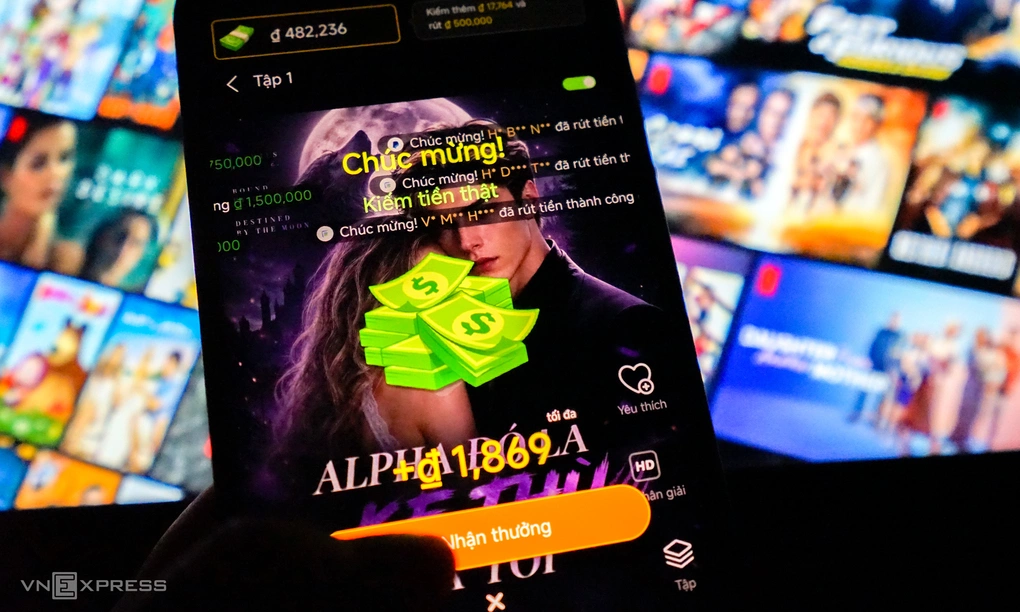
Reward interface of a short-drama mobile app advertising cash rewards for video streaming.
Similarly, 28-year-old “Hong Hanh” in Lam Dong encountered identical manipulation with MixReels. Following in-app tasks, she installed unauthorized software from unknown websites, including a document reader requesting invasive device permissions.
“My smartphone started popping up intrusive commercials every 10 seconds, even after disconnecting internet access,” Hanh explained. “I could neither navigate system controls nor perform a factory reset because ads continuously hijacked the screen.”
Ultimately, she had to pay an independent repair shop to reflash the device firmware. Consequently, she lost stored private files while paying out-of-pocket technical expenses.
Alongside the rapid surge of viral miniseries, cash-for-viewing apps have proliferated across primary marketplaces. On Google Play, CoinDrama has accumulated over 10 million downloads, while CashDrama surpassed 5 million installations. Competitors including Reel Drama and Bonus Drama achieved 100,000 installs, alongside FreeFlick and Reel Reward topping 50,000 downloads each. Meanwhile, comparable platforms on the Apple App Store also record millions of downloads.
These applications share an identical playbook: granting generous starting balances, then obligating ad views and outside installs to unlock funds. As usage increases, awarded credits diminish exponentially, preventing users from ever satisfying cash-out thresholds.
Across online discussion boards, numerous victims report spending hours watching sponsor clips before recognizing the exploitative scheme. Several users had to reformat infected handsets after inadvertently installing intrusive adware and malicious payloads.
This predatory trend extends across international boundaries. According to Thai PBS, the Bangkok Metropolitan Police Bureau recently cautioned the public against watching streaming dramas to earn money. Authorities noted that most offerings represent fraud where withdrawals remain impossible or demand advance cash collateral.

Promotional prize-spin popup displayed when streaming a short video.
According to Dr. “Le Duy Tan”, founder of AIoT Lab VN and lecturer at International University under Vietnam National University Ho Chi Minh City, monetization gimmicks built around video viewing are not novel. However, they continue ensnaring victims by exploiting desire for effortless secondary income.
“The mindset of ‘it doesn’t hurt to try since I have nothing to lose’ pushes many into testing these tools,” Tan explained. “However, figures displayed within software do not represent legitimate bankable currency.”
Online marketing models function when enterprise brands pay networks to display impressions, with developers collecting payouts via advertising brokers. Crucially, distribution networks such as Google AdMob strictly forbid developers from paying direct cash incentives to consumers purely for clicking or watching advertisements.
Unscrupulous software operators introduce virtual point meters, deceptive prize wheels, and gamified progress gauges to maximize engagement. While gamification is not intrinsically fraudulent, opacity surrounding conversion mechanisms and withdrawal terms serves as a major red flag. Consumers must stay vigilant when platforms demand outside software installations, friend referrals, or upfront security deposits.
“Users believe they are streaming entertainment to earn a wage, but in reality, they merely generate ad revenues for shady publishers,” Tan warned. “The on-screen balance functions merely as psychological bait.”
Mr. “Nguyen Duc Hoai”, co-founder and CEO of Bizino AI, highlighted that alongside lost hours, victims face severe cybersecurity threats from downloading unverified external installation packages.
While not every incentivized application contains exploit vectors, side-loading installation files from unknown web portals—particularly unverified Android APK packages—creates profound device exposure. Depending on granted access permissions, malicious applications can harvest credentials, scrape notifications, intercept two-factor authentication codes, and monitor user touch events.
To safeguard personal assets, cybersecurity specialists recommend strict digital safety hygiene: never transfer monetary deposits to unlock virtual balances, never disclose authentication tokens, and never treat modest initial test transfers as proof of long-term legitimacy.
“Individuals need to build digital resilience by pausing before irresistible online promises,” Hoai concluded. “Always question who is funding the reward, where the capital originates, and what privacy tradeoffs are being demanded.”
Source: vnexpress.net
Discover more from Vietnam Insider
Subscribe to get the latest posts sent to your email.