

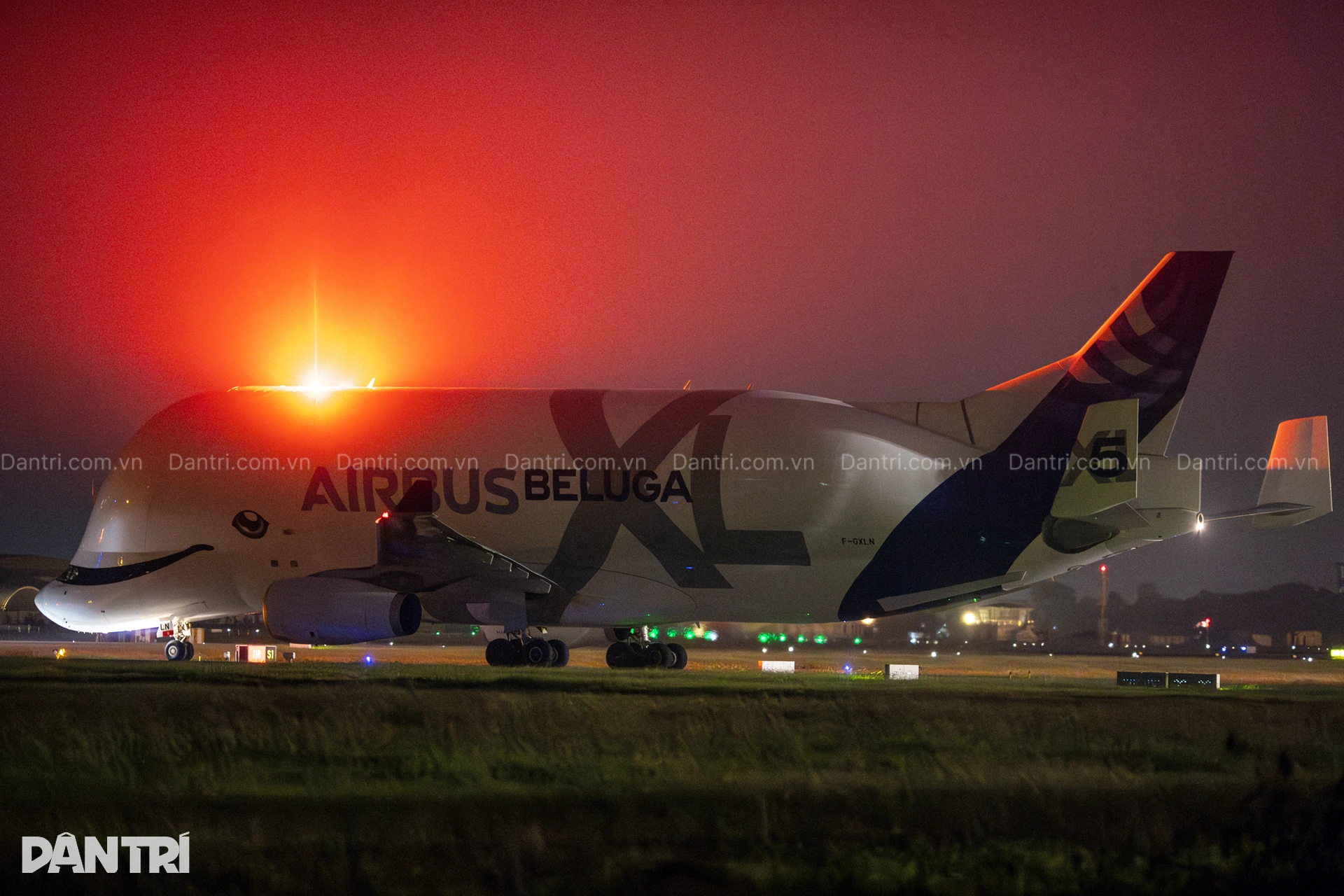
The arrival was an Airbus Beluga, a dedicated super transporter built by Airbus to ferry aircraft wings and fuselage sections. The landing marked the first time a Beluga aircraft touched down in Vietnam.
A Fleeting Visit
The aircraft was an Airbus A300-600ST, the original first-generation Beluga. Arriving from Kolkata, India, as an empty ferry flight, the aircraft was scheduled to depart Da Nang for Taiwan the same evening. Although it remained on the tarmac for only a few hours, its unusual silhouette drew photographers to the airfield perimeter. Local social media channels filled quickly with aviation imagery. One local photographer observed that the airport had previously welcomed Air Force One and aircraft carrying the Russian president. However, he had never seen an airplane shaped like a whale.

The aircraft measures 56.15 meters in length and 17.25 meters in height. Inside, it utilizes a semi-automated cargo handling system across the main deck. A common misconception circulated at the time: several contemporaneous reports labeled the airframe as a “BelugaXL.” Nevertheless, the airframe dimensions and official A300-600ST designation confirmed it as the earlier ST generation. In July 2023, another A300-600ST departed Da Nang for Clark, Philippines, marking the aircraft type’s maiden landing in that nation.
Airbus did not disclose the official purpose of the transit flight. At the time, the European manufacturer was actively marketing the outsized transport capability of its Beluga ST fleet to external customers. That commercial venture originated in early 2022. The first commercial charter occurred in late December 2021, transporting a helicopter airframe from Toulouse, France, to Kobe, Japan.
From the Super Guppy to the Beluga Whale
Airbus operates as a pan-European consortium. As a result, factories in France, Germany, Britain, and Spain manufacture wings, fuselages, and tailfins before shipping them to final assembly lines. The consortium initially relied on overland road networks. However, rising production rates eventually pushed Airbus to move heavy aerostructures by air. For over two decades, that logistical role belonged to the turboprop Super Guppy. The final Super Guppy retired on October 24, 1997, after roughly 26 years of operational service.

A project to replace the aging fleet launched in 1991. Aérospatiale and Deutsche Aerospace established a joint subsidiary to oversee development, with Airbus financing the program directly. Aerospace engineers cut away the upper fuselage of an A300-600 airframe. Above the floor line, they mounted a massive bubble-shaped cargo bay, complemented by an upward-opening nose door and a lowered cockpit floor. The prototype conducted its maiden test flight on September 13, 1994, in Toulouse, entering commercial service in 1995.

The name Beluga, which references the white arctic whale, originated as an informal nickname due to the aircraft’s distinctive swollen crown. The moniker gained immense internal and public affection, prompting Airbus to adopt it as the formal operational designation. In total, the manufacturer constructed only five airframes: registrations F-GSTA, F-GSTB, F-GSTC, F-GSTD, and F-GSTF. The youngest unit, F-GSTF, entered service in 2001. Annually, the fleet logged roughly 7,600 flight hours, with only 5% of segments flown without revenue payloads. Due to the lowered cockpit arrangement, conventional tow tugs cannot push back a Beluga from the front nose gear, requiring specialized pushback procedures.
The Beluga ST cargo bay measures 37.7 meters in length with an interior diameter of 7.4 meters and a payload capacity of approximately 47 metric tons. Beyond ferrying internal Airbus components, the specialized airframe tackled unique external missions. In 1997, it hauled a chemical tank for a merchant vessel, setting a record for the heaviest single payload moved by air. In 1999, it carried Eugène Delacroix’s iconic painting Liberty Leading the People from Paris to Tokyo. In 2003, it transported Eurocopter Tiger and NH90 helicopters to the Avalon Airshow in Australia.
The most famous missions involved space agency payloads. In 2006, a Beluga delivered the European Space Agency’s Columbus laboratory module to the Kennedy Space Center for subsequent launch to the International Space Station. The aircraft also transported the MPLM Leonardo, Harmony, and Tranquility space station modules. In 2022, it delivered the HOTBIRD 13G telecommunications satellite to Cape Canaveral. Later, in September 2024, a Beluga touched down at London Heathrow, delivering replacement structural components from Toulouse to repair a damaged British Airways aircraft.

BelugaXL: The Smiling Sky Whale
As manufacturing output for the A320neo and A350 escalated, the Beluga ST fleet reached maximum utilization limits. In November 2014, Airbus initiated the BelugaXL program. The new specifications required an interior cargo hold roughly 45 meters long, a diameter of 8 meters, a 50-ton payload capability, and sufficient space to transport two complete A350 wings simultaneously—a task impossible for the Beluga ST. Engineers combined the forward fuselage of an A330-200 Freighter with the aft section of an A330-300, adding an outsized fuselage shell that widened the exterior cross-section from 5.6 meters to 8.8 meters.

The resulting BelugaXL airframe measures 63.1 meters long and 18.9 meters high, powered by Rolls-Royce Trent 700 turbofans. It delivers an operational range of roughly 4,000 kilometers and a cargo volume of 2,209 cubic meters, offering 30% more capacity than the Beluga ST.
The prototype’s maiden test flight took place on July 19, 2018, lasting 4 hours and 11 minutes above Toulouse before roughly 10,000 spectators. The European Union Aviation Safety Agency issued type certification on November 13, 2019, followed by the aircraft’s first revenue flight on January 9, 2020. The sixth and final BelugaXL completed its maiden flight on July 21, 2023. The whimsical whale smile livery won an internal employee vote, capturing 40% of all ballots cast over five competing designs. Airbus compared the aircraft’s 19-meter height to a three-story residential building, with its 51-ton maximum payload matching the combined weight of seven mature male elephants.
Sunset of the First Generation
As the full six-aircraft BelugaXL fleet entered routine service, Airbus attempted to commercialize the older Beluga ST models. The standalone freight subsidiary Airbus Beluga Transport was established in early 2022, securing an air operator certificate on November 13, 2023. However, Airbus halted this commercial outsized freight enterprise in early 2025, operating its final external revenue charter on January 17, 2025.

On January 29, 2026, Airbus formally began retiring its operational A300-600ST fleet. The fifth airframe, F-GSTF, made its final landing at Hawarden Airport near the Broughton wing assembly plant in North Wales, where it serves as a dedicated STEM education center for schools and surrounding communities. Airbus plans to withdraw all remaining Beluga ST airframes before 2027.
At least one airframe has secured a permanent museum home. The fourth aircraft, F-GSTD, performed a farewell flyover above Toulouse before being transported overland to the Aeroscopia aviation museum, parking alongside a preserved historic Super Guppy.
Airframes that once hauled commercial aircraft wings and space station components now welcome museum visitors into their cockpits and main decks. Meanwhile, core logistical missions have transitioned entirely to six BelugaXL freighters—carrying a broader smile across a familiar silhouette over global skies.
Reference sources: Airbus Group, Tuoi Tre Newspaper, The Aviationist
Discover more from Vietnam Insider
Subscribe to get the latest posts sent to your email.