

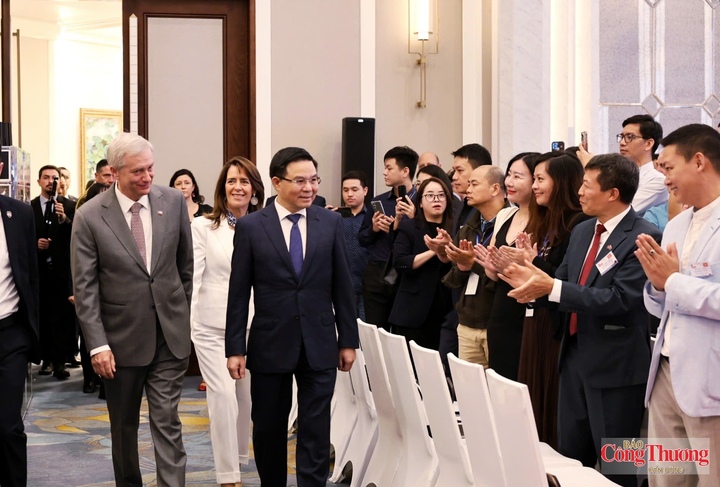
On the morning of November 16 in Hanoi, the Vietnam–Chile Business Forum was held within the framework of the official visit to Vietnam by President of the Republic of Chile José Antonio Kast. Co-organized by the Vietnam Chamber of Commerce and Industry (VCCI) and the Export Promotion Bureau of Chile (ProChile), the event drew the participation of President José Antonio Kast and First Lady María Pía Adriazola, Minister of Industry and Trade Le Manh Hung, along with representatives of regulatory agencies, trade promotion bodies, industry associations, and the business communities of both countries.
Taking place on the occasion of the 55th anniversary of diplomatic relations between Vietnam and Chile (1971–2026), the forum served as a pivotal promotional milestone aimed at deepening dialogue, connecting enterprises, identifying partnership opportunities, and translating trade and investment potential between the two economies into tangible outcomes.
From Cooperation Frameworks to Substantive Opportunities
Addressing the forum, Tran Ngoc Liem, Deputy Secretary General of VCCI, underscored that the attendance of the Chilean President and his high-level delegation demonstrated strong commitment to advancing bilateral economic, trade, and investment cooperation.
According to Mr. Liem, despite their geographical distance, Vietnam and Chile share significant similarities in developmental orientation as well as common values of peace, cooperation, and progress. Economically, Chile stands as one of Vietnam’s foremost partners in Latin America, while Vietnam continues to hold its position as Chile’s largest trading partner within ASEAN.
The foundation of bilateral collaboration has been reinforced through the Vietnam–Chile Free Trade Agreement (VCFTA), signed in 2011 and effective since 2014, alongside both nations’ participation in the Comprehensive and Progressive Agreement for Trans-Pacific Partnership (CPTPP). These pacts provide a favorable framework for businesses on both sides to expand merchandise trade, access new markets, and integrate more deeply into global supply chains.

Overview of the Vietnam–Chile Business Forum.
Citing bilateral trade figures, Mr. Liem noted that two-way trade turnover surpassed 1.7 billion USD in 2025. In the first ten months of 2026, bilateral trade exceeded 1.6 billion USD, up 4% year-on-year, with Vietnam’s exports to Chile alone reaching over 354 million USD, representing a 23% increase.
However, from the perspective of the business community, the VCCI Deputy Secretary General observed that substantial room for economic cooperation remains untapped. Vietnam possesses competitive advantages in manufacturing and exporting consumer goods, mobile phones and components, textiles and garments, footwear, agricultural products, and processed foods. Conversely, Chile boasts abundant natural resources with strategic commodities such as copper, timber, wood pulp, fishmeal, and wine, alongside strengths in high-tech agriculture and renewable energy.
Against this backdrop, VCCI proposed three strategic directions to accelerate corporate collaboration. First, enterprises should maximize the effective utilization of bilateral and multilateral FTAs, proactively remove technical barriers, intensify trade promotion, and expand market reach for flagship products. Businesses from both nations need to participate more actively in trade matching events, fairs, exhibitions, and business forums to better understand mutual demand, consumer preferences, and market characteristics.

Tran Ngoc Liem, Deputy Secretary General of VCCI.
Second, both sides should expand investment cooperation and value chain linkages in high-potential sectors such as renewable energy, the digital economy, high-tech agriculture, and sustainable development. According to Mr. Liem, Chilean enterprises can leverage Vietnam as a strategic gateway to penetrate the Southeast Asian market of over 650 million consumers, while Vietnamese companies can utilize Chile’s extensive network of free trade agreements to diversify export destinations.
Third, both countries must strengthen logistics connectivity and maritime infrastructure while addressing freight costs and transit times to bolster the competitiveness of import-export goods.
From the Chilean business community’s standpoint, Susana Jiménez, President of the Confederation of Production and Commerce of Chile (CPC), emphasized the imperative to strengthen corporate ties, advance concrete projects, and sustain partnerships forged during the presidential visit.
Ms. Jiménez noted that since 2020, bilateral trade has recorded an average annual growth rate exceeding 14%. She highlighted that Vietnam—with a population surpassing 100 million, a dynamic economy, and deep integration into global manufacturing chains—represents a highly attractive market for Chilean enterprises.
The CPC President pointed out that in 2025, over 90% of Chilean exports to Vietnam consisted of non-mining products. Among these, seafood reached nearly 150 million USD, accounting for roughly half of Chile’s total export value to Vietnam. Chilean fruit exports to Vietnam surged by 36% between 2022 and 2025, with cherry shipments more than doubling.

Susana Jiménez, President of the Confederation of Production and Commerce of Chile (CPC).
In the opposite direction, Vietnam serves as a vital Asian supplier for Chile. Beyond mobile phones and computers, Chile imports electrical equipment and solar energy products from Vietnam. This lays a solid groundwork for both sides to expand collaboration in logistics, manufacturing technology applications, and sustainable development solutions.
Ms. Jiménez also highlighted bilateral investment potential, noting that both nations should prioritize projects capable of establishing a long-term corporate presence in each other’s markets. Additionally, tourism presents promising opportunities to enhance connectivity for travel agencies, service providers, and localities.
Removing Bottlenecks and Accelerating Corporate Linkages
Delivering opening remarks, Minister of Industry and Trade Le Manh Hung stressed the need to translate existing cooperation frameworks and comparative advantages into concrete results. Accordingly, enterprises from both countries should proactively capitalize on tariff preferences under FTAs, strengthen connections among industry associations, importers, and distribution networks, and expand investment partnerships linked with technology transfer, human resource development, and adherence to sustainability standards.
The Ministry of Industry and Trade affirmed its readiness to coordinate closely with relevant Chilean authorities to resolve obstacles, facilitate trade flows, and promote joint cooperative initiatives.

Minister of Industry and Trade Le Manh Hung delivers opening remarks at the forum.
During the business dialogue session, delegates focused on partnership prospects in agriculture and food processing, export potential for Chilean meat and fruit into Vietnam, and insights from Vietnamese enterprises regarding market expansion in Chile.
Notably, participants raised critical issues concerning logistics connectivity, shipping costs, customs procedures, technical standards, and quarantine regulations—factors that directly impact market access, operating expenses, and product competitiveness.
Discussions at the forum underscored that expanding bilateral trade volume requires not only commercial outreach but also tighter coordination among regulatory agencies, trade promotion organizations, and the business community to dismantle trade barriers, facilitate market entry, and match compatible partners.
With its expansive network of free trade agreements and deep international integration experience, Chile holds strong potential to act as a springboard for Vietnamese businesses entering South America. Conversely, Vietnam serves as a welcoming destination and strategic gateway for Chilean firms expanding across ASEAN and wider Asia.
The Vietnam–Chile Business Forum not only created valuable networking opportunities for both business communities but also helped concretize economic cooperation orientations for a new phase of bilateral ties. Sustaining dialogue, reinforcing linkages, and resolving practical bottlenecks will serve as the cornerstone for turning shared potential into substantive, sustainable trade and investment partnerships.
Source: congthuong.vn
Discover more from Vietnam Insider
Subscribe to get the latest posts sent to your email.