

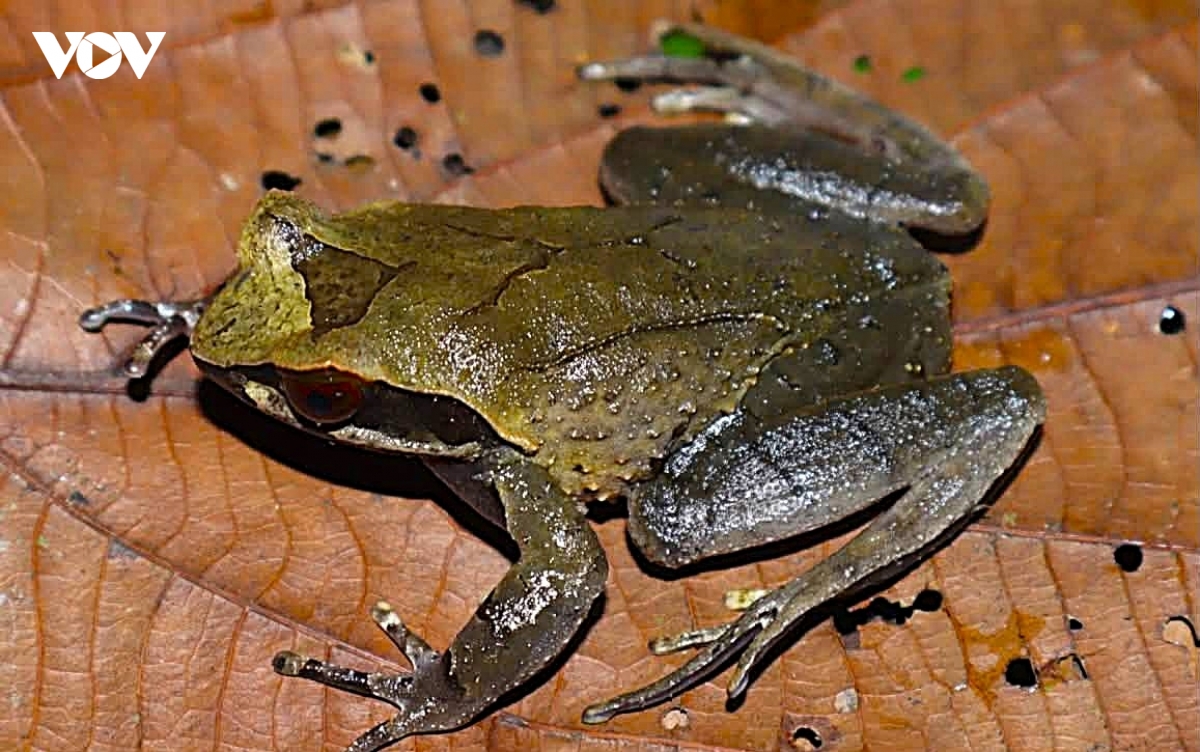
On November 12, Vu Quang National Park (Ha Tinh Province) announced that a new frog species discovered within the park’s forests was officially published in the international scientific journal Zootaxa in 2026.

A newly discovered frog species with horns on its head (the Vu Quang horned frog) has just been found and published at Vu Quang National Park in Ha Tinh Province. Photo: Tien Phong.
The amphibian has been named the Vu Quang horned frog, bearing the scientific name Xenophrys vuquangensis. Its name honors the locality where the research specimens were collected.
The study involved a team of 10 scientists from domestic and international institutions. During a field survey conducted in April 2025, researchers collected nine specimens belonging to the horned frog group within the genus Xenophrys.
To confirm the species’ taxonomic identity, scientists analyzed morphological traits alongside 16S mitochondrial DNA sequencing. The findings demonstrated that the collected specimens possess distinct characteristics setting them apart from all previously described species, fulfilling the scientific criteria required for recognition as a new species.
Phylogenetic analysis further confirmed that the Vu Quang horned frog belongs to the genus Xenophrys and is closely related to Xenophrys truongsonensis. Genetic divergence between the newly identified species and compared congeners ranges from 4% to 14.8%.
Morphologically, the Vu Quang horned frog is medium-sized. Snout-to-vent length in males ranges from 63.9 to 68.6 mm, while a female specimen measured 77.6 mm.
A distinctive feature of this species is the arrangement of dorsal skin ridges forming a pattern resembling the “>—<” symbol. Its body coloration ranges from reddish-brown to grayish-brown, marked by large white spots along the flanks and posterior thighs.
Researchers observed that the frog is primarily nocturnal, showing peak activity between 7:00 p.m. and 10:30 p.m. Its natural habitat comprises evergreen forests near streams, where individuals were found on the forest floor, tree branches, and boulders adjacent to flowing water.
The formal description of Xenophrys vuquangensis not only adds a new amphibian to Vietnam’s national faunal checklist but also contributes vital scientific data regarding the biodiversity of the Truong Son mountain range.
However, the species’ full geographic distribution, population size, and conservation status remain inadequately defined. Scientists will require further field surveys and research to clarify these ecological parameters.
Source: Nguoi Dua Tin
Discover more from Vietnam Insider
Subscribe to get the latest posts sent to your email.